Despite what you may have heard, opera’s not dead.
At least, not in Atlanta. Nationwide data shows cause for concern: OPERA America found a nearly 21 percent drop in national ticket sales from 2019 to 2023. It’s not surprising. For years, the opera world has tried to get butts in seats and find its funding future.
But in Atlanta, there’s a different story. In fact, Opera is in Atlanta growing. Since 2019, the budget has ballooned from $7.5 million to over $15 million a year. It’s now on the list of America’s top 10 opera companies by budget, and The Atlanta Opera is renowned for innovative, experimental productions.
Simply put, Atlanta Opera broke from the trends. And it did so by turning the industry upside down.
That’s how General and Artistic Director Tomer Zvulun sees it, at least. He joined the company in 2013 and has led it into a new era, where business cards are emblazoned with the tagline “Breaking the Boundaries of Opera.”
Zvulun’s vision is simple. He loves the opera, and he wants to bring it to everyone.
“I feel that opera has this stuck-up image that is only for rich people, and I feel that my mission in life is to break the boundaries of opera and make it the people’s art,” Zvulun said.
Zvulun grew up in a small town in Israel without an opera house. In fact, his first artistic love was film – Federico Fellini, Ingmar Bergman and Alfred Hitchcock were his early heroes. His first classical music experience was the score to “Jaws” by composer John Williams.
Those early days influenced his approach to opera, and more importantly, selling tickets to the opera. But it didn’t really take off until 2020 and the onset of COVID-19. When the pandemic shut down the entire world, the Atlanta Opera stayed open.
“The idea of turning opera on its head, and breaking the boundaries of opera, came from the pandemic,” Zvulun said. “During the pandemic, we felt the boundaries of opera must be broken in order to bring the world in, and it became the mantra of the organization.”
The opera partnered with epidemiologists and experts to design the safest possible experience. Then they went out and bought a massive circus tent, set it up on the baseball field of Oglethorpe University and kicked off a run of 40 shows. The performers stood in the crowd, separated by plexiglass. It was a hit.
Their COVID-19 series drew attention and eventually moved to the Cobb Energy Performing Arts Centre, where most of the regular-season opera shows take place.
When explaining the decision, Zvulun quoted German-American composer Kurt Weill, who fled Nazi Germany in the 1930s and came to New York. He made substantial contributions to the theater during his career, and his words are Zvulun’s inspiration:
“If the boundaries of opera cannot accommodate the theater of our time, these boundaries must be broken.”
So Zvulun set out to create the theater of our time.
He kicked off a “Discovery Series” aimed at getting young people excited about opera, with tango operas, jazz operas, musical theater and scores performed all across the city. He expanded the 20,000-student education program to a digital resource serving over 100,000 students. He captured productions on film to broadcast globally in 29 countries.
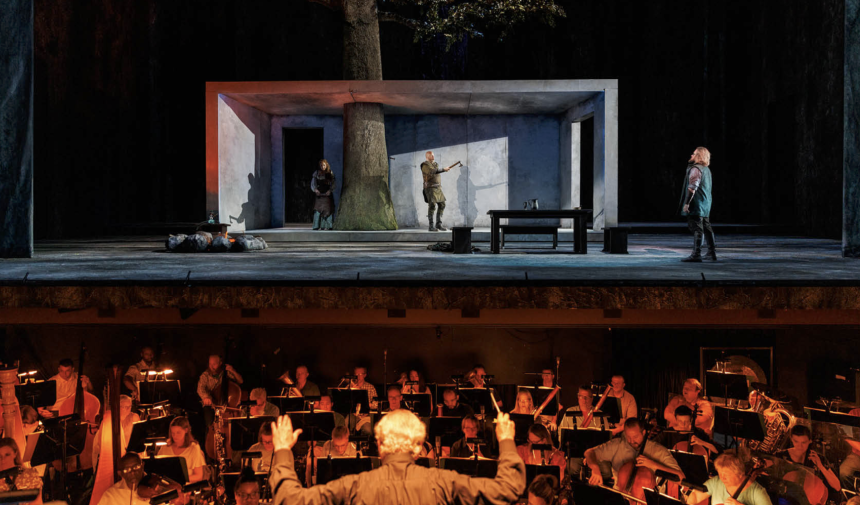
Even the productions themselves break boundaries. Atlanta Opera Director of PR and Communications Michelle Winters said Zvulun “delivers entertainment, delivers excitement and delivers fun” while knocking down barriers.
“I have people who show up, who will come to our desk and say ‘Who knew I liked opera? I had no idea that it was so much fun and that it was so interesting and engaging,’” Winters said.
She credits the director, explaining, “there are ways to do Macbeth, and there is Tomer’s way to do Macbeth.” His approach draws people in. On average, 20 to 25 percent of ticket sales from every production are “new to file” – not repeat customers.
Zvulun’s approach clearly paid off.
On Feb. 16, the Atlanta Opera broke ground on the Molly Blank Center for Opera and the Arts at the historic Bobby Jones Golf Course Clubhouse in Buckhead along the Beltline. It’s a huge investment that will change the game for the opera company, set to open in late 2027.
The new facility will feature Rosemary Hall, a 200-seat recital hall and the Atlanta Opera Coca-Cola Theatre, a 6,000 square foot rehearsal space that will also be an immersive theater space with retractable risers for seating and a mezzanine overlook for additional seating.
“A vision of immersive productions and the dialogue between art forms grew into becoming a center for art,” Zvulun said. “Our hope is that these two venues that are intimate will have programming that will complement the grand opera that is playing at the Cobb Energy Center.”

Zvulun credited an unnamed board member with suggesting the location for a new headquarters. He credited Arthur Blank for making him “dream bigger” than any small-scale plans.
In total, the capital campaign for the project totaled $72 million; $48 million for the “bricks and mortar,” $16 million in grounds improvement and $8 million for contingencies.
All but $10 million has already been raised, thanks to major donations including $10 million from the Lettie Pate Evans Foundation, $20 million from an anonymous donor and $25 million from the Arthur M. Blank Foundation (and another $2.5 million to keep the Discovery Series going.)
There is also a $70 million operating campaign to keep the opera running at the same level for the next five years. With both campaigns combined, the Atlanta Opera has crossed the $100 million fundraising mark.
With this money, Zvulun will be able to truly create a theater that breaks the boundaries of his field.
He explained the rehearsal hall will be perfect for chamber operas, cabarets, musicals, immersive theater and even film screenings. The recital hall will host performances against a backdrop of nature.
The building is also set against the NW Beltline Connector Trail, which will encourage foot traffic and events on the massive lawn. Zvulun said he aims to show performances on a massive projector or have people wear headphones and listen to a performance on the green.
“The whole idea about breaking the boundaries of opera that is basically epitomized in this building is something that we’re very devoted to,” Zvulun said.
Breaking the boundaries also helps sustain the opera long term. While other operas are panicking about an aging and shrinking donor base, or high ticket costs that price out many audience members, Zvulun is looking to be nimble with the opera.
“When we have this space, the paradigm and the business model completely change,” Zvulun said.
The Atlanta Opera currently operates out of the Cobb Energy Performing Arts Center, a massive 2,700-seat theater. But the opera does not own its space. It makes no money from parking or concessions. In fact, the opera has to pay for its company to park on location.
And the Atlanta Opera hosts costly productions. Every grand opera costs at least a million dollars, according to Zvulun. Ticket sales only cover about 20 percent of the cost, and they range from $40 to nearly $300 for a show like “The Marriage of Figaro.” The rest of the opera is reliant on major donors and philanthropy — a model already in decline on the national scale.
To keep opera going, Zvulun wants to bring younger audiences in and encourage new crowds to love the interdisciplinary art form. The center will allow him to do that.
“What this will do is that it will provide alternative, intimate opportunities for people to see classical music,” Zvulun said. “Not in a symphony hall, but in a chamber opera; not in a big fat grand opera ivory tower, but in an immersive, grungy space.”
Since the opera owns the new center, it will benefit from rental fees and concessions. The grand operas will still take place at the Cobb Energy Performing Arts Center, but smaller productions will happen frequently, steps from the Beltline.
That means a higher quantity of lower-cost productions in an area with major foot traffic. Zvulun believes it will draw in those younger crowds who are intimidated or priced out by the “ivory tower” of a major theater.

Winters echoed the director, and said there’s a definite hunger — that young people “want something to get dressed up for.” She has seen all generations and walks of life attend shows at the Atlanta Opera.
After all, in Zvulun’s words, opera is “the people’s art.”