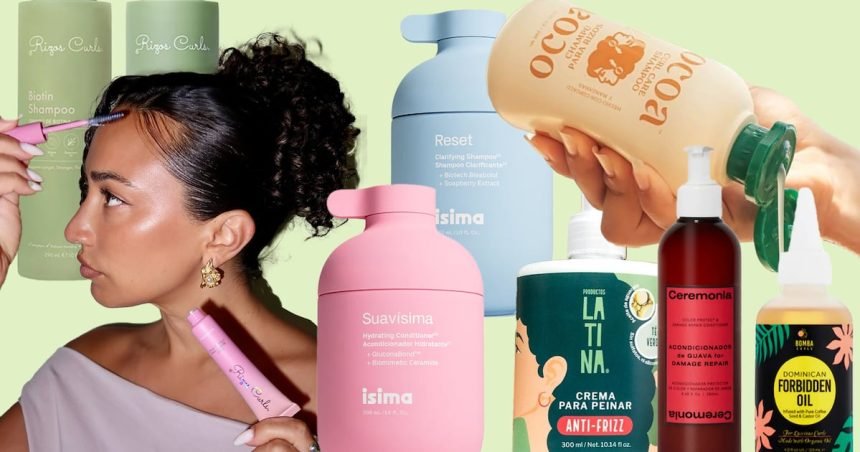
When Pilar García Bonilla began brainstorming her hair care brand, Latina, in 2023, one movie stuck in her mind: “The Princess Diaries”, when Anne Hathaway’s curls are straightened so she can “look like a princess.” It reflected the way I felt —I didn’t fit in within the beauty industry,” she said. “They’d told us that only straight hair is beautiful.”
For fellow Latino-owned brands like Dominican-founded Ocoa and Afro-Domican hailing Bomba Curls, it’s a familiar story: the origin stories of both discuss eschewing shame to embrace their curly hair types. Now, these brands are poised to meet the moment, with a large global consumer base and years of product innovation enabling them to meet and serve curly princesses all over the world.
“In the US, consumers from Latin America and Spanish-speaking nations in Europe broadly make up the most engaged consumers in hair care, spending 26 percent more on hair care than other demographics, said Anna Mayo, a vice president for NielsenIQ’s beauty vertical. The average household penetration for shampoo and conditioner in the US is 86.3 percent, and 68.5 percent for hair styling; among Latino shoppers, these rates climb nearly 10 percent each.
A higher-spending, underserved cohort created an environment for Latin-owned brands to thrive. Ceremonia, Rizos Curls, and Ocoa have been snapped up by retailers such as Target, Sephora and Ulta Beauty step with rising demand for natural-ingredient forward formulations with authentic South American heritage.
But demand doesn’t always translate to sales, especially when these indies are up against the Pantenes and Garniers of the world, which not only dominate the US but key growth markets like Mexico, Argentina and Columbia. Latino-owned indies have to scale their brand awareness across borders — and need significant investment to do so.
Combining Commerce and Community
Compared to brands with mass appeal like L’Oréal Elvive or Pantene, Latino-owned brands tend to be deeply rooted in community and heritage, from their product development to their marketing messages. Many of these indies employ organically sourced ingredients and talk about haircare as a ritual, said Leah Boston, senior analyst at Euromonitor International.
“Immigrants from many countries rely on treatments based on natural ingredients that have been passed down through generations,” said Julissa Prado, founder and CEO of Rizos Curls. Prado is a first generation Mexican-American whose parents immigrated to LA, where she started her business.
Building community comes naturally. In its early days, Rizos Curls relied on a network of “50 Mexican cousins in LA who could do everything we didn’t have budget for,” said Prado. The social media following Rizos Curls has amassed is loyal. “We shared our growth from starting in our uncle’s garage, they’ve seen it almost like a reality show,” she said. Now nine years old, the brand has ballooned to over 370,000 Instagram followers, and employs 19 people.
García Bonilla, who founded the brand Latina with her brother in Mexico in 2023, also relied on community to begin, launching a Facebook group called Rizo’s Latinos (which translates to Latin curls) with her friends and family. It’s since grown to include 776,000 members. In “Pueblos Mágicos” — Mexican towns recognised by the government for their cultural significance — the brand hires local artists to paint murals. “They’re designed to celebrate Latina identity, confidence, and self-expression, and to serve as a non-digital touch point,” said brand co-founder Victor Garcia.
Their grassroots community building efforts and organic marketing are priceless traits of indie brands, said Danielle Alvarez, who founded the media agency The Bonita Project in 2018. Alvarez helps incumbent brands who want to tap into the Latino hair market, through influencer marketing, advising on brand.
“L’Oréal will reach out, not so much for PR, but mostly to build their Latino influencer network, and build those relationships on behalf of the brand,” said Alvarez. “They know it’s something that these Latino hair care brands already have.”
Scaling the Message
Even with an established direct-to-consumer base, brands still face the challenge of scaling that community globally.
While indies in the US face competition from conglomerates at home, those giants are only more ubiquitous south of the border. In Brazil, Latin America’s largest market, Unilever’s Seda and Dove dominate, along with Brazilian Natura. Procter & Gamble’s Pantene is a bestseller in Mexico and Argentina, while L’Oréal’s Elseve (Elvive in the US) is also growing rapidly across the region. As well as sprawling ranges that cover all price points, multinationals have spent years establishing strong local presence across both production and retail.
These conglomerates take a splashier approach to marketing. To unlock the lucrative Latino and Spanish speaking market, Pantene has worked with singers Juliette Freire and Liniker as faces for the brand in Brazil — Friere alone has a reach of over 28 million Instagram followers. In South America, the L’Oréal-owned Garnier Fructis line is already a bestseller: to translate that brand appeal to latinos around the world, in 2025, the brand tapped Mexican-American singer Becky G as a global brand ambassador. G stars in the brand’s “Put it to the Test” campaign, showcasing how the Fructis line works to keep her hair sleek and straight.
Indies don’t have the same levers to pull to meet their new audiences where they’re at.
Since entering the US via Ulta in April 2025, the Garcia’s Latinas has had to constantly adapt to reach US consumers. “Demands are very different. For example in Mexico we sell more reparation products, where demand in America is for styling,” said Victor Garcia. Rizos Curls has held events in the US centred on curl education, but doesn’t have the budget to pull off these activations in other markets.
Securing investment is critical for these brands to grow. Since becoming one of only 58 Latina founders to raise over $1 million in 2020, Swedish-Latina Babba Rivera’s brand Ceremonia went on to raise $10 million in series A funding in 2023. The brand used the funds to expand into over 500 Sephora locations in the US.
In 2025 Isima, the brand co-founded by popstar Shakira and former Oribe general manager Sid Katari, also raised over $12 million in funding in mid-2025, allowing it to forge ahead with its rapid global expansion across the US, the UK, Chile, Peru, Columbia and Mexico — where it has become an Ulta bestseller.
“I would be open to taking on investment and partnering with somebody, but they would have to be aligned with our values. Those are the three C’s: community, culture and curls,” said Prado.
She added, “The ability to really speak to a niche is something that can be scaled.”
Sign up to The Business of Beauty newsletter, your complimentary, must-read source for the day’s most important beauty and wellness news and analysis.