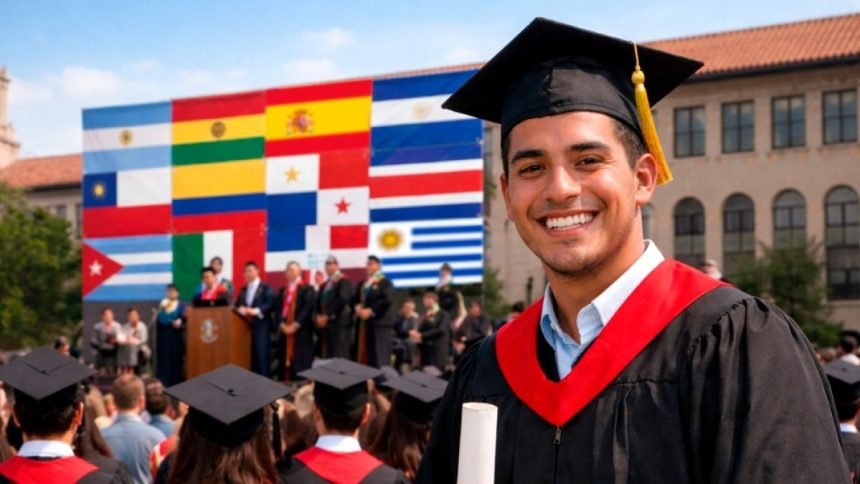
The prestigious Washington Monthly magazine and the NGO Excelencia in Education compiled a ranking of the universities that best serve Hispanics in the United States, focusing on higher education as a tool for social mobility.
Washington Monthly argued that this indicator is necessary due to the accelerated growth of the Hispanic student body in the country and the historical lack of specific information on their performance, access and success in different educational institutions.
Key methodology: Understanding Hispanic social mobility
The study differs from other traditional rankings by focusing on specific Latino student success and support. For that, it takes into consideration several items:
- Transfer and graduation rates: it collects specific information on transfers and graduations of Hispanic students, and not just the general college population. It provides more accurate information for the Hispanic student body.
- Institutional recognition: considers whether educational institutions have a Seal of Excellence, developed by the NGO Excelencia in Education as a certificate for institutions that demonstrate a specific dedication to the Hispanic student body.
- Economic factors: evaluates two critical factors for Hispanic social mobility:
- Net price: the final annual cost when “factoring in aid.”
- Pell Grants: the percentage of students who receive that government subsidy for students with “exceptional” financial need.
Rob Wolfe, editor in charge of presenting the rankings, remarked that the top-performing institutions demonstrate that the best way to serve Hispanics “aren’t limited to one part of college.”
A prime example is UT Rio Grande Valley, which ranks second in the rankings for best four-year universities, because, according to Wolfe:
“[UT–Rio Grande] boasts a comprehensive strategy that includes “Tuition Advantage,” a program that pays tuition and fees for students with family incomes under $125,000; a dual credit program with several area high schools; and a robust international student services department for its Latin American undergraduates.”
Below are the best universities for Hispanics, divided into four-year and two-year degree programs:
Cal State leads the way: Top four-year colleges for Hispanics
California State University, Los Angeles (Cal State Los Angeles or CSULA) is the top-ranked in the four-year undergraduate category. At this institution, Hispanics represent more than three-quarters of its student body and graduate at a rate similar to the general population.
The ranking authors assert that “the regional university in East L.A. is a powerful engine of social mobility,” highlighting metrics such as its net price of $4,551 and its high percentage of students benefiting from Pell Grants.
“These rankings affirm what we have long known— that our university empowers dreams and transforms lives,” Erik Frost Hollins of the university’s Strategic Communications assured VOZ. “The dedication of our excellent faculty and staff to our students’ success is why we are and why we remain number one in changing trajectories for individuals, families, and communities.”
Rounding out the podium of top four-year Hispanic colleges are University of Texas – Rio Grande Valley (UT Rio Grande Valley), which has an even higher percentage of Hispanic students than CSULA but fewer Pell Grants and higher cost, and Texas A&M International.
Here is the full ranking for top four-year colleges and universities:
California leads the ranking
This pattern is highlighted by the authors’ ranking, who also point out that among the top 20 institutions, 8 belong to the California State University (CSU) Campus System. All these universities, they assert, “are united by their low prices, favorable graduation rates, and high numbers of nonwealthy students.”
From CSU they assured VOZ that they were “immensely proud to stand as a national leader in serving Hispanic students.“
Amy Bentley-Smith, of the CSU president’s office, emphasized that “the university system has a long history of expanding access to first-generation and low-income students – those historically underserved by higher education, which include Hispanic students.”

South Texas College: Best for Two-Year Degrees
The Washington Monthly compiles a separate ranking for two-year degrees (or associate degrees) because in them a transfer to another college has a different value than in four-year studies.
While in the latter a transfer may mean that the student dropped out or changed schools to complete his or her studies, in an associate degree the student who changes schools usually does so to lengthen his or her studies to a four-year degree. Transfer is therefore a positive indicator of educational progression.
Taking this particularity into account, South Texas College tops the ranking of two-year degrees. The creators of the ranking highlight:
- An “overwhelmingly” high 95% Hispanic student body.
- A “staggeringly low” cost.
- More than one-third of its students receive Pell Grants.
The magazine also asserts that South Texas College focuses heavily on student support services for its first-generation and English as a Second Language (ESL) students. It also stresses that the institution encourages hands-on vocational training, including partnering with universities in Mexico to prepare young people for the manufacturing sector.