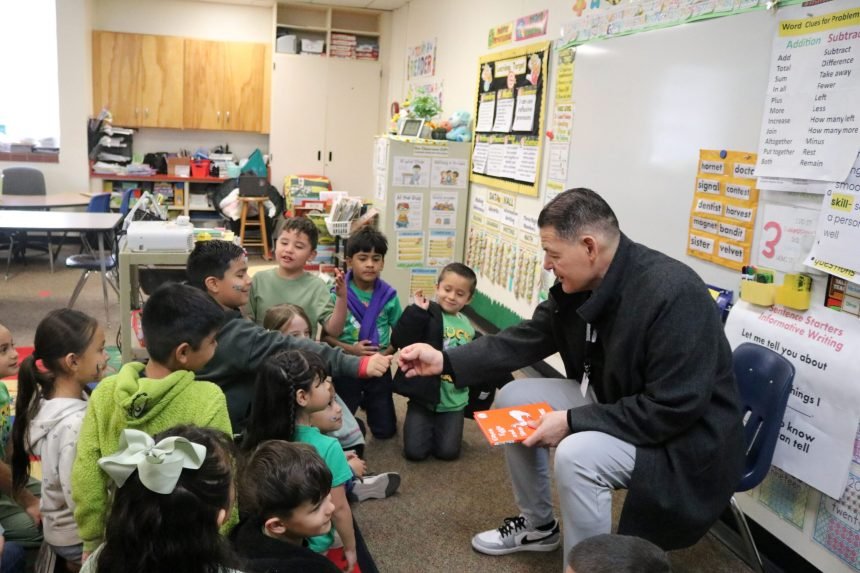
Teachers are still respected. Education is still venerated. These are two hallmarks of a district that serves a rural, predominantly Hispanic community in southern Arizona, Superintendent Dave Verdugo says.
“Because of our culture here, our community still believes that being a teacher is a high position to hold,” says Verdugo, leader of Santa Cruz Valley Unified School District No. 35. “So, students are very well supported by families and the community.”
The 260-square-mile district operates five schools about 10 miles from the Mexican border, and 97% of its students identify as Hispanic. The district has a large number of dual-language students, a high free- and reduced-lunch rate and has a 94% graduation rate, notes Verdugo, Arizona’s 2026 Superintendent of the Year.
The biggest challenge is getting more students to continue their education after high school. Only about 40% of the district’s graduates attend a four-year college or seek postsecondary certification, he adds.
Currently, 17 teachers are dual-enrollment certified; Verdugo is working to grow that number by partnering with a local community college and identifying staff who are eligible to teach college-level courses.
The goal over the next several years is to have more students graduating with both a high school diploma and an associate’s degree. Verdugo hopes to offer evening classes for students and adults who want to accumulate credits toward two-year degrees.
Santa Cruz Valley USD’s robust CTE program covers sports medicine, law enforcement, agricultural science, engineering and ROTC programs.
Verdugo and his team are planning to create new pathways where middle school students can take high school courses such as geometry and Algebra 1, Spanish, English and history.
How education has changed
During Verdugo’s 35 years in education, the role of schools has expanded far beyond instruction to services such as telehealth and adult education. Santa Cruz Valley USD feeds all of its students year-round, for free.
His district built an aquatic center where, this past summer, more than 600 children learned to swim. It also operates a performing arts center and will soon open an exercise facility.
“In a rural community, you’re the hub, so you try to provide opportunities and amenities for families,” he points out. “I understand my main job is academic achievement, but also my job is to support the community in any way that it needs. That’s the role education has taken upon itself.”
From hype to integration: Become an AI expert at FETC 2026