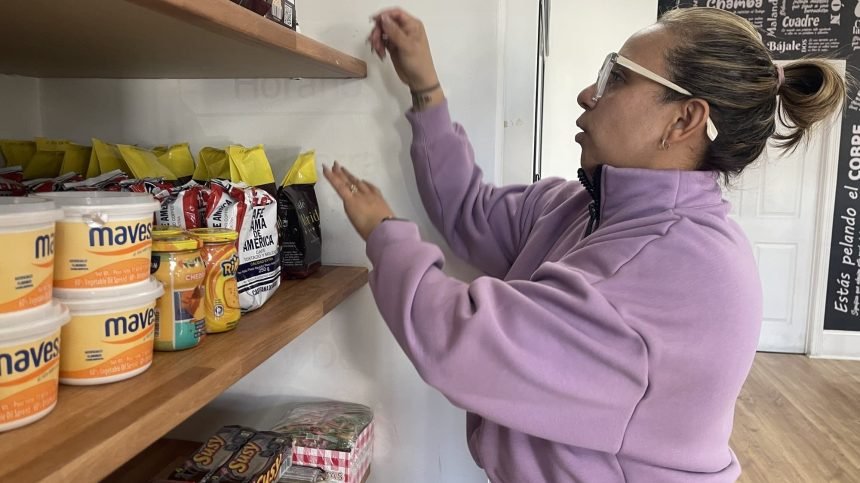
At La Pradera Latin Market in Katy, Texas, the taste of home comes in the form of Venezuelan cheeses. It’s comfort food for the thousands of Venezuelan immigrants who have moved to this small suburban city west of Houston.
Leidelyn Castellanos runs this clean, well-lit store inside a dingy strip mall. A refrigerator keeps her specialty Venezuelan cheeses cool while her shelves are filled with other products from back home like chocolates, cookies, and coffee.
“As Venezuelans … we like and appreciate what’s our own and so a market emerged [for our products] that came from all the Venezuelans who came here or immigrated to this city,” Castellanos said in Spanish.
She opened her shop in 2019, catering to the Venezuelan population that has grown to roughly 75,000 people in the Houston metro area, according to 2024 Census ACS data. So many of them live in the Katy area, it’s sometimes called “Katyzuela.”
She sells her cheeses to Venezuelan food trucks and restaurants in town and her regular clients that come into the store weekly.
“That is beautiful,” she said. “It’s important that our products continue to be present on the tables of Venezuelans.”
At La Pradera Latin Market in Katy, Texas, Leidelyn Castellanos sells specialty Venezuelan cheeses to the local immigrant community.
Elizabeth Trovall/Marketplace
Castellanos and her husband first came to Texas because of his job in the oil fields.
“I saw all the good things that Katy had to offer,” she said. She was especially drawn to the good schools and affordable homes.
She’s watched the community grow — new immigrants from Venezuela moving here, starting businesses and buying houses. Strip malls in Katy, like the one Castellanos works out of, are peppered with bakeries, food trucks and money transfer businesses with red, yellow and blue Venezuelan flags out front.
But the recent wave of immigration is not how Houston’s relationship with Venezuela started.
“The ties between the city of Houston and the city of Maracaibo … which is where the oil industry started in Venezuela … the links were very, very strong,” said Francisco Monaldi, a professor at Rice University, who is Venezuelan.
He said before Houston received tens of thousands of Venezuelan immigrants, it was Americans who sought opportunities in Venezuela.
A training video called Assignment: Venezuela, from the 1950s, portrays an American father who is assigned to work in Venezuela’s oil fields. In the video, the character describes the oil fields as “quite a sight.”
In Houston, Monaldi often meets Americans who worked in Venezuela many decades ago.
“I keep finding when I give a speech here, people that tell me ‘I lived in Venezuela. I was a petroleum engineer.’ And tons of them are married to a Venezuelan,” Monaldi said.
And now that the U.S. government wants to develop Venezuela’s oil sector, this dynamic may start to emerge once again in places like Katy, with Venezuelans in the U.S. who work for American energy companies going on assignment in Venezuela.
“All these companies are doing surveys inside their companies to see how many Venezuelans are on their payroll, which of them are willing or interested in going back to Venezuela,” Monaldi said.
He said there’s been lots of interest so far. And it makes a lot of sense for both the Venezuelans in Houston and the energy companies that employ them.
“They know the culture. They have families there,” he said. “Venezuelans could serve as sort of guides to going into the country. And so there is a lot of demand for the skilled oil Venezuelan technical people in this city right now.”
A stint back in Venezuela at a big oil company may be attractive for some. But for Leidelyn Castellanos in Katy, she fears returning to Venezuela would endanger her family.
“Just stepping onto the Venezuelan border, we don’t know what could happen to us. Nothing is safe,” she said. “The country needs a complete restructuring.”
Rebuilding the country will take time and Castellanos’ kids were raised here, but families like hers may not have a choice.
Castellanos said community members are getting detained by ICE. Foot traffic at her store has dropped. And the Trump administration is in a legal battle to end Temporary Protected Status for hundreds of thousands of Venezuelans.
“Even with having a work permit for five years, an ID,” she said, “if you suddenly get caught up in an ICE raid, they’ll still detain you.”
She said even for people like her, who have followed immigration laws, there’s no guarantee you’ll be safe from deportation.