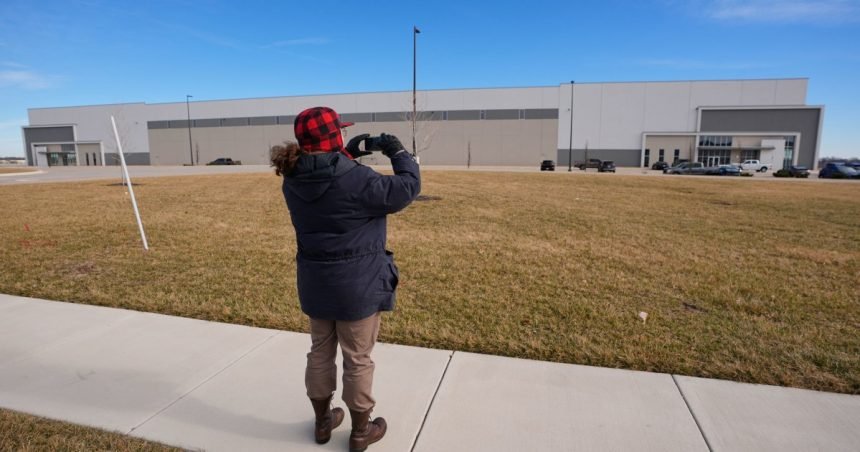
Trump’s administration now is taking steps to open more large-scale facilities. In January, ICE paid $102 million for a warehouse in Washington County, Maryland, $84 million for one in Berks County, Pennsylvania, and more than $70 million for one in Surprise, Arizona. It also solicited public comment on a proposed warehouse purchase in a flood plain in Chester, New York.
Federal immigration officials have toured large warehouses elsewhere, without releasing many details about the efforts.
“They will be very well structured detention facilities meeting our regular detention standards,” ICE said in a statement, adding: “It should not come as news that ICE will be making arrests in states across the U.S. and is actively working to expand detention space.”
Detention site foes face legal limitations
State and local governments can decline to lease detention space to ICE, but they generally cannot prohibit businesses and private landowners from using their property for federal immigrant detention centers, said Danielle Jefferis, an associate law professor at the University of Nebraska who focuses on immigration and civil litigation.
In 2023, a federal court invalidated a California law barring private immigrant detention facilities for infringing on federal powers. A federal appeals court panel cited similar grounds in July while striking down a New Jersey law that forbade agreements to operate immigrant detention facilities.
After ICE officials recently toured a warehouse in Orlando, Florida, as a prospective site, local officials looked into ways to regulate or prevent it. But City Attorney Mayanne Downs advised them in a letter that “ICE is immune from any local regulation that interferes in any way with its federal mandate.”
Officials in Hanover County also asked their attorney to evaluate legal options after the Department of Homeland Security sent a letter confirming its intent to purchase a private property for use as an ICE processing facility. The building sits near retail businesses, hotels, restaurants and several neighborhoods.
Although some residents voiced concerns that an ICE facility could strain the county’s resources, there’s little the county can do to oppose it, said Board of Supervisors Chair Sean Davis.
“The federal government is generally exempt from our zoning regulations,” Davis said.
Kansas City tries to block new ICE detention site
Despite court rulings elsewhere, the City Council in Kansas City voted in January to impose a five-year moratorium on non-city-run detention facilities. The vote came on the same day ICE officials toured a nearly 1-million-square-foot (92,903-square-meter) warehouse as a prospective site.
Manny Abarca, a county lawmaker, said he initially was threatened with trespassing when he showed up but was eventually allowed inside the facility, where a deputy ICE field office director told him they were scouting for a 7,500-bed site.
Abarca is trying to fortify Kansas City’s resistance by proposing a countywide moratorium on permits, zoning changes and development plans for detention facilities not run by the county or a city.
“When federal power is putting communities on edge, local government has a responsibility to act where we have authority,” he said.