
Supreme Court to decide fate of Trump’s tariffs
The Supreme Court will decide whether President Donald Trump’s global tariffs represent an overreach of presidential power.
(This story has been updated to include additional information)
The U.S. Supreme Court struck down some of President Donald Trump’s tariffs on Feb. 20, siding with Oregon in a 6-3 decision that will have broad impacts on his presidency.
Oregon and 11 other states joined businesses in claiming Trump had exceeded his power and was not authorized to impose tariffs under the 1977 International Emergency Economic Powers Act (IEEPA).
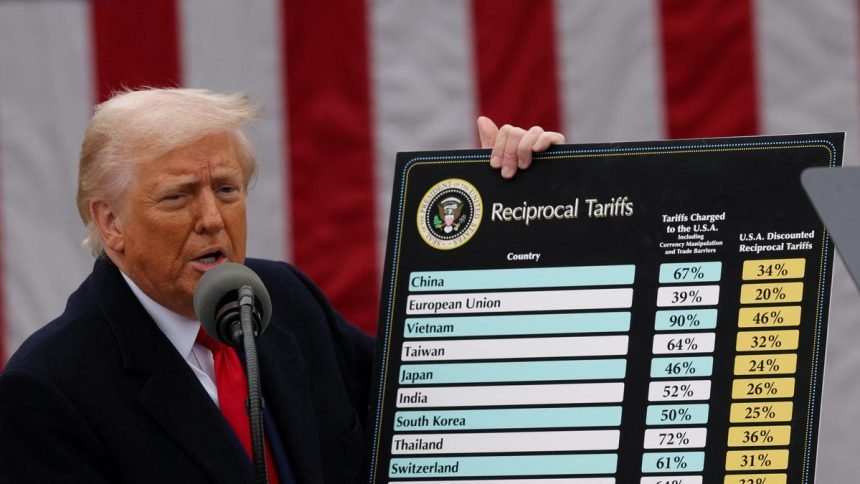
Trump relied on IEEPA as justification for a series of executive orders declaring emergencies and issuing “trafficking” and “reciprocal” tariffs.
Tariffs have been a major part of Trump’s foreign and economic policy and helped shape his second term.
Chief Justice John Roberts and Justices Sonia Sotomayor, Elena Kagan, Neil Gorsuch, Amy Coney Barrett and Ketanji Brown Jackson formed the majority.
“Based on two words separated by 16 others in Section 1702(a)(1)(B) of IEEPA—’regulate’ and ‘importation’—the President asserts the independent power to impose tariffs on imports from any country, of any product, at any rate, for any amount of time. Those words cannot bear such weight,” Roberts wrote in the court’s opinion.
Justices Samuel Alito, Brett Kavanaugh and Clarence Thomas dissented.
Justices considered the long term impacts of expanding the president’s power, how refunds for businesses who paid the tariffs would work and the president’s authority over foreign affairs during Nov. 5 oral arguments.
During the proceedings, some of the court’s conservative voices, including Roberts, Gorsuch and Coney Barrett, appeared skeptical of the Trump administration’s arguments.
The Supreme Court considered the case on an expedited timeline. Lower courts had ruled in Oregon’s favor.
“Today, the Supreme Court made it clear that no President gets to levy taxes on Americans disguised as tariffs,” Oregon Attorney General Dan Rayfield said in a statement.
“I’m grateful to the Oregon Department of Justice team, including Deputy Attorney General Benjamin Gutman, who argued this case before the Supreme Court, and to the attorneys general across the country who joined this effort,” Rayfield said.
Trump called the ruling “deeply disappointing” in a Feb. 20 press conference.
“They’re dancing in the streets, but they won’t be dancing for long. That I can assure you,” Trump said of foreign nations he believed were celebrating the decision.
The decision is “a big win,” and Rayfield is proud of all the Oregonians who assisted in the case, he told reporters Feb. 20.
Shortly after the decision was announced, Trump said he would issue an additional 10% temporary global tariff through what Rayfield called “a vastly different tool” from the justification used for the stricken tariffs.
The new tariffs will be issued Feb. 20 via executive order under section 122 of the Trade Act of 1974, Trump said.
Rayfield said the Oregon Department of Justice will be keeping a close eye on what happens with any new tariffs.
“The moment that the President steps out of his lane, if he steps outside of the authority Congress grants him, you better believe we’ll be back in court,” he said.
“I urge the White House to abandon its costly tariffs once and for all. Businesses and consumers in our state and across the nation need lower costs and more job opportunities,” Oregon Treasurer Elizabeth Steiner said in a statement. “Oregonians cannot afford to bear the financial cost of these financially devastating and legally suspect actions any longer.”
Steiner cited a report from Democrats on the U.S. Joint Economic Committee that estimated American families have paid an additional $1,700 in the past year because of the tariffs.
USA TODAY reporter Bart Jansen contributed to this report.
Anastasia Mason covers state government for the Statesman Journal. Reach her at acmason@statesmanjournal.com or 971-208-5615.