In Atlanta, tax allocation districts are an economic tool used for major development projects throughout the city — and a point of contention politically.
Tax allocation districts (TADs) are zones in which a base property tax value is frozen at creation, and any increases in property tax above that base are used for development in that specific area rather than funding public schools or government services. Base property tax revenue still goes to public services as usual. In other parts of the country, TADs are also known as tax increment financing (TIF).
The redevelopment of the abandoned Atlantic Steel Mill into the Atlantic Station shopping center and residential area was supported by TAD funding.
The City of Atlanta has eight active TADs: Atlanta Beltline, Campbellton Road, Eastside, Hollowell/Martin Luther King, Metropolitan Parkway, Perry Bolton, Stadium Area and Westside.
The Georgia Redevelopment Powers Law, enacted in 1985 with a majority of voter support, gave local governments the authority to use TADs to pay for redevelopment costs. The first TAD was established in 1992 to help develop the Centennial Olympic Park in preparation for the 1996 Olympic Games.
The eight TADs in Atlanta are set to expire between 2030 and 2050. Atlanta Mayor Andre Dickens’ office has proposed extending all eight TADs as part of the mayor’s Neighborhood Reinvestment Initiative unveiled last year, arguing that an extension could raise $5.5 billion in investments, and last fall, Councilmember Michael Julian Bond introduced legislation for an extension to 2055.
This proposal has received pushback from residents and advocacy groups, who argue that TADs contribute to gentrification and primarily benefit big developers. At a November meeting, the mayor’s office decided to postpone consideration of the legislation until sometime early 2026.
“In the spirit of collaboration, in the spirit of transparency, in the spirit of getting this right, we’re going to wait until next year,” said Courtney English, the chief of staff and chief policy officer of the mayor’s office.
Here’s what you should know about tax allocation districts.
What kind of projects do TADs fund?
Invest Atlanta, the economic development authority for the City of Atlanta, has a role in approving projects and administers TAD funds. This money functions as gap funding, according to Invest Atlanta CEO Eloisa Klementich, meaning that it helps fill the gap for projects that have other sources of funding.
“What happens is we tell developers, ‘You will get all your entire capital stack, and when you’re almost there, that’s when you come to us,” Klementich said. “So to give you a sense of the impact, for every $1 that we’ve invested in TAD dollars, we’ve been able to produce in private investment $12.”
TAD funding primarily goes to infrastructure, which can mean boosting a business’ curb appeal and residential development.
“One of the programs that we have [is] very much targeted to small businesses in the city of Atlanta who need that support and oftentimes cannot or are so focused on the business that they do not have the funds to focus on the infrastructure on the outside,” Klementich said.
Each TAD has its own strategic goals. For example, the Atlanta Beltline TAD is intended to extend the Atlanta Streetcar system and support urban development in the areas around the 22-mile loop.
According to Invest Atlanta, TADs have funded 7,181 affordable housing units in total as of the end of 2025.
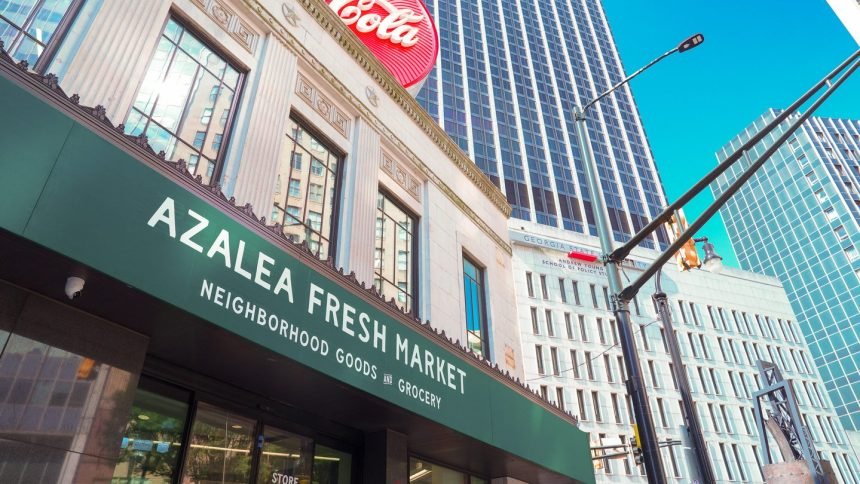
In the past, TADs also funded a YMCA of Metro Atlanta Leadership and Learning Center in Vine City, Salvation Army’s Center of Hope homeless facility, a CenterWell Senior Primary Care center on Donald Lee Hollowell Pkwy, Azalea Fresh Market and Sweet Auburn’s redevelopment.
Recently, TAD-funded renovations began last June to the old Atlanta Constitution building to turn it into a mixed-use development called the Folio House. The ground floor will serve as a commercial space, and the upper floors will be converted into 50 affordable housing units at 30%-80% of the area’s median income and commercial space. There will also be 151 affordable housing units in a building in the surrounding area.
The Atlanta Community Food Bank received a $250,000 TAD grant and a $250,000 Atlanta Food Access Catalyst grant that allowed the organization to open a community food center in Adamsville on Martin Luther King Jr. Drive SW last summer. According to CEO and President Kyle Waide, the TAD grant funded capital requirements for the center, such as equipment and technology.
“This is a really important historical neighborhood and community in Atlanta,” Waide told WABE. “There are a lot of seniors living there. It has high rates of food insecurity in that community, and not enough access to food resources — both grocery resources and charitable food resources.”
How are TADs approved?
Invest Atlanta underwrites projects to determine their feasibility, then hands over projects to that particular TAD’s advisory committee, made up of various stakeholders, for a recommendation on the project. Housing projects also go to the Neighborhood Planning Unit for a recommendation.
Then, the Invest Atlanta TAD Committee, made up of representatives from Atlanta Public Schools, the Atlanta City Council and Fulton County Commission, as well as community members, votes on whether to approve the project. Finally, the full Invest Atlanta Board of Directors votes on the project.
Both the TAD Committee and Board of Directors meetings are open for public comment.
Why have TADs received criticism?
Critics of TADs have said they contribute to racial and socioeconomic inequities in the city by redirecting tax revenue away from schools and other public services and toward big developers.
At a November Atlanta City Council meeting, then-Councilmember-elect Kelsea Bond raised concerns about the extension of the city’s TADs during the public comment section.
“Not only do the TADs not have a great track record of generating affordability, but extending them would also mean continuing to siphon funds away from our already struggling public school system,” Bond said.
Bond, who represents District 2, told WABE that TADs have not truly delivered on their affordable housing promises.
“There were many promises to build affordable housing on the Beltline, but very little of that housing today is meaningfully or deeply affordable, and, in fact, very little TAD revenue has actually been used towards deeply affordable housing, which you could argue is the most needed in the city,” Bond said.
Invest Atlanta has argued that TADs prevent “further decline in underinvested areas” and raise property values in a certain area, therefore expanding the property tax base that funds schools and city services after the TAD expires.
“The majority of our projects are not going to what is being said of corporations,” Klementich told WABE. “It really is going to what I feel are projects that are essential to the social determinants of health for our communities and stimulating economic growth to these parts of the city.”
“Very little TAD revenue has actually been used towards deeply affordable housing, which you could argue is the most needed in the city.”
District 2 Councilmember Kelsea Bond
Nevertheless, Bond said, the mayor’s proposal to extend TADs means the public school system and local government would wait several more decades to see that extra revenue.
“Extending them for another 30 years is kind of breaking that promise that ultimately that new revenue will be reinvested back into our school system,” Bond said.
Instead of extending TADs, Bond argues Fulton County should raise taxes on luxury commercial properties.
Residents and advocates from organizations like the Housing Justice League, Beltline Rail Now and Atlanta Democratic Socialists of America have also spoken out against TADs’ track record in the city and called for more transparency around their future usage.
The Atlanta DSA has demanded a set of conditions be met before the City Council considers any TAD extensions. The organization wants an audit of current TADs, a plan for TAD expenditures that includes community feedback, a TAD oversight commission made up of community members and an assessment of taxes on luxury commercial properties.
Bond, who began their term as a councilmember this month, said TADs’ goals of funding grocery stores, affordable housing and public amenities sound “really nice on paper” but can be funded through other means.
“My question is why we aren’t using our current city budget on those projects if we find them so important?” they said. “I’m really looking forward to the city budget process coming up in mid-2026 and figuring out how we can allocate our existing funds towards those sorts of projects and make sure that we’re following through on the many things that we’ve already promised Atlanta voters that we’ve struggled to follow through on.”