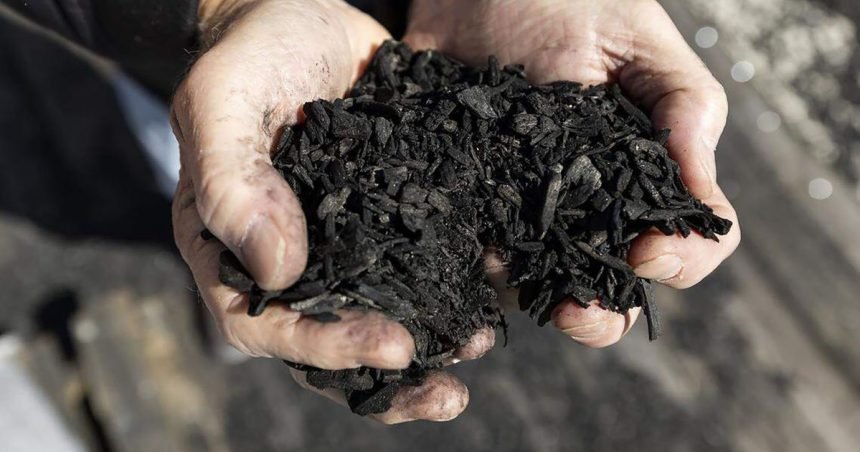
At the top of the South Dade Landfill, a massive oven that turns wood into charcoal is being tested by Miami-Dade County as an environmentally friendly way to cut down on landfill waste.
The material that comes out of the machine, “biochar” has the potential to clean dirty water, nourish soil and even be used in roads. Plus, it has lower emissions than a simple bonfire, leading to cleaner, healthier air that contributes less to climate change.
“When our mayor said she wanted to look towards zero waste, this is the start of that,” Aneisa Daniel, the Director of Solid Waste Management, said.
About 10% of the county’s waste is green material, which includes decaying trees and invasive plants. It is usually broken down into mulch to cover up landfill trash. But organic waste releases methane, a potent greenhouse gas, as it decomposes. Instead, this machine breaks down all of those gases and stores the carbon in the charcoal. Some studies suggest that biochar can lock in carbon for hundreds of years.
The county hosted a demonstration to show how the new facility worked on Friday.
Wood chips move from a container onto a conveyor belt and into a shipping-container-enclosed machine, where they are heated to 1,400 to 2,000 degrees with limited oxygen before being misted and released into large bags roughly every eight minutes.
The extreme heat destroys polluting gases, and instead of smoke, a chimney releases only heat. Down the line, that heat could be captured to generate electricity.
“This is the only biochar facility located on a landfill,” said Harold Gubnitsky, CEO of Fort Lauderdale-based Clean Earth Innovations. “It’s one of a kind. No one else is doing this.”
Clean Earth Innovations received $100,000 from the Miami-Dade Innovation Authority’s Solid Waste Innovation Challenge. The biochar machine was one of three solutions the county is piloting. Beyond the county’s funding, the company said it was a multimillion dollar investment to prove it worked.
Pilot projects with the county can last no longer than one year, and the county hasn’t made any commitments beyond that with Clean Earth Innovations.
The machine will run at the South Dade landfill seven days a week. It will only process 4,000 tons, or less than 1%, of the county’s approximate 500,000 tons of green waste. The county hopes to grow the operation if the tests go well.
Currently, the machine is being fed with invasive trees from Cutler Bay, the closest neighbor to the landfill.
“We always have to deal with people complaining about the landfill smell, but more importantly, every year it gets higher and higher, and this is a great step to slow that down,” Tim Meerbott, Mayor of Cutler Bay, said.