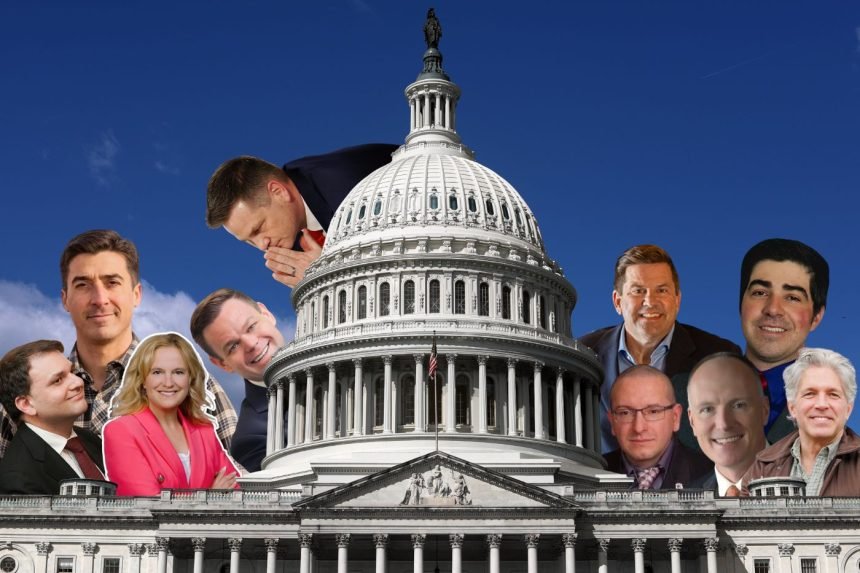
When Wyoming Republicans show up to vote in August’s primary election, they may face a long list of choices in the race for the state’s lone U.S. House seat. The official candidate filing period is still a month away, but 10 Republicans have announced they plan to run for Congress.
U.S. Rep Harriet Hageman, who now holds the seat, announced last year she will run for U.S. Senate — a decision partly responsible for the crowded field of candidates who see an opportunity in pursuing a rarely open seat.
The candidates so far include current office holders, such as Wyoming Senate President Bo Biteman and Secretary of State Chuck Gray, as well as former officials, like Jillian Balow, who previously served as superintendent of public instruction, and one-time Cheyenne lawmaker John B. Romero-Martinez.
Former U.S. Senate candidate Reid Rasner is also running alongside five other Republicans who would be new to public office: Frank Chapman of Moran, Kevin Christensen of Casper, Steve Friess of Jackson, David Giralt of Casper and Matt McGinnis of Pinedale.
“You’ve got an open seat, and they don’t come along very often,” Jim King, University of Wyoming emeritus professor of political science, told WyoFile.
Still, King said he’d be surprised to see as many as 10 candidates actually run. The candidate filing period opens May 14 and closes May 29, leaving plenty of time for candidates to drop out.
“I wouldn’t bet on this being the final number,” King said, adding that he expects candidates with name recognition to stay in the race, but only time will tell.
Federal campaign records could serve as an indicator of who will ultimately run, King said. Eight candidates have filed their statements of candidacy, Federal Election Commission records show. However, only three — Chapman, Gray and Rasner — have reported campaign receipts, almost all of which are in the form of personal loans to their campaigns. Chapman has lent his campaign $560,000, while Gray has lent $500,000 and Rasner $208,500.
However, King said he still expects to see a large field where no single candidate receives more than 50% of the vote.
Crowded Republican primaries for higher office aren’t completely unusual for Wyoming. Eight Republicans ran for U.S. House in 2016, for example, while 10 sought a seat in the U.S. Senate in 2020. When six Republicans vied for governor in 2018, Mark Gordon ultimately won the primary with 33.4% of the vote.
“Which you can’t really say that’s the preferred candidate of most people in the state, because it’s not,” Matthew Harris, a political science professor at Park University in Missouri, told WyoFile.
(Conversely, when Gordon ran for reelection against three other Republicans in the 2022 primary, he secured 61.5% of the vote before winning the general election with 74% of the vote.)
Harris has written about crowded primaries across the country, and the way they lower the number of votes needed to secure a candidate’s nomination.
“We do continue to see this, especially in places where there’s not really multi-party competition,” Harris said. “And the concern there is that, you know, when you lower the bar as in terms of, ‘OK, what’s the percent of the vote I’m going to need to win?’ then that means that somebody who’s maybe fringe or extreme or not very qualified can, if they can hold that 25%, that can be enough [to win.]”
On one hand, Harris said, having a lot of candidates “can be a sign of a robust democracy, and people want to get involved and they want to throw their hat into the ring.”
But that doesn’t necessarily sync up, Harris said, when a candidate can win a nomination with less than a majority of the vote.
“There’s always this question in democracy of: ‘How do you translate the will of the people into the representative that they get?’” he said.
A crowded primary can also create a confusing choice for voters, Harris said, especially when there may be little daylight between candidates.
“In a lot of these GOP races, it’s sort of who can demonstrate that loyalty to President Trump,” Harris said. For voters, he said, the decision may come down to “‘How do I decide between these five or six people who all are like, Make America Great Again?’ And that’s where, you know, it probably comes down to name recognition and money and endorsements, things like that.”
Trump has not weighed in on Wyoming’s U.S. House race as he did in 2022, when he backed Hageman to oust one of his biggest political rivals at the time, then-Rep. Liz Cheney. Trump’s endorsement caused several candidates to drop out of the race that year. It remains unclear if the president will back someone this time around, but several candidates have said they are seeking his endorsement.
Runoff elections and ranked-choice voting can help in requiring candidates to meet a certain threshold of support, Harris said, but neither have been widely adopted across the country.
In 2025, Speaker of the House Chip Neiman, R-Hulett, brought legislation to create a runoff election for Wyoming’s top five elected offices. At the time, he cited the 2026 governor’s race as his inspiration.
“I’ve already heard where there could be potentially eight candidates in this upcoming governor’s race, and that field consistently seems to grow,” Neiman told lawmakers.
The bill died in the Senate when it failed to meet a deadline. Meanwhile, lawmakers voted that same year to prohibit ranked-choice voting in any election in Wyoming.
Wyoming’s crowded primaries did produce one major voting change. When Gordon won the 2018 Republican nomination with less than 50% of the vote, his opponents alleged he only won due to the support of Democrats changing their party affiliation to Republican. Those claims were shown to be statistically unfounded, but endured nonetheless. In 2023, the Legislature voted to prohibit voters from changing their political party affiliation once the candidate-filing period opens, or during the 96 days leading up to the primary election.
As such, Wyoming voters have until May 13 to make any changes to their party affiliation.