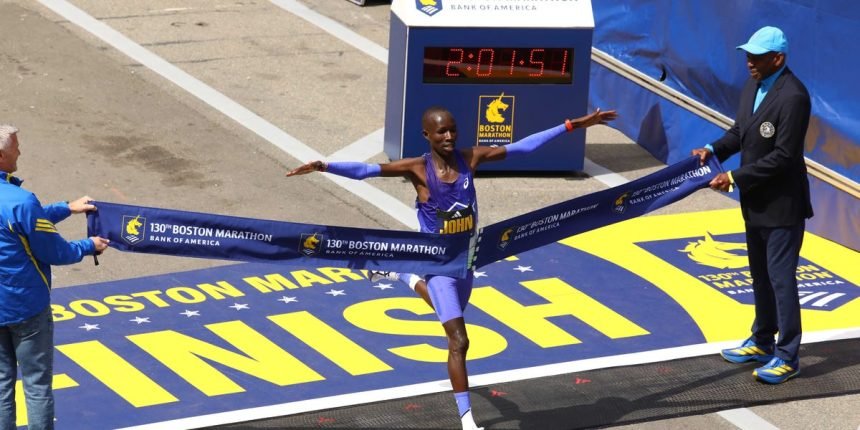
For the second consecutive year, John Korir surged in the Newton hills and ran unchallenged over the final 10K to win the Boston Marathon. The Kenyan bettered not only his winning time from last year but also the course record with his 2:01:52. Korir took an astounding 1 minute and 10 seconds off of the previous course record of 2:03:02, set by Kenyan Geoffrey Mutai in 2011 when runners enjoyed a strong tailwind for much of the race.
“I knew I would defend my title, but I didn’t know I would run that fast,” Korir said at the post-race press conference.
Alphonce Simbu of Tanzania repeated his second-place finish of last year. Benson Kipruto of Kenya, the 2021 Boston winner, placed third. Simbu (2:02:47) and Kipruto (2:02:50) were also under the previous course record.
Zouhair Talbi was the first U.S. finisher, running 2:03:45 to place fifth. Talbi’s time is 1 minute and 13 seconds faster than the previous best U.S. time in Boston history, Ryan Hall’s 2:04:58 from 2011. Talbi’s time is also faster than Connor Mantz’s U.S. record of 2:04:43, but won’t count as a U.S. record because of Boston’s point-to-point course.
Charles Hicks was the second U.S. finisher, with his 2:04:35 (also under Hall’s previous record) good for seventh place. Clayton Young was the third U.S. finisher, placing 11th in 2:05:41. To give context to how deeply fast today’s race was, consider that last year Young placed ninth while running 1 minute and 23 seconds slower than he did today.
Korir ran patiently early in the race as Germany’s Hendrik Pfeiffer and Americans Ryan Ford and Alex Maier most often fronted the pack. The pace was solidly in the 2:03 range early on, but the more difficult part of the course was still to come.
Korir’s first real move was to reel in Ethiopia’s Lemi Berhanu, the 2016 Boston winner who surprisingly took the lead just before halfway, which he passed in 61:43. Korir overtook Berhanu three minutes later, then eased back, allowing Milkesa Mengehsa, Talbi, and a few others to join them. Boston first-timer Mengesha then took a solo lead early in the Newton hills, but Korir easily chased him down in the 20th mile.
“When he went, I was not that much worried, because I knew I could [catch] him,” Korir said about Mengesha’s move.
A 21st mile of 4:36—which includes Heartbreak Hill!—gave Korir a solo lead that he only increased to the end.
There was a lot of pre-race talk about whether the course record would fall today. Some of that stemmed from favorable weather—starting temps in the 40s and what race organizers characterized as “a slight tailwind”—and some of that stemmed from the persistence of Mutai’s mark, set long before the super shoe era.
The pace was solid from the start, but controlled. One thing that helped to tee up Korir’s chances was that there weren’t any early cat-and-mouse periods, where the pack would catch one or three men and then slow while waiting for someone to make a move.
When Mengesha went to the front in the early Newton hills, Korir knew he needed to keep him close, given the Ethiopian’s PR of 2:03:17, third fastest in the field. But Korir also knew that part of the course much better than did his prey. He methodically chased down Mengesha and then kept his momentum going to discourage the other members of what had been the chase pack.
Korir reached 20 miles in 1:33:48, matching the previous checkpoint record, set by Sissay Lemma in 2024. But there the similarities ended. Two years ago, Lemma covered his final 10K in a sluggish (by elite standards) 32:29 to hang on for the win in 2:06:17.
Korir, in contrast, was just getting going. He followed that 4:36 21st mile with a 4:25 22nd mile. Two questions remained: How often would he keep looking back despite being unchallenged? And how hard would he keep pushing despite being unchallenged?
The answers: Korir eventually stopped looking back, but he never let up. By running his remaining miles between 4:26 and 4:34, he made progress on the course record in big enough chunks that there was zero mystery toward the end whether it would soon be his. Korir covered his final 10K in 28:14.
Korir, age 29, has a reasonable claim of being one of the top three men marathoners in the world. Since winning Chicago in 2024, he has won the past two Bostons and last December’s Valencia. His time in Valencia, 2:02:24, makes him the eighth fastest man in history. His only recent blemish was last October’s Chicago, where he sped up early in the second half despite being on world record pace and wound up dropping out.
Fun fact: Korir’s repeat win today brings the family Boston titles to three. His brother Wesley won in 2012.
Korir earned $150,000 for his win and a $50,000 bonus for breaking the course record.
Scott is a veteran running, fitness, and health journalist who has held senior editorial positions at Runner’s World and Running Times. Much of his writing translates sport science research and elite best practices into practical guidance for everyday athletes. He is the author or coauthor of several running books, including Running Is My Therapy, Advanced Marathoning, and Meb for Mortals. Scott has also written about running for Slate, The Atlantic, the Washington Post, and other members of the sedentary media. His lifetime running odometer is past 110,000 miles, but he’s as much in love as ever.