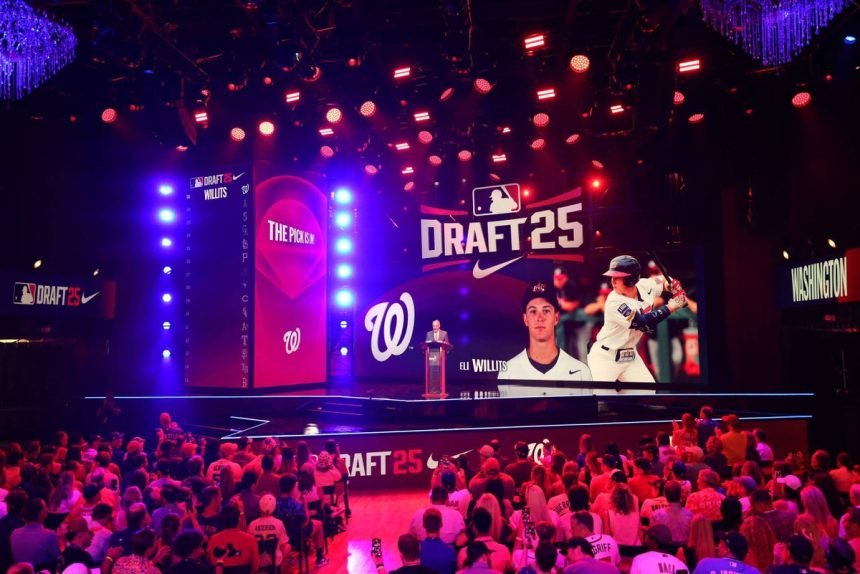
The 2026 MLB Draft is nearly here! This year’s event will have a different feel, as it shrinks from three days of selections to two days, with Day 1 going four rounds and Day 2 spanning rounds five through 20. Here are the key things you need to know about this summer’s amateur draft:
When: Day 1 — Saturday, July 11, beginning at 1 p.m. ET; Day 2 — Sunday, July 12, beginning at 11:30 a.m. ET
How to watch: The first 10 selections on Day 1 will air exclusively on NBC/Peacock; picks 11-40 will air on MLB Network and stream on MLB.com and MLB TV. The rest of the picks on Day 1 will stream on MLB.com and MLB TV. Day 2 will also stream on MLB.com and MLB TV.
How to follow on The Athletic: Led by senior baseball writer and longtime MLB Draft and prospect analyst Keith Law, The Athletic will have live coverage and instant analysis, as well as in-depth coverage of every organization’s full class. All of our MLB Draft coverage can be found here.
Who are the top prospects? Law has ranked the top 100 prospects for this year’s draft, with UCLA’s Roch Cholowsky at No. 1.
What’s the latest buzz on who will be picked in the first round? Though Cholowsky is the top prospect in this year’s class, Law has the White Sox selecting high school shortstop Grady Emerson at No. 1 in his latest mock draft.
Draft order: The Chicago White Sox have the first selection, followed by the Tampa Bay Rays, Minnesota Twins, San Francisco Giants, Pittsburgh Pirates, Kansas City Royals, Baltimore Orioles, Athletics, Atlanta Braves and Colorado Rockies rounding out the top 10.
Five teams received 10-pick penalties for exceeding MLB’s second surcharge threshold of the Competitive Balance Tax and were pushed out of the first round — the New York Mets (first selection at pick 27), the New York Yankees (first pick at No. 35), the Philadelphia Phillies (first pick at No. 36), the Toronto Blue Jays (first pick at No. 39) and the Los Angeles Dodgers (first pick at No. 40).
The Braves and Astros each received an extra pick under MLB’s Prospect Promotion Incentive, with the Braves getting pick No. 26 for Drake Baldwin being on their Opening Day roster and winning NL Rookie of the Year and the Astros earning pick No. 28 for Hunter Brown’s top-three finish in the AL Cy Young Award voting.
The Giants (pick No. 29) and Rays (pick No. 33) each acquired Competitive Balance Round A picks in trades; the Pirates have an extra pick in the second round for failing to sign Angel Cervantes last season (pick No. 51); and the Red Sox (pick No. 67) and Cardinals (picks No. 68 and 72) added extra selections in the Competitive Balance Round B via trades.
The Cubs received a compensation pick (No. 75) when the Dodgers signed Kyle Tucker, and the Astros, Padres and Phillies each got a compensation pick after the fourth round for losing free agents who had been given qualifying offers (Framber Valdez, Dylan Cease and Ranger Suárez, respectively).
The Dodgers have only six picks in the first 10 rounds due to forfeiting selections for signing free agents who had received qualifying offers.
For the full draft order, click here.
Can teams trade draft picks? With the exception of pre-draft trades for picks in the two Competitive Balance rounds, teams cannot trade draft picks. They can, however, trade a player they sign in the draft after the World Series concludes in the year in which the player was drafted.
Draft bonus pools: Under MLB’s collective bargaining agreement, teams are limited in what they can spend on bonuses in the draft. Each pick through the first 10 rounds is allotted a draft signing bonus slot and a team’s bonus pool is calculated by adding up the bonus slots for each of its first 10 round picks. Players selected after Round 10 don’t count against the bonus pool unless their bonuses exceed $150,000, in which case any amount over $150,000 counts against the pool.
Teams face a 75 percent tax on the overages if they exceed their pool by 0 to 5 percent. Spending 5-10 percent over their pool amount results in a 75 percent tax plus the loss of a future first-round pick. Going 10-15 percent over the bonus pool results in a 100 percent tax and the loss of future first- and second-round picks. Teams regularly pay the first tier of tax penalties but haven’t historically dipped into those second and third tiers of penalties.
Though each slot has a bonus pool allotment, teams are allowed to spend their bonus pools as they see fit. Consequently, you often see teams take players who sign for significantly above or below their assigned slot value. Below are the bonus pools for each team for this year’s draft, with the Pirates having the biggest pool and the Dodgers having the smallest:
MLB Draft bonus pools by team
| Top 15 | Bottom 15 |
|---|---|
|
1. Pirates: $19,130,700 |
16. Angels: $11,755,400 |
|
2. Rays: $19,009,300 |
17. Reds: $10,758,500 |
|
3. White Sox: $17,592,100 |
18. Rangers: $10,219,200 |
|
4. Giants: $17,350,600 |
19. Cubs: $9,644,100 |
|
5. Twins: $16,929,600 |
20. Padres: $9,644,100 |
|
6. Cardinals: $16,612,300 |
21. Guardians: $9,303,700 |
|
7. Royals: $15,954,000 |
22. Tigers: $9,165,100 |
|
8. Braves: $15,870,800 |
23. Red Sox: $8,219,200 |
|
9. Rockies: $15,557,600 |
24. Mariners: $8,218,200 |
|
10. Athletics: $13,840,300 |
25. Brewers: $8,042,900 |
|
11. Astros: $13,712,700 |
26. Phillies: $7,773,000 |
|
12. D-backs: 13,603,100 |
27. Yankees: $7,342,800 |
|
13. Orioles: $13,114,000 |
28. Mets: $6,730,900 |
|
14. Nationals: $12,278,300 |
29. Blue Jays: $5,543,100 |
|
15. Marlins: $11,960,100 |
30: Dodgers: $3,951,900 |
What is the deadline for signing draft picks? Players taken in this weekend’s draft will have only a short window to negotiate with their selecting teams. Teams have until July 27 at 5 p.m. ET to come to terms with their draft picks, with one exception: If a selected player attends junior college the school year after the draft, teams will have a window to sign those players that begins at the end of the player’s junior college season up until the week before the beginning of next year’s draft. Bonuses for those players are capped at $225,000.
Teams that fail to sign players selected in the first three rounds will receive a compensation pick in that same round one pick later than the unsigned pick the following year. However, those teams will lose the bonus slot value for the pick they didn’t sign in the current draft year.