While it’s increasingly difficult to predict which flavors, concepts and topics will define how diners eat and drink each year, a handful of chefs, restaurateurs and cafe owners who spoke to the Tribune said there are a few inescapable truths for 2026.
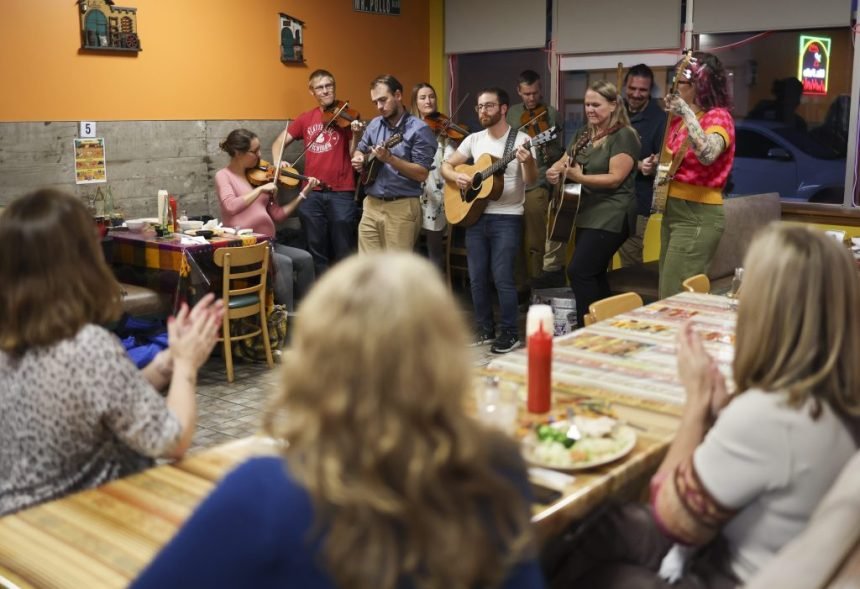
For one, many restaurants — especially those in immigrant-heavy neighborhoods — are hoping to patch up some of the economic woes of last year by making adjustments, while others are expanding their space to host community events as “third places” become even more desirable. Other industry insiders think 2026 will be a year for global flavors and smaller menus.
Restaurants expanding reach
Marcos Carbajal, owner of Carnitas Uruapan in the Little Village, Pilsen and Gage Park neighborhoods, has been vocal about the financial struggles plaguing his restaurant since federal immigration enforcement rippled through the city starting in September. Carbajal said he’s likely not the only restaurant owner in the area whose strategies for 2026 emphasize catering opportunities and community outreach to attract customers beyond their ZIP codes.
“I think for a lot of Latino-owned restaurants like ours, we’re really looking to the outside, far beyond the borders of our neighborhoods this year,” Carbajal said.
Considering that, Carbajal said many restaurants across the city will likely try to expand their catering capabilities and promote those offerings on social media. That will not only reach customers where they are, but it’ll also bring in more revenue with big orders, he noted.
Restaurants and bars doubling as community-driven safe spaces
Carbajal said restaurants in general tend to be driven by social inequality issues and wanting to do good things, but that desire will ramp up even more in 2026, as the industry adjusts to dealing with the continued impact of immigration enforcement. Carbajal also said he’d love to do more initiatives like Todos Ponen, which in January raised money that provided direct grocery support for 125 Latino families in the Little Village, McKinley Park, Pilsen, Logan Square, Hermosa, Avondale and Belmont Cragin neighborhoods.
“Things that do good on both sides — from a social perspective, help the most vulnerable people and in our communities, but then also help expose our business to other consumers,” Carbajal said.
And it isn’t just restaurants doubling as community-driven hubs. Julia Momose, a mixologist and partner at Kumiko in the West Loop, which won a 2025 James Beard Award for Outstanding Bar, said she thinks the biggest changes this year will also be seen in the beverage industry.
“People are looking for experiences that feel grounding and sincere. Cocktails are becoming quieter — less about spectacle and more about precision, balance and care. But what matters most right now is what bars represent,” Momose said. “Bars are increasingly becoming ‘third places,’ spaces where people can gather outside of home and work. With that comes responsibility. Hospitality is not neutral. These spaces can be places of refuge, organizing and community. They are where conversations about justice happen, where resources get raised, where people show up for one another.”
Smaller, more curated menus and cross-utilization of ingredients
With more than 40 years of experience in the hospitality industry, sisters Amy Lawless and Clodagh Lawless, owners of The Dearborn in the Loop, offered a few seasoned takes on what menus might look like this year, or at least, what direction they might go in.
“With constant stimulation from social media and the pressure to discover the next big thing, I think smaller, more curated menus or experiences that focus on extra attention to detail can make things feel more inviting and interesting,” Amy Lawless said. “The goal is to elevate experiences to the point where they’re memorable or at least engage guests in a way that encourages them to try things they wouldn’t normally consider.”

Clodagh Lawless said that with the rising costs of goods and groceries, she expects to see restaurants trim down their menus and cross-utilize ingredients.
“I read recently that the 100 ridges in a chef’s hat symbolize the 100 ways to cook an egg. Using ingredients in new and interesting ways will be paramount,” she said.
Tariffs could have a significant impact on the dining and beverage scene
Chef Sujan Sarkar of Michelin-starred Indienne in Chicago’s River North neighborhood said sweeping global tariffs could continue to have a negative effect on the industry. Depending on the goods, restaurants might find themselves unable to afford certain key menu ingredients, while others might start looking at domestic alternatives that require entire menu items to change.
Sarkar, who opened his regional Indian-focused restaurant Nadu last April to much acclaim, said the menu there relies heavily on ingredients imported from India.

“At Nadu, sometimes we are a little bit concerned about the ingredients — the invariance is also something to look into (with tariffs). Can you really sell (a dish) consistently for a month or two?” Sarkar said. “That’s the challenge with these tariffs and import/export problems.”
Tariffs will also affect the cost of alcohol.
“I know this may push U.S. consumers to consider our own wine regions more, purely because of cost,” said Clodagh Lawless. “Oregon, Washington and California are wonderfully established markets, but also upstate New York and some East Coast growing regions are producing great juice. This year may see a large drop in purchases of wine from foreign markets and some push for wine produced in the U.S.”
Spirit-free pairings at more fine dining restaurants
Momose, who is largely credited with popularizing the term “spirit-free” to describe thoughtful and sophisticated nonalcoholic drinks to advocate for more positive, high-quality alternatives to the term “mocktail,” said she expects spirit-free pairings will continue to climb in popularity, as they already are far more common now than they were even a few years ago.

“Not as an afterthought, but as a true parallel experience,” Momose said. “Guests increasingly want options that feel just as intentional and celebratory as an alcoholic pairing, whether they’re not drinking that night, pacing themselves, or simply curious.”
What’s most exciting to Momose is that spirit-free beverages have moved beyond “substitutes.”
“The best ones aren’t trying to imitate cocktails exactly — they’re built with the same level of structure and care: balance, texture, acidity, aroma and length on the palate,” she noted.
In terms of ingredients, Momose expects to see more use of teas, roasted grains, botanicals, fermentation and culinary techniques that create depth without alcohol. Diners interested in spirit-free drinks should look out for ingredients such as koji, verjus, vinegars, herbal distillates, clarified juices and other components that bring umami, texture and depth.
“Spirit-free drinks are becoming their own language on menus, and the trend is toward seriousness — pairing-driven, ingredient-driven and fully integrated into the dining experience rather than separated from it,” Momose added.

Global food influences
Aaron Cuschieri, executive chef of The Dearborn, believes the concept of Spanish tapas will make its way back onto mainstream menus, with shared small plates becoming popular again.
He also thinks the industry will see the continuation of the “French food revolution” — not just the brasseries, but more French fine dining restaurants popping up in 2026-27.
“And here’s a hot take — a personal opinion: One item we are going to start to see on menus everywhere is Japanese soufflé pancakes,” Cushieri offered.
Amy Lawless added: “For adventurous restaurateurs, I love the idea of featuring food and wine from places you might not expect, like Serbia or the Middle East or Africa. These underrepresented cuisines could see a spark in 2026 and beyond.”
Big screen or home stream, takeout or dine-in, Tribune writers are here to steer you toward your next great experience. Sign up for your free weekly Eat. Watch. Do. newsletter here.