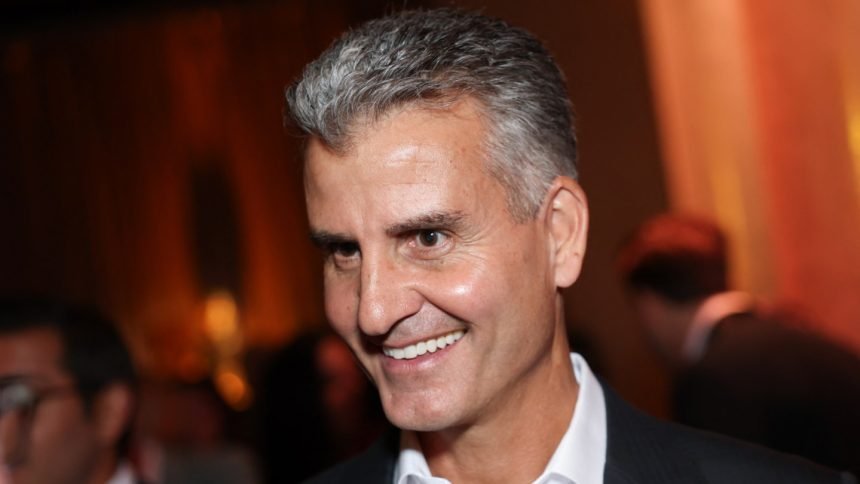
Twenty-four hours after he was named the next CEO of Disney, Josh D’Amaro addressed the company’s 230,000 or so employees for the first time. D’Amaro, joined by current CEO Bob Iger and the recently promoted president and chief creative officer Dana Walden, sat on the stage of the main theater on the company’s Burbank studio lot, where ABC World News anchor David Muir grilled them in a town hall about the new structure and what it will mean for the company going forward.
Iger transformed Disney, making blockbuster acquisitions like Pixar and Marvel and pushing it into new tech-forward lines of business like streaming with Disney+. D’Amaro indicated he would keep up with the disruption. “We are 100 years old, but we’re 100 years young as well, willing to embrace new technology, new creators and new markets,” D’Amaro told staff. “That willingness to change and take risks is what keeps the brand going, and it’s something I intend to continue to push on.”
Taking risks means not standing still, and when D’Amaro officially takes over Disney in March, he no doubt will want to put his own stamp on the company — just as Iger did before him — leaning into how consumers want to be entertained today and into the future.
The list of items on his to-do list will be long. What should Disney’s structure look like going forward? How does he expect Walden to rally the creative forces in her new role? (Not to mention that Walden’s ability to harness and grow Disney’s content engine will be one of the big stories to watch in the coming years.) And, perhaps most important: How should Disney embrace technology? And does linear TV have a role in that future?
Across the entertainment business, there is a new era of leadership at the top, and with Hollywood in a moment of more uncertainty than it has experienced in the past century or so, those executives all will be jockeying to position their companies to succeed at a time when even survival seems uncertain.
That includes Paramount’s David Ellison, who has made it clear to the industry that he is in it for the long term, and Mike Cavanagh, who will be the first person without the last name “Roberts” to lead the cable TV and media giant Comcast (Brian Roberts is co-CEO). It includes Lachlan Murdoch, who multiple industry sources predict will seek to remake the company his father founded now that his siblings are out of the picture. And then there’s D’Amaro, who will need to chart a course for the most powerful of all traditional entertainment companies amid that tech upheaval.
“There is a next generation that is poised to take over now, and it’s going to be one that really grapples with technology in a way that none of the previous generations have,” says Jonathan Miller, CEO of Integrated Media Co. and a former chief exec at AOL and News Corp. “Whoever’s sitting in the C-suite now does not have the luxury of time.”
If you look carefully, you can see the outline of where D’Amaro may be taking Disney. The executive, alongside Disney games chief Sean Shoptaw, was the driving force in the company’s $1 billion investment in Fortnite developer Epic Games. Together, the companies are creating an IP-filled interactive universe that fans will be able to explore, though Epic Games CEO Tim Sweeney tells The Hollywood Reporter that they aren’t ready to share any more details just yet. “Josh and Disney really get it and have a crisp understanding of how the future of their film and TV IP, Disney+ and games fit together into a digital ecosystem and tie into parks and other things,” he says.
Multiple sources familiar with D’Amaro’s thinking predict that gaming and interactivity will be key strategic priorities for him when he takes charge. It’s a topic he has not shied away from.
“He sees the digital realm — and Epic is a manifestation of that — as a very important place for fans to interact with their favorite characters, franchises and brands in a comprehensive way that you can monetize and that will serve fan interest in a way that, other than a theme park, it’s really impossible to do,” says Kevin Mayer, the former head of strategy at Disney who now co-leads Candle Media. “It democratizes the theme park experience in a digital way. Not everyone can get to a theme park; it has limited capacity. Epic Games and that universe has unlimited capacity.”
Whether that is partnerships, like the company has now with Epic or Electronic Arts, or whether Disney pursues a major acquisition deal to get into the space itself will be D’Amaro’s call to make. And the new CEO will be spearheading Disney’s push into AI-generated content, as its groundbreaking partnership with OpenAI kicks into gear. That deal will see Darth Vader, Lightning McQueen, Stitch and other beloved Disney characters available for users to create videos with in Sora and, ultimately, within Disney+. Suddenly, fans won’t just be able to watch their favorite characters, they will be able to manipulate them (within guardrails, of course), as the creator economy and the creative economy collide with AI technology.
“If you’re not deep into it, and you’re not anticipatory of how trends are changing, what’s interesting to people, you’re going to be almost definitionally behind,” says Rick Rieder, BlackRock’s chief investment officer of global fixed income, who is a friend of D’Amaro.
At the Consumer Electronics Show in Las Vegas in January, top Disney executives framed AI as an “accelerator,” something that will dramatically speed up the degree to which fans will interact with and engage with the characters and content entertainment companies created. D’Amaro will be tasked to lead that acceleration, and analysts expect them to move fast.
Which brings the question back to linear TV. The summer after he returned to Disney, in 2023, Iger sat on CNBC’s makeshift set in Sun Valley, Idaho, and said that the company’s linear TV business may “not be core” to the company. Ultimately, Disney kept the channels, but moves by Warner Bros. Discovery and Comcast to sever theirs have certainly raised that question once again, with multiple Wall Street analysts wondering whether that decision should be revisited.
“With a renewed focus on potential asset separations across the media landscape, the question of what a stand-alone ESPN might be worth has become more tangible,” MoffettNathanson’s Robert Fishman wrote Feb. 3, noting that ESPN is valued at $30 billion in its NFL deal. “Would Disney be able to remove any ongoing overhang in the stock by spinning out or selling off its portfolio of linear networks starting with its cable networks but also consider ABC and its TV station portfolio?”
Of course such a move would not be easy. ESPN, ABC and other Disney linear programming have become tightly integrated into Disney+ over time, making such a separation a bigger challenge than the maneuvers made by competitors.
D’Amaro isn’t shy about shaking things up. “Bob’s a big risk-taker, I’m a big risk-taker,” D’Amaro told Muir. At a time when Disney is facing major disruption, such gambles may be just what the company needs.
This story appeared in the Feb. 11 issue of The Hollywood Reporter magazine. Click here to subscribe.