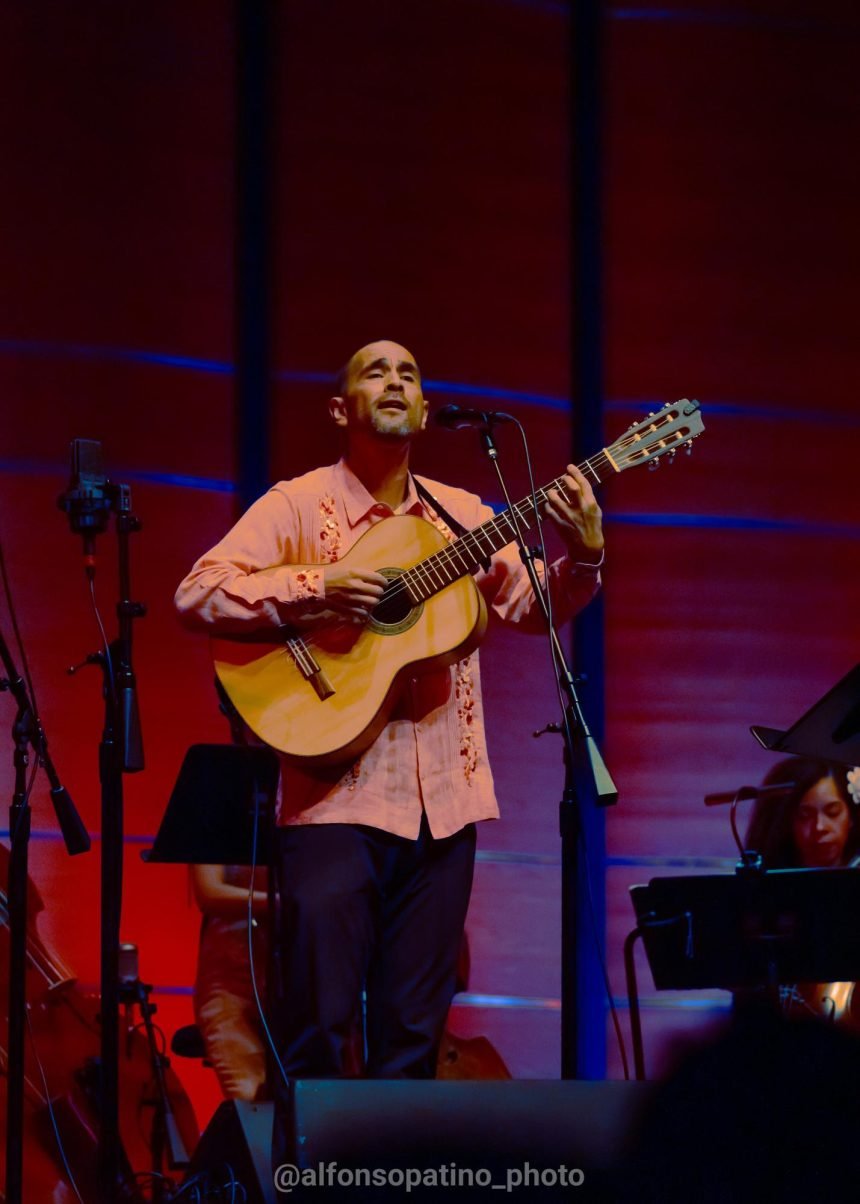
For five years, Javier Jara taught music at Manor Middle School in Manor, Texas, to a mostly Latino student population. Jara said the day after the 2016 presidential election, most of his students stayed home, fearing deportation. Jara, who immigrated to America from Ecuador, resolved to take action to change what he viewed as negative stereotypes facing his community.
“As an artist, I have to reflect the times,” Jara said. “That’s my life motto.”
Alongside his wife, Jane O’Brien, a journalist and UT alumna with a degree in Latin American Studies and journalism, Jara collected stories from 12 immigrants from different Latin American countries. He asked Yahir Durán, a songwriter and longtime friend, to write poems based on their lives. Jara turned the poems into songs, tailoring each arrangement to a musical style native to its subject’s homeland. Our Rhythms, Our Voices, released on Friday, bringing all 12 tracks together into a narratively rich tapestry of musical tradition.
“I’m a vessel,” Jara said. “I’m channeling other people’s stories, but I’m an immigrant myself, so definitely it resonates with me.”
Jara said the songs on Our Rhythms, Our Voices represent a wide range of experiences within America’s Latino immigrant community. “La Paloma,” written for Patricia Núñez, uses the symbol of a dove, capturing Núñez’s tumultuous childhood in which she moved between Mexico and San Antonio, leaving her struggling to keep up in both English and Spanish. Núñez, now a candidate for a Ph.D in curriculum and instruction at UT and an advocate for dual-language learning, said she spent much of her life feeling undesired in both places.
“It’s not a story that I had shared with everyone, but it was important to me for the advocacy of dual language,” Núñez said. “I did it for that.”
Núñez, like most of the subjects for Our Rhythms, Our Voices, had a personal friendship with Jara before he began putting the project together. “Rio Bravo,” however, tells the story of a father and daughter from El Salvador who drowned in the Rio Grande River in 2019 while crossing the Texas-Mexico border. Christabel Lin, who played violin on the album, said Jara tells stories people need to hear.
“We’re in a time where these stories are starting to come forward, and it’s been a tough time for people to reckon with the fact that their neighbors, people they know, are getting affected,” Lin said. “I think it’s cathartic. Music is a great way to be present and reflect on these personal stories.”
After more than five years of development, Jara and his team finished recording Our Rhythms, Our Voices in August 2024, before a long delay pushed the release date to 2026. In that time, Donald Trump began a second term as president and instituted immigration crackdowns.
“In a bad way, it’s good timing,” Jara said. “I’m sad that (the album is) relevant more than ever, but it is.”
Jara said live performances of the album attract emotional responses from audience members, who often thank him for making them feel represented and proud of their cultural traditions. In the future, he plans to undertake a similar project for migrants from the global south.
“A lot of sentiments of joy and sadness and nostalgia are brought up because of this (music),” Jara said. “People are moved, definitely. That moves me to keep on doing it, no matter what.”