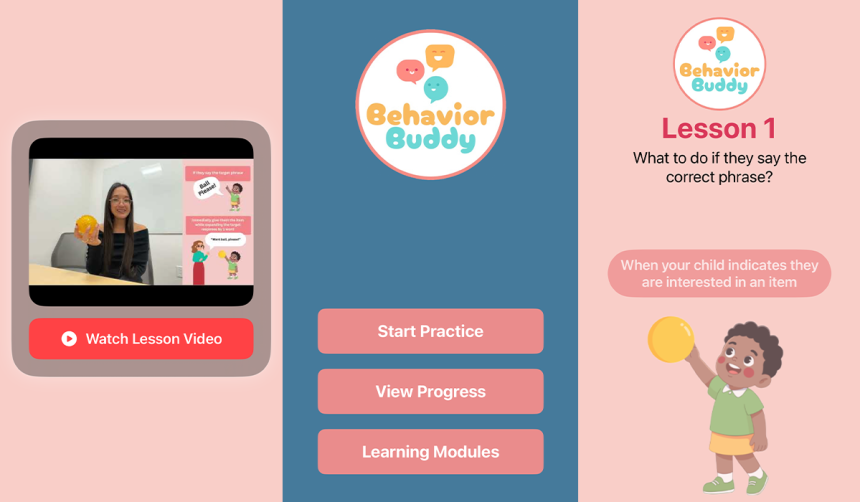
Not all caregivers have the tools they need at home to manage communication barriers with children with autism. UT San Antonio researchers have developed an app to provide access and convenience in the palm of their hand.
Housed in the Brain Health Consortium at UT San Antonio, Behavior Buddy offers timely, practical support when families need it and enhances existing services outside of scheduled sessions. The app serves as a tool to remind caregivers of proper techniques and best practices.
Texas faces a severe shortage of autism services: an estimated 250,000 residents with autism rely on only 5,665 BCBAs, according to two studies. With a recommended caseload of 12 children per provider, about 73% lack access to therapy. The gap is wider in rural communities, where services are often nonexistent.
The app’s co-creator, Leslie Neely, a UT San Antonio professor in the Department of Educational Psychology in the College of Education and Human Development and Associate Director of the Brain Health Consortium, explains the driving force behind the project.
“Originally, the idea stemmed from something that’s always been an underlying motivation for my research: to extend resources to underserved areas and improve the sustainability of our interventions,” Neely said.
Drawing from personal experience, Neely understands the struggles caregivers face.
“I am a behavior analyst, but I had a child who had to go to speech therapy,” she recalled. “I would sit there thinking I’m going to do these exercises at home, and then get home and think, ‘What was I supposed to do again?’” This common challenge became the motivation to create Behavior Buddy.
Many caregivers say their children thrive more in a comfortable home environment than in clinical settings. Parents described the app as an effective, family-friendly tool that supports learning at home. Some users also appreciated the app’s convenience and practicality. The app helps caregivers fit practice into their busy schedules, maintain accountability and collect data when clinic services aren’t available.
“Nothing like this exists,” said a parent that participated in the app’s initial testing. “It would be really nice to have the app. I told my husband, ‘If this happens, it’s going to be a game changer.’”
The app leverages artificial intelligence (AI) to provide real-time support, using a unique approach called behavioral skills training. It offers verbal and written instructions, modeling, role play and performance feedback. Users can select specific communication goals, such as teaching two-word requests, and the app listens and provides targeted guidance. Several families noted that the app strengthened their involvement and created meaningful learning moments together.
Behavior Buddy is built around the needs of families. The app provides gentle, constructive feedback, noting improvements like increased vocalization. “You did a great job. Your child has said three words in the last minute. Before he/she only said one word,” the app might report, accompanied by links to instructional videos.
A collaborative team of behavior analysts and engineers has been meticulous in its approach. The team is led by Neely and Adel Alaeddini, PhD, a professor in the Lyle School of Engineering at Southern Methodist University, along with project managers Haley Tapia and Marie Conant.
Currently in the initial testing phase, the researchers are recruiting 30 additional families in Texas with children two to twelve who have emerging vocalizations to participate in their randomized control trial (RCT). This research method shows the effectiveness of an intervention. When an RCT shows positive results, it gives strong evidence that the tool is helpful and an important step to getting it to the people who need it most.
Neely is considering expanding the capabilities of the application as the current version shows promising results. Future iterations could address challenges like aggression, self-injury behavior and even adaptive skills such as toilet training and shoe-tying.
The team’s primary goal is to provide families with a sense of progress and hope.
“Kids with autism and their caregivers hear, far too often, how far behind they are,” Neely said. “By thoughtfully integrating technology into everyday moments, we want to help caregivers recognize their child’s strengths and see meaningful progress happening in real time.”
Neely leads the UT San Antonio Applied Behavior Analysis Program, which educates students, conducts research and provides outreach to help children with autism and their caregivers. As the program nears its 10th anniversary, it has helped more than 1,800 families and secured more than $15 million in research funding to support children and families in Texas.
As the Behavior Buddy app continues to be developed, families of children ages 2-12 with autism are invited to complete an interest form by March 15 for free one-on-one research sessions with a BCBA.