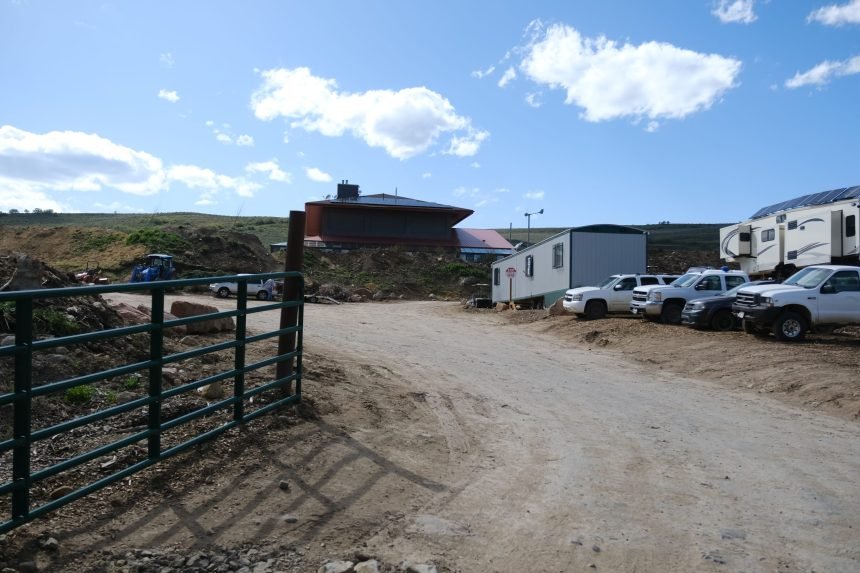
Spoil to Soil has fewer than 50 days to remove trash and other unauthorized materials from its property before the Summit County government shuts down the business entirely.
The recycling facility in Browns Canyon had its conditional use permit revoked last year after county staff submitted a 55-page report to the Eastern Summit County Planning Commission detailing dozens of alleged violations.
Jared Clayton, who owns the property with his wife, Kristen, appealed the decision and brought the case before the Summit County Council in September. County councilors appeared concerned with the violations, but they settled on offering the company a six-month window to fix the issues and apply for an amended permit.
However, county staff told councilors on Wednesday that they still had not received an application for the amended permit, which would likely take more than six weeks to work through. The deadline for Spoil to Soil to clean up the property is April 15.
Scott Buchanan, a code enforcement officer, said he visited Spoil to Soil twice in December to check on its progress. The first inspection was on Dec. 11, and Buchanan said most unauthorized items, including chunks of asphalt and animal carcasses, were removed from the property, but he still observed wooden pallets and “non-green waste material,” or trash, on the land.
The second inspection was on Dec. 18. Buchanan said the wooden pallets had been removed at that point, but the trash was still present and visible in the windrows, which are long piles of dirt used to facilitate composting and the creation of mulch.
Kyle Reeder, the Claytons’ attorney, said the garbage was still there because revoking the conditional use permit prohibited the company from processing the soil. He requested Spoil to Soil be given permission to use one of its machines to make removing the trash easier.
He also asked to be allowed to sell the mulch to help clear the land and earn revenue.
County planner Amir Caus said he didn’t necessarily oppose Reeder’s suggestion, but he was concerned the operation could “expand into something more than just removing it.”
“From our perspective, in order for them to sell mulch, they need to have a valid conditional use permit, which was required as part of the business license to sell in the first place,” Buchanan added. “That’s the reason why we said if you took in materials that are under the (conditional use permit), you can’t operate as a business and sell it during this period of time.”
County councilors asked if Spoil to Soil had reached out to county staff to resolve the issue. Reeder said the company had requested assistance multiple times, but Buchanan said there were only two conversations prior to the December inspections, both of which centered on selling boulders, rocks and other materials from the property.
Chief Civil Deputy Dave Thomas said there are also other issues with the land that need to be resolved before the April 15 deadline aside, including obtaining the proper permitting, adjusting hours of operation and widening Lower Bowl Road.
County Councilor Chris Robinson pointed out that even if the violations are resolved in the next 50 days, Spoil to Soil still hasn’t applied for its amended conditional use permit. Clayton asked if it would be possible to reinstate the original conditional use permit instead, but the County Council seemed hesitant to take that route.
“When it came to our level, we purposefully delayed taking action until we believed we had given proper notice of violation, and there was a course of conduct that led us to take the decision and the steps we did,” Robinson said.
He also mentioned a lawsuit that Spoil to Soil filed in Summit County’s Third District Court in November, which challenged the County Council’s decision to suspend the conditional use permit. Robinson indicated he was uncomfortable discussing an issue actively working its way through the courts and that if county staff and Spoil to Soil are able to work together, he would expect the company to drop the complaint.
“We had to reserve our rights, but our intention was to always work with the staff,” Reeder said. “”We’ve been talking with them, trying to work through it without having to go a litigation route. We don’t want to go the litigation route. We want to just work with staff and reopen.”
County Council Vice Chair Roger Armstrong preferred to wait and see how the cleanup efforts on the property play out before making any adjustments to the violations process or the business’s conditional use permits, with which the rest of the County Council appeared to agree.
“I’m going to be gentle about this, but there’s been a course of conduct that has not been what I would regard as honest and transparent on the property to now in terms of some of the materials that have been taken in and some of the business that has been conducted,” Armstrong said.
The County Council ultimately didn’t take action on the violations other than giving Spoil to Soil permission to operate machinery to remove trash from the windrows.