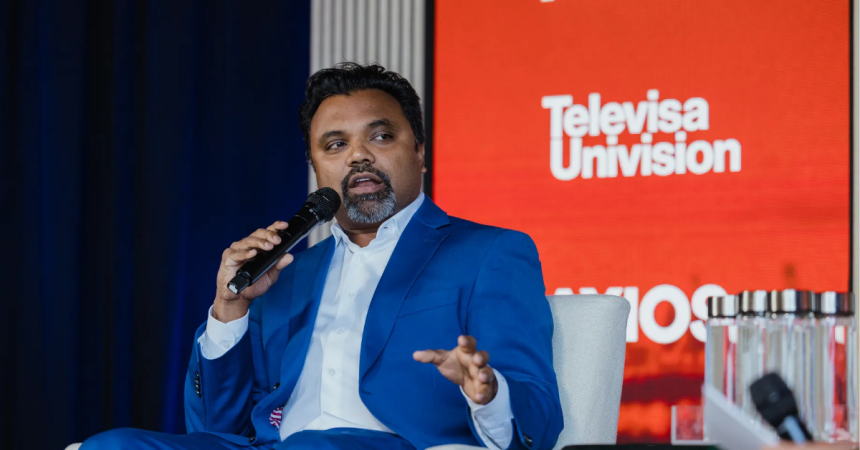
March, 2026.- At the SXSW 2026 festival, the Axios House panel served as a critical wake-up call for the Democratic Party regarding its relationship with the Hispanic community. Ignacio Meyer, a top executive at Univision, warned that Democrats must urgently adjust their messaging to win back Latino voters ahead of the pivotal 2026 midterm elections. With congressional control hanging in the balance, Meyer emphasized that this demographic is no longer a guaranteed voting bloc but a decisive force that demands a clear and culturally resonant value proposition.
The urgency of this recalibration is backed by the decisive shift seen in 2024, where Latino voters played a key role in Donald Trump’s victory, granting him a record-breaking 48% of their support nationwide. Meyer highlighted that these figures exposed a growing gap between the party’s platform and the Hispanic working class. This trend underscores that the shift is not a temporary fluke but a clear indication that Republicans have successfully tapped into the economic anxieties of a community that feels increasingly alienated from traditional political structures.
A central theme of the discussion was the sophistication and independence of the modern Hispanic voter. Meyer asserted that Latinos want to be persuaded by issues and solutions rather than partisan politics, rejecting the idea of being treated as a monolith. This sophistication means that political campaigns must move beyond identity-based outreach and instead focus on substantive policy, recognizing that the community’s cultural power is intrinsically linked to their demand for tangible economic progress and respect.
Furthermore, the panel issued a sharp critique of superficial and last-minute campaign tactics. The Univision executive condemned “check-the-box” strategies, such as late-cycle ad spending or the use of Google Translate for Spanish outreach, which lack cultural authenticity. According to Meyer, effective political communication must be consistent and culturally genuine, avoiding the mistake of treating the Latino community as an afterthought that only requires attention in the final weeks leading up to an election.
The conversation also delved into the internal diversity of the Hispanic population, debunking the myth of a singular “Latino vote.” It was noted that culture is often more significant than language, as a message tailored for a Mexican-American in California will not resonate the same way with a Caribbean immigrant in the Northeast. This complexity requires a strategic, localized approach that understands regional roots, moving past the outdated notion that one broad strategy can effectively reach the 65 million Hispanics across the U.S.
Finally, Congressman Greg Casar (D-Texas) provided a roadmap for recovery centered on authenticity and economic relief. Casar pointed out that rural Latino voters in Texas are showing high engagement levels, but the path to victory remains simple and direct: lowering prices and putting more money into people’s pockets. He concluded that Democrats have a real opportunity to regain ground if they commit to a message that speaks directly to household economics with a tone that feels both consistent and sincere.