Toward the end of the Mavericks’ season in 1994-95, Jason Kidd recorded his fourth triple-double in 10 games. Conventional wisdom, however, was that he was still trailing Grant Hill in the race for Rookie of the Year. When told of the feat, the point guard for the lottery-bound Mavericks sarcastically responded to a reporter, “Maybe this game doesn’t count.” It did, of course, and it made an impression. Kidd was making a late-season push for the honor, and a month later, he would share the award with Hill. “For me, I just went out there and let my talent and my game speak for itself,” Kidd said at the time. “I thought if I could play well, the writers would vote on talent.”
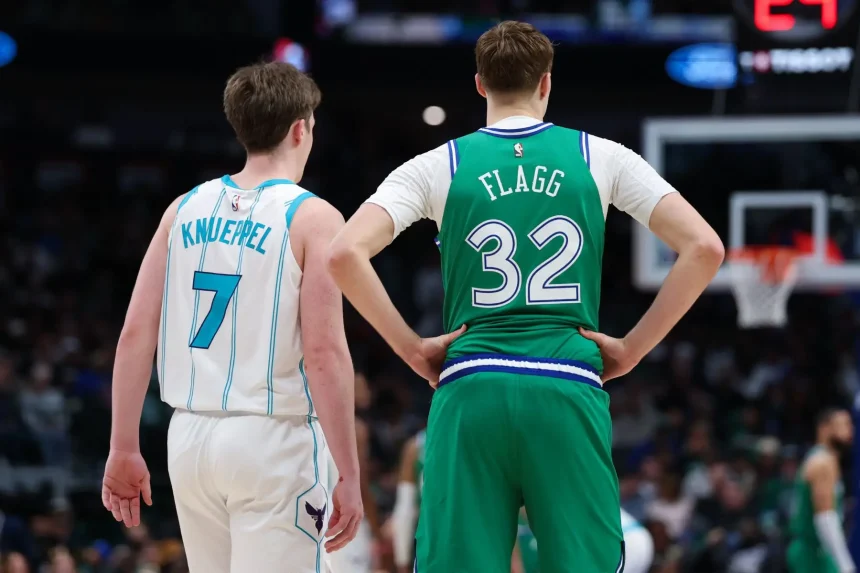
They did. Now the lottery-bound Mavericks of 2025-26 are hoping for a similar outcome with Cooper Flagg, as the race for Rookie of the Year remains tight. Once the prohibitive favorite, Flagg now is the underdog to his former teammate at Duke, the Hornets’ Kon Knueppel, who leads the NBA with 243 three-point field goals and already owns the rookie record in the category. Either would be a deserving winner; there is no need to tear down one player to elevate another. But while Flagg needs a late surge in his last 11 games, a deeper look reveals a compelling argument for him to take the trophy home.
Rookie of the Year has traditionally been solely an individual award, largely because top picks land on struggling teams where wins are scarce. But the Hornets have become the darlings of the NBA and rightly so, having won the second-most games in the league since January 22. That kind of turnaround after early season floundering has complicated the narrative.
That said, while Knueppel has undoubtedly played a key role in the Hornets’ elevated performance, his arrival coincided with the continued development of Brandon Miller, LaMelo Ball, and Miles Bridges. If you were to swap Knueppel and Flagg, would the Hornets lose a step? Or would Flagg then be praised for that same “contribution to winning?”
The Mavericks entered the season with expectations of being immediately competitive, pairing Dereck Lively II and Anthony Davis with their prized rookie. Instead, the season was reshaped due to early struggles, injuries, and front-office changes. Flagg was thrust into unfamiliar and demanding roles—on and off the court.
He started his first NBA game at point guard. After the Davis trade, he was handed leadership responsibilities and, effectively, the keys to the franchise as a teenager who didn’t turn 19 until mid-December. The expectations were immense. He has been asked to do more, and he has delivered.
Kidd sees it every day. “What Cooper’s doing as a rookie might look easy, but it’s not very easy,” he says. “With the injuries we’ve had, to do what he’s doing is very impressive. I truly believe he deserves to be Rookie of the Year. It’s not easy to come in with all the hype and expectations and be able to deliver, if not be even better than what the expectations were.”
The numbers support the argument. While often facing the opponents’ best defender, Flagg is averaging 20.1 points, 6.7 rebounds, and 4.5 assists per game. If he maintains those marks, he will become just the fourth rookie in the last 50 years to do so. For context, LeBron James produced 20.9 points, 5.5 rebounds, and 5.9 assists in his rookie season. Across the board, Flagg ranks in the top five among rookies in points, rebounds, assists, steals, and blocks. Only six rookies in the last 30 years have accomplished that. (Knueppel is top 5 in points.)
There’s more.
He has had 30 games with at least 10 points, 5 rebounds, and 5 assists—more than double the next closest rookie. Knueppel, by comparison, has had 10 such games despite playing in 11 more games overall. Only three rookies since 2000 have exceeded 31 such games, and all three won Rookie of the Year. Flagg has 10 games of 25/5/5—more than all other rookies combined. And he has done that while missing a dozen games due to injury. Over the last seven seasons, only Victor Wembanyama and Cade Cunningham recorded more, with 12 each. Flagg also joined Allen Iverson as the only rookies in the past 50 years to score 150 points over a four-game span.
What’s more, Flagg’s playmaking continues to evolve. Over his last 10 games, Flagg is averaging 6.6 assists. He is just the fourth rookie non-point guard since the merger to reach that mark, joining Wembanyama, James, and Joe Dumars.
What makes this even more remarkable is his age. Flagg entered the league as its youngest player at 18. Remember, he could be playing in March Madness as a freshman right now. Instead, he is rewriting NBA record books after reclassifying. Flagg holds the record for the most points in a game by a teenager, with 49 in an overtime loss to Knueppel and the Hornets. His 27 games with 20 or more points rank sixth all-time among teenagers. He has 24 games as a teenager of 15/5/5, second only to James’ 40, and has the rest of this season and into next year to climb higher.
Defensively, his impact is growing as well. Over Flagg’s last 13 games, he has had four games with at least three blocks after having just one in his first 46. His help defense and rim protection have taken a significant leap, and his versatility allows him to guard positions 1 through 5.
He’s also delivering in high-leverage moments. The Mavericks have played in a league-high 40 clutch games, and Flagg ranks 15th in the NBA in clutch scoring, best among all rookies. His 85 clutch points provide a striking context. Last season’s Rookie of the Year, Stephon Castle, led all rookies with 38 in 26 games. Over the past seven years, only Paolo Banchero has recorded more, with 91 in 40 games. (Knueppel has scored 48 clutch points in 26 games.)
And all of it comes with intangibles, too, as Flagg has embraced his role as the leader of the franchise off the court. Earlier this month, while sidelined with an injury, Flagg remained active and vocal from the bench. In Toronto, after a physical and frustrating game, he was walking near the Mavericks’ bench when he noticed a teammate down on the opposite side of the court. He turned, sprinted over, and was the first to help him up. Kidd notices it all.
“He’s a coach’s dream,” he told me. “Open to coaching, accepts any challenge, learns from mistakes and is one of the most impactful rookies I have ever played with or coached. Impressive for someone so young.”
Kidd would know. Three decades ago, he made a late surge to claim a share of the Rookie of the Year award. Flagg has built a convincing case to do the same in 2026. What we are witnessing is both historic and generational. Now we wait to see if the voters agree.
Author
Brian Dameris
Brian Dameris writes about the Mavericks for StrongSide. He is the former Director of Basketball Development for the Dallas Mavericks and is currently a studio analyst for Mavs TV broadcasts on Bally Sports Southwest. For the past seven years he has been co-host of the The Ticket’s Mavs Postgame Show and can also be heard weekly on his Mavs podcast “Take Dat Wit You” with Mark Followill.