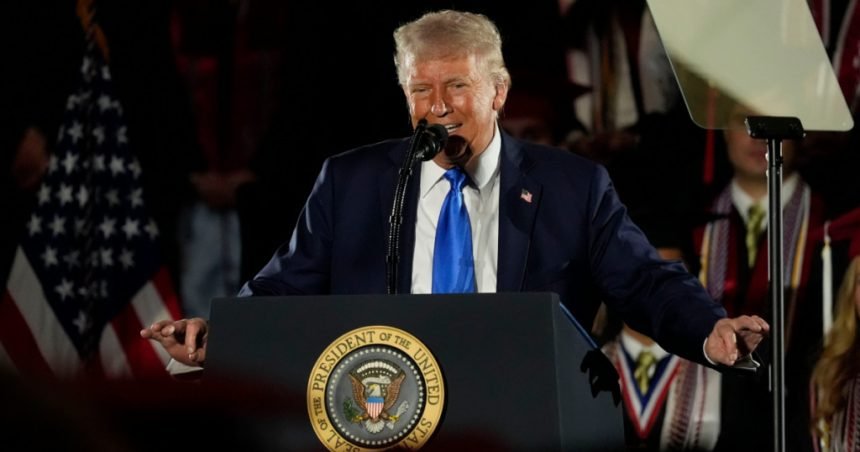
After President Donald Trump signed an executive order aiming to fix college sports, NCAA president Charlie Baker released a statement. Trump signed it Friday, exactly four weeks after a roundtable at the White House.
As On3’s Pete Nakos reported, the executive order – which is to take effect Aug. 1 – takes aim at transfer movement and player eligibility, as well as Olympic sports. It calls for the NCAA to change its rules so athletes are given one “free” transfer as an undergraduate and again as a graduate. However, the order is likely to face legal scrutiny, which Trump said he expected when he announced his plans to sign it.
Advertisement
SUBSCRIBE to the On3 NIL and Sports Business Newsletter
In a statement, Baker called the executive order more progress toward the protections the NCAA is seeking for athletes. He said the next step is for Congress to take up legislation regarding college athletics, which was also part of Trump’s order.
“The NCAA has modernized college sports to deliver more benefits for student-athletes, and the Executive Order reinforces many of our mandatory protections – including guaranteed health care coverage, mental health services, and scholarship protections,” the statement read.
“This action is a significant step forward, and we appreciate the Administration’s interest and attention to these issues. Stabilizing college athletics for student-athletes still requires a permanent, bipartisan federal legislative solution, so we look forward to continuing to work alongside the Administration and Congress to enact targeted legislation with the support of student-athlete leaders from all three divisions.”
Advertisement
Details of Donald Trump’s new executive order
Friday’s executive order is President Donald Trump’s second related to college sports. It is notably pointed at the transfer portal, allowing an athlete to transfer one time during a five-year period of eligibility to play right away. They would be able to transfer again if they complete a four-year degree. The order also explicitly states that professional athletes would not be allowed to return to college sports.
However, the one-time transfer rule was changed in 2024 following a judge’s order in West Virginia. The ruling intended to stop the NCAA from enforcing its bylaw barring athletes from transferring multiple times and playing right away. The NCAA’s eligibility rules are also the subject of multiple lawsuits, though the association has come out on top in the majority of those cases.
In Friday’s executive order, Trump also cited athletics-related spending by schools, which he also criticized in the past. Although he signed an order related to college sports in July 2025, he acknowledged, “more comprehensive executive action is required before college sports are lost forever.”