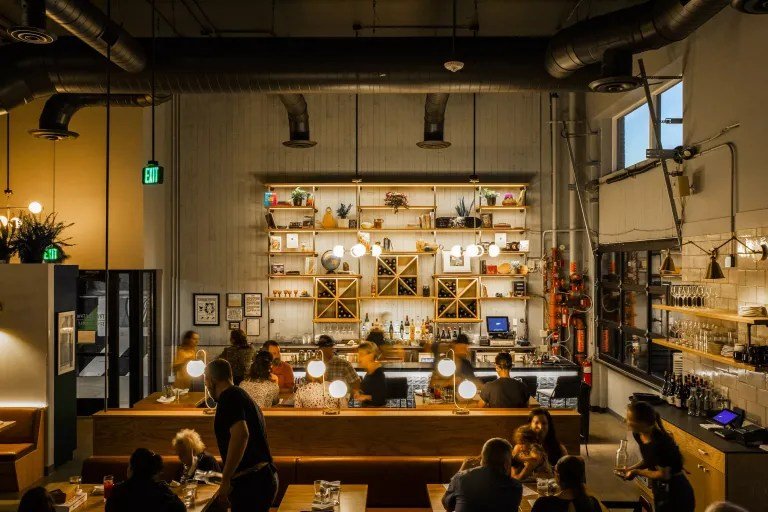
Twelve years ago, I co-founded my first restaurant, Work & Class, in Denver’s RiNo neighborhood. I was young and hungry, a first-time entrepreneur who’d spent fourteen years working her way up from the dish room to host stand to server to manager to, finally, owner of my own restaurant. My aim was simple: to create a small, lively restaurant that contributed positively to everyone it touched — staff, guests, vendors, and the neighborhood around us.
Admittedly, I was nervous. What if no one came? Would anyone even notice that we’d opened our doors? Could I make it in an industry often deemed the toughest there is? And most terrifying of all, what if the restaurant went belly-up and I couldn’t repay the small-business loan I’d taken out against the equity in my house?
Thankfully, none of my fears came true. People came. There was enough money to cover rent, payroll, insurance, and payments to the bank and investors who’d given us our humble start. I handed out Christmas bonuses to staff, gave annual raises, and built up a cash reserve for emergency repairs, economic downturns, and the other unwelcome surprises that come with running a small business. The neighborhood embraced us, and other restaurants and small businesses began to line RiNo’s streets. Denver’s restaurant scene was exploding. With manageable startup costs, diligent work, and careful finances, success was within reach.
I sold my shares in Work & Class in 2016, proud of what we’d built. Five years later, I did it again. I opened The Greenwich in 2021, older and more experienced, with a sharper business plan and clearer eyes. What I didn’t anticipate was that the city I’d learned to operate in had fundamentally changed in those short years.
Every year at The Greenwich felt like running uphill in wet sand. Labor costs rose relentlessly — not because I paid badly, but because Denver’s tipped minimum wage escalated faster than any financial model could reasonably absorb. Between 2019 and 2025, Denver’s tipped minimum wage increased nearly 95 percent, from $8.08 to $15.79. Today it stands at $16.27 — the highest tipped minimum wage in the country among cities that still maintain a tip credit system. And that tip credit — the mechanism that accounts for the fact that tipped employees regularly earn $30 to $50 an hour, including gratuity — stayed frozen at $3.02. (As a note, the tip credit is optional; operators can choose whether to use it based on their own business model and compensation philosophy. For many full-service restaurants, it’s a crucial tool for keeping labor costs manageable while still ensuring that servers and bartenders take home a livable wage.)
Meanwhile, rent climbed. Insurance climbed. The cost of goods climbed. My guests, already paying some of the highest menu prices in the country, were quietly hitting their limit.
I want to be precise about what that means in human terms. At Work & Class, I gave Christmas bonuses and annual raises. I invested in my people because the economics allowed it and because it was the right thing to do. At The Greenwich, the mandated wage increases consumed every dollar I might otherwise have reinvested into the business and the people in it.
The cruel irony is who bore that cost most quietly: not the servers and bartenders whose base wages were rising automatically by law, and who routinely took home $40 to $50 an hour with tips — well above Denver’s minimum wage, and well above the wages of entry-level workers earn in any industry. It was the cooks. The dishwashers. The people working the hardest jobs in the building, with the fewest options and the least leverage saw the smallest gains during the years that Denver’s wage policy was celebrated as a victory for workers.
I sold The Greenwich at the end of 2025. I made that choice deliberately, with clear eyes, because the trajectory was not going to improve.
My experience was not unique. A recent report commissioned by Denver Economic Development & Opportunity, Visit Denver, and inKind confirmed that the experience I had was happening at scale. Full-service restaurant employment in Denver is down nearly 15 percent from 2020. In September 2025, Denver recorded the steepest year-over-year spending decline in dining among major U.S. cities. Restaurants contribute 13 percent of the city’s sales tax revenue, which is now declining. Profitability has turned negative for many operators, even as comparable restaurants outside Denver that operate under the same state laws — but without Denver’s local wage structure — remained stable.
That last point matters enormously. This is not a national trend being blamed on Denver. The comparison group is right here in Colorado.
The facts in that report are, sadly, now under attack. A coalition of 56 restaurants — many of them coffee shops and bars, rather than full-service restaurants most affected by the current wage policy — has written to the City Council to discredit it, arguing that its authors are restaurant owners who stand to benefit from the policy changes they recommend. It’s a convenient charge, and worth addressing directly.
The data in that report does not come from its authors — it comes from the Bureau of Labor Statistics, Colorado Department of Labor & Employment, the Denver Department of Finance, The Economist, Bank of America, and OpenTable. You don’t have to take the authors’ word for anything. You can look up the numbers yourself.
What’s more telling is what the critics’ own letter acknowledges: that permitting is broken, that rents are too high, that safety is a problem, that the city isn’t doing enough to support independent operators — all conclusions the report reached as well. They agree with nearly everything in the report — except the part about labor costs. Agreeing that the patient is sick while refusing to discuss the fever isn’t a counterargument. You haven’t entered the debate. You’ve shut it down.
Denver built something truly worth fighting for — a restaurant culture that was independent, creative, and community-rooted in ways that set this city apart. That culture is contracting. The neighborhoods that once hummed with new restaurants and new ideas are quieter now, and the operators best positioned to restore that energy are the ones being squeezed out fastest.
What they need — what this city needs — is not a shouting match, political campaigns, or letter-writing contests. It is an honest, clear-eyed conversation about all of the forces that are making it harder to open a restaurant, keep one open, and do right by the people who work in them. Twenty years in this industry taught me one thing above all else: The hardest problems only get solved when everyone is willing to tell the truth. Denver has done it before. It can do it again. But not with its eyes closed.
Westword.com frequently publishes opinion pieces and commentaries on matters of interest to the Denver community. Have one you’d like to submit? Send it to editorial@westword.com, where you can also comment on this piece.