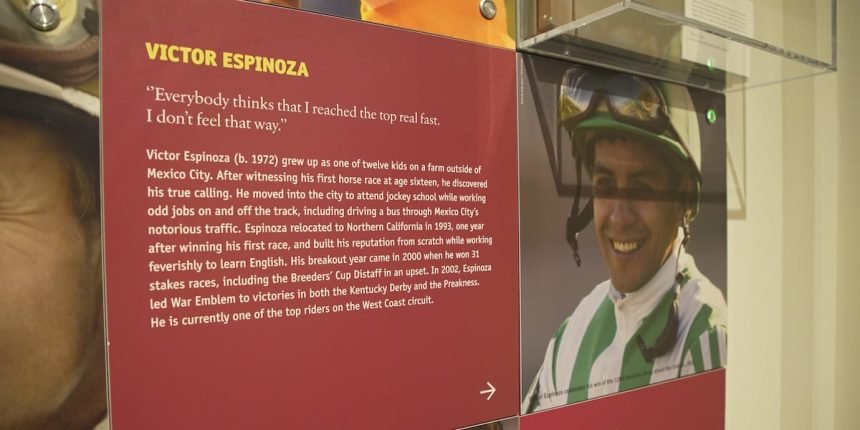
LOUISVILLE, Ky. (WAVE) – Did you know the Kentucky Derby Museum has opened its first bilingual exhibit honoring Latino jockeys and their contributions to horse racing?
The exhibit, called A Las Carreras, features stories of Latino jockeys who have raced in the Kentucky Derby.
Among the pieces in the exhibit are silks worn by Puerto Rican jockey Angel Cordero Jr., who won the 100th anniversary of the Kentucky Derby in 1974. The exhibit also includes the saddle Peruvian jockey Edgar Prado used when he won the Kentucky Derby in 2006 while riding Barbaro. A statue of that horse stands outside Churchill Downs.
Jessica Whitehead, the senior curator of collections at the Kentucky Derby Museum, played a key role in putting A Las Carreras together.
“We are always looking for ways to tell a broader, more inclusive story of the Kentucky Derby to make people feel like they belong, so that they can see themselves in the Derby tradition,” she mentioned. “They can see themselves in the Derby race.”
The first Latino jockey to ride in the Kentucky Derby happened way back in 1920. That first rider, Jose Rodriguez, was from Cuba and was one of the top riders of that era. Rodriguez came in second in the Kentucky Derby.
In 1958, Milo Valenzuela would become the first jockey with Latino heritage to win the Kentucky Derby. Valenzuela was born in Texas, just across the border from Mexico, where his family was from.
And then in 1963, Panamanian rider Braulio Beza won the Kentucky Derby on Chateaugay, becoming the very first Latino-born jockey to win the Run for the Roses.
“It’s inescapable to think about the contributions of Latino jockeys to this sport and to our race,” Whitehead pointed out. “You know, this race, the Kentucky Derby, is something that has an international stage, and on that international stage, people all over the world are seeing riders from Puerto Rico, seeing riders from Peru, seeing riders from incredible Central and South American countries who are just absolutely dominating this sport and just showing peak athleticism, incredible grace, incredible horsemanship.”
Among the incredible athletes the exhibit looks to honor is Reyluis Gutierrez. Four years ago, he ran in the 148th Kentucky Derby. The Panamanian jockey finished in sixth place riding Barber Road.
“It’s one of those races you never forget the feeling,” he commented. “It wasn’t like any other race. Loading in the gates, I’ll never forget how quiet it got, but then when the gates opened, I’ve never sensed a rush and a roar like that in my career.”
Gutierrez, a first-generation American with Panamanian roots, was born into a horse racing family. His father is a trainer, and two uncles either were or are currently jockeys.
“The horses, they give you everything,” he said. “And they’ve given me everything in my life. As far as getting a college education and high school education for my sister and me, it was because of the horses. My family wanted more for us, but in the end, I’m 5′1 and I decided to stick around with the horses. I’m glad I made that decision.”
While competing in the Kentucky Derby was not something he necessarily dreamed of, Gutierrez is looking forward to the day when he can compete a second time. The Panamanian jockey said he hopes his story will inspire more Latinos to go into horse racing.
“No matter what it is you want to do, you want to ride the Kentucky Derby, or you want to be, you have to believe in yourself,” he emphasized. “And no matter how far away that dream feels, believe it, believe you can do it. Push yourself because if you have a goal, you will reach that destination. Maybe not tomorrow, maybe not next year, maybe not in two years, but you can reach that as long as you keep pushing towards that.”
The A Las Carreras exhibit is located on the second floor of the Kentucky Derby Museum.
Copyright 2026 WAVE. All rights reserved.