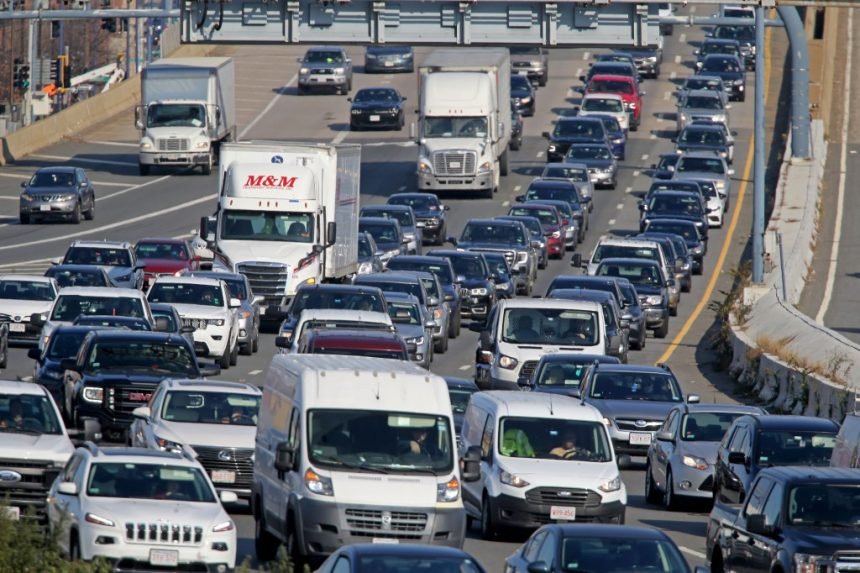
Boston Mayor Michelle Wu said congestion pricing is working in New York City and sees it as a strong traffic-calming solution for the Hub.
The Wu administration’s intent to study congestion pricing as a strategy to discourage people from driving into Boston was first revealed in the mayor’s climate action plan this week, and Wu made her position clearer on Tuesday.
“I’ve always believed that every tool should be on the table and this is an important one,” Wu said on GBH’s Boston Public Radio. “We’re seeing it work in New York.”
Wu said congestion pricing, which would impose a fee for drivers traveling into Boston, has the ability to reduce traffic and pollution by charging higher prices at peak hours to “even out the traffic,” and encourage the use of public transportation.
She said a congestion charge would also provide funding to improve public transportation in the region.
“It can be a win-win, if we can deliver on it,” Wu said. “We need to continue … studying this, because if we want to get past certain ceilings on what we’re doing with climate, with traffic flow, with public transportation access, there are tools that are available that could help push us through.”
Congestion pricing is listed as a strategy in Wu’s five-year climate action plan, which was released by the city on Monday and aims to achieve carbon neutrality by 2050, and 50% of that goal by 2030.
The potential tax has been kicked around for years in Boston and has proven to be politically polarizing. New York City imposed a congestion pricing system early last year amid resistance.
Gov. Maura Healey was more measured when asked for her position on a potential congestion fee in her GBH radio segment on Tuesday.
“We’ve got to work to keep our roads safe,” Healey said. “We certainly need to reduce congestion and reduce traffic on our roads, and we need to protect our communities from climate change. Those are all three things that I believe in.
“It’s also in a moment where people are already struggling with costs and affordability, so we can’t be creating more problems for people that way,” Healey added. “But, as I understand it, it’s a study, so we’ll see what comes out of it.”
While she seemed noncommittal this week, Healey has been more receptive to congestion pricing than her predecessors.
A bill that would have created a mobility pricing commission to look into such a tax was vetoed a number of times, including by former Gov. Charlie Baker in the summer of 2022, when he cited equity concerns.
Two years ago, Healey created the transportation funding task force, an entity that said at the time that it was planning to look into the mobility pricing strategies the vetoed legislation would have considered.