With the NFL Draft complete and rookie minicamp just around the corner, the Atlanta Falcons still have plenty of questions to address as Kevin Stefanski’s first season as head coach approaches.
Today, let’s look at six of the most interesting among them.
When will James Pearce Jr. be back?
Let’s get this one out of the way first. The short answer is we don’t know. The pretrial intervention program Pearce entered in hopes of having his three felony charges dismissed will extend into October, and the NFL may reserve whatever punishment it hands down until after that. If so, the Falcons will have a decision to make when training camp begins on whether to allow Pearce to rejoin the team before the case concludes.
However, the league’s personal conduct policy gives it a lot of leeway in handling matters like this. It could hand down a suspension before Pearce’s legal proceedings are done — and even if all his charges are dropped.
Falcons general manager Ian Cunningham declined to address Pearce’s case during the draft, but given the severity of his charges, it’s possible the 22-year-old doesn’t play at all in 2026.
Who’s going to be the quarterback?
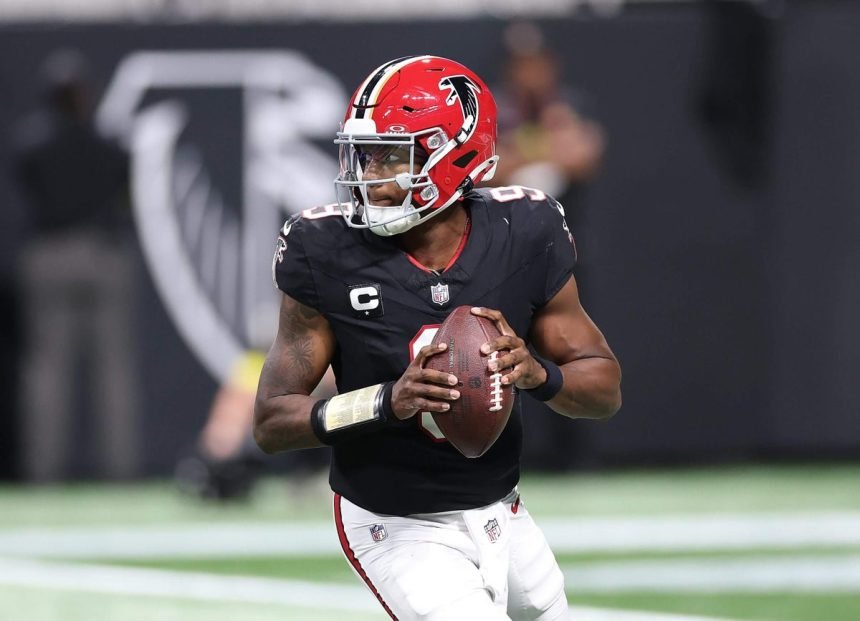
The biggest development of May so far for the Falcons was Michael Penix Jr. dancing at his wedding last weekend. Atlanta’s third-year quarterback and his new bride were on the dance floor and all over social media, which offered at least some encouragement after Penix suffered a season-ending ACL tear in Week 11 last year. Obviously, dancing and starting an NFL football game are vastly different athletic accomplishments, but it was good to see Penix up and on his feet. The next milestone will be the start of mandatory minicamp on June 16, which will be seven months from the date of Penix’s injury.
His health is the first piece of information we need to determine what kind of competition he’ll face from free-agent addition Tua Tagovailoa. From there, it’s going to be about who best fits into Stefanski’s offense. On the surface level, that looks like Tagovailoa. Stefanski and his system place a high value on accuracy. Tagovailoa is a career 68 percent passer who has never been below 64 percent in a season. Penix is a career 59.6 percent passer who has never been above 60.1 percent. The comparison is not quite that simple because Penix ranks sixth in the NFL over the last two years in deep pass rate (13 percent) while Tagovailoa is 64th (7 percent). Still, immediately after proving he’s healthy, Penix will have to prove to his new coach that he can be a more accurate passer in all areas of the field than he has been the last two seasons.
It’s hard to imagine the Falcons not giving Penix a shot this year, considering they spent the No. 8 pick on him just two years ago and he still doesn’t have 400 NFL pass attempts. But the new coaching staff and personnel department don’t have any of their professional reputation attached to him, so maybe they don’t feel the pressure to play him.
When will the Drake London extension come?
And how much will it cost? Cunningham has been thinking about London’s second contract since he took the job in January, and now that the draft is complete, it’s time to get it done.
London is set to play on his fifth-year extension this year at a price of $16.8 million, but there’s no need for the Falcons to let him start the season on the last year of his contract. This new regime has spent its first four months on the job making conservative deals that allow for maximum flexibility in the future. Now it’s time to make the kind of move that establishes a long-term vision for the organization.
London is the perfect player on whom to make that type of bet. He is 15th in the NFL in receiving yards (3,961) since being drafted eighth overall in 2022, and he’s in the top 10 in the league in the last two years in receiving touchdowns (16) and yards per game (75.5). He’s a low-maintenance player who works hard on the practice field, and he’s far and away Atlanta’s best receiver.
The Falcons could make London one of the five highest-paid wide receivers in the league with a deal worth $33 million or more per year. That would be below only Jaxon Smith-Njigba ($42.1 million average annual value), Ja’Marr Chase ($40.3 million), Justin Jefferson ($35 million) and CeeDee Lamb ($34 million).
Maybe the most straightforward comp for London is the Jets’ Garrett Wilson, who was taken two spots after him in 2022. Wilson has more career catches than London (315 to 304), but London has more yards (3,961 to 3,644) and touchdowns (22 to 18). Wilson signed a four-year, $130 million deal last summer.
If I were to guess at London’s new deal, I’d guess four years for $135 million, but the real number to watch will be the fully guaranteed money. Wilson’s total of $38.3 million fully guaranteed ranks just 15th among wide receivers in the league, according to Overthecap.com.
Will Jessie Bates get an extension?
Bates is quietly entering his final year of the deal he signed in 2024. The 29-year-old three-time All-Pro safety said in April that he would like to retire a Falcon, but doing this deal isn’t as obvious a decision as the London deal. The new Falcons regime already let 30-year-old linebacker Kaden Elliss walk away this offseason.
“Every year is a one-year contract,” Bates said. “Things can change, people get traded or get cut.”
The smart money says Bates will be on the roster in 2027. He’s playing this year as the eighth-highest-paid safety in the league ($16 million). Atlanta will probably start the negotiations on any new deal at a lower number than that based on Bates’ age, but he’s going to have plenty of bargaining power because of his production in Atlanta and the fact that there’s no heir apparent on the roster. With Bates and Xavier Watts, the Falcons have one of the best safety duos in the league. Moving on from Bates would put a lot of weight on Watts’ shoulders.
Which returnees are on the bubble?
An overhaul of the coaching staff and front office always makes for nervous offseasons for some players, especially draft picks of the previous regime who have yet to cement a spot in the rotation. The Falcons have plenty who fall into that category and are facing critical training camps.
First, there are the injury issues. Linebacker Troy Andersen, a second-round pick in 2022, has played in only 26 games over four years due to a litany of injuries and didn’t see the field last year. Edge rusher Bralen Trice was a third-round pick in 2024 but suffered season-ending knee injuries in both of his professional preseasons. It’s impossible to properly handicap their roster chances without seeing their health in training camp, but it’ll be an uphill road for both.
Then there’s a group of players who could land anywhere between key contributor and looking for a new job. Cornerback Clark Phillips III, a fourth-round pick in 2023, started seven games his first two seasons but played only one game last year due to injury. Linebacker JD Bertrand, a fifth-round pick in 2024, played only 12 defensive snaps in the final six games last year. He could open training camp as a starter in a young room, but he’ll have to prove he can play the style that defensive coordinator Jeff Ulbrich wants to play. Wide receiver Casey Washington, a sixth-round pick in 2024, has only seven catches in 15 career games. He showed some early flashes last year before being a non-factor down the stretch.
Offensive tackle Jack Nelson, a seventh-round pick last year, will need a good July after Atlanta brought in two undrafted free agents at his position this offseason. Storm Norton’s return to health makes Nelson’s path tougher. There’s a thought that veteran tight end Charlie Woerner could be a cut candidate after the addition of Austin Hooper, but Woerner’s blocking makes him very valuable for a coaching staff that wants to play multiple-tight-end sets.
Who will start at linebacker?
Ulbrich said in January that it would take more than one player to replace Elliss if he left in free agency. It turns out it took four.
After Elliss signed a three-year, $33 million deal to return to the Saints, the Falcons signed Christian Harris and Channing Tindall in free agency and drafted Kendal Daniels and Harold Perkins Jr. Harris, who has 27 professional starts, is the most proven of the group, but he played just 10 percent of the defensive snaps in Houston last year. Daniels, a fourth-round pick, could be in the starting conversation at some point this season, but it’s hard to expect that early in the season.
The lack of an obvious option means Bertrand could be in the mix for the job. He has the benefit of a year in Ulbrich’s system, but doesn’t have the same type of athletic profile as Harris and Daniels, so he’s not an ideal scheme fit. With established starter Divine Deablo playing on the final year of his deal, linebacker is the Falcons’ hardest position to predict beyond this season.