On Wednesday, a gathering of investors and civic leaders met inside one of the most innovative and modern buildings in Houston to discuss one of the city’s oldest, creakiest landmarks.
Inside the Ion District, the former Sears campus transformed into a 16-acre innovation hub in 2021, the Astrodome Conservancy hosted “Market Day.” This three-hour pitch session aimed to secure private investment for the renovation of the Astrodome, often referred to as the unofficial Eighth Wonder of the World.
“This is Houston and we built the dome first,” said Beth Wiedower Jackson, the Executive Director of the Astrodome Conservancy. “We’re going to do something completely unique and innovative with it again.”
Article continues below this ad
Leases on the NRG Park campus with the Houston Texans, RodeoHouston and the facilities under the purview of Harris County Houston Sports Authority—Astrodome, Reliant Stadium, NRG Arena and NRG Center—come due in 2032. As negotiations continue, the future of the Astrodome, which closed 18 years ago, is back at the center of redevelopment discussions.
“The future of the Astrodome can no longer be deferred,” said Phoebe Tudor, Chair of the Astrodome Conservancy Board. “The Dome is structurally sound. It is a protected historic landmark. And we have a viable development concept demonstrating how it can once again serve the public and generate economic activity.”
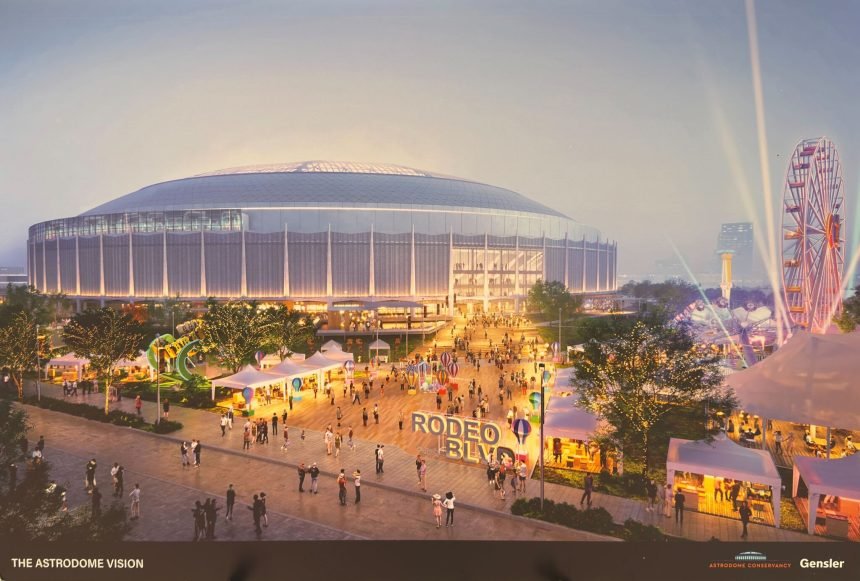
The organization has unveiled a development concept outlining various adaptive-reuse scenarios for the Astrodome, illustrating its potential as a flexible, revenue-generating, multi-use civic destination.
Article continues below this ad

The Astrodome Conservancy, in partnership with architectural firm Gensler, revealed renderings of what NRG Park could look like in the future.
“The components of revenue generation … hotel, office space, venue rental, ticket sales, concessions and merchandise—all the stuff that comes with an arena,” Bobby Tudor, CEO, Artemis Energy Partners, said in a financial presentation on Wednesday.
Tudor then pointed out other, more provocative uses of a revamped Astrodome space.
“The possibility of using some meaningful portion of this huge space for data farming, data generation and storage,” said Bobby Tudor. “All of those we see as attractive revenue sources here.”
Article continues below this ad
Other proposed opportunities included a NASA Center in partnership with Space Center Houston, aimed at bringing STEM education and exposure closer to Houston’s core. Using the Astrodome as a film stage for production studios was also proposed, given the state’s tax incentive for filming in Texas.
The renderings shown on Wednesday are simply ideas at this point, but it’s clear that many in the room feel that the time is now to act on behalf of the Astrodome.

Film stage? NASA Center? Indoor retail hub? The Astrodome Conservancy highlighted the potential of the revitalized stadium in renderings on Wednesday.
“The question is no longer whether the Astrodome can be reused—it is whether we have the resolve to act,” Phoebe Tudor said in a statement. “By convening the development and investment community at Market Day, we are demonstrating that the opportunity is real and that the Conservancy is prepared to help move this project into its next phase. The blueprint exists. The opportunity is real. Now comes the choice.”
Article continues below this ad
The choice entails a substantial cost, as the Conservancy’s ultimate goal is to solicit feedback to help inform a forthcoming Request for Information (RFI) as partnership structures and investment strategies take shape.
“The project put forward here by the Conservancy envisions a total project cost of around $840 million,” said Bobby Tudor. “Now that is a lot of money. It’s a big project.”


The Astrodome Conservancy, in partnership with architectural firm Gensler, revealed renderings of what NRG Park could look like in the future.
The Conservancy’s pitch to Harris County and investors leans heavily on a historic tax credit program that allows developers to claim a combined 45% on rehabilitation expenditures for income-producing historic properties.
Article continues below this ad
“A project at this scale would receive somewhere on the border of $300 million in state and federal cash infusion claimed over five years after project initiation,” explained Bobby Tudor. “$210 billion can be used for private development components. $90 million for the arena, $210 million for the commercial component.”

The Astrodome Conservancy, in partnership with architectural firm Gensler, revealed renderings of what NRG Park could look like in the future.
Those tax credits would cover over one-third of the proposed Astrodome renovation but still leaves a massive chunk remaining that could be covered by Harris County or private investors. As elections continue at the county and state levels, new officials in key seats will have their say in advocating for the use—or denial—of public funds to support the project.
An alternative is the demolition of the Astrodome, which would cost $55 million, according to a commissioned study by Kirksey Architecture. However, razing such a historical landmark wasn’t a real option for anyone in the old Sears building on Wednesday.
Article continues below this ad
“Would you do that to the Alamo? Did we wipe the stockyards up in Fort Worth? Would we do that to the San Jacinto Monument just east of here? This is the level of significance where the Astrodome sits,” said Jackson. “The St. Louis Arch, which is a national historic landmark, was built the same year by the same design team as the Astrodome. We can do the same here. It has value.”