As backlash to education technology continues to grow across New York City, dozens of Upper Manhattan public schools came together over the past week with a fresh twist on an old idea:
No screens in the classroom.
Thirty-eight public schools across District 6, which covers Hamilton Heights, Washington Heights and Inwood, participated in a parent-led initiative dubbed “Screen Break.”
As part of the experiment, which had the backing of the district superintendent, teachers were encouraged to limit screen use in the classroom and to set aside unstructured time for movement and play. Outside of school, families took part in free programming across the district — from a neighborhood clean-up and book exchange, to improv and arts and crafts.
The response was positive, even from many students.
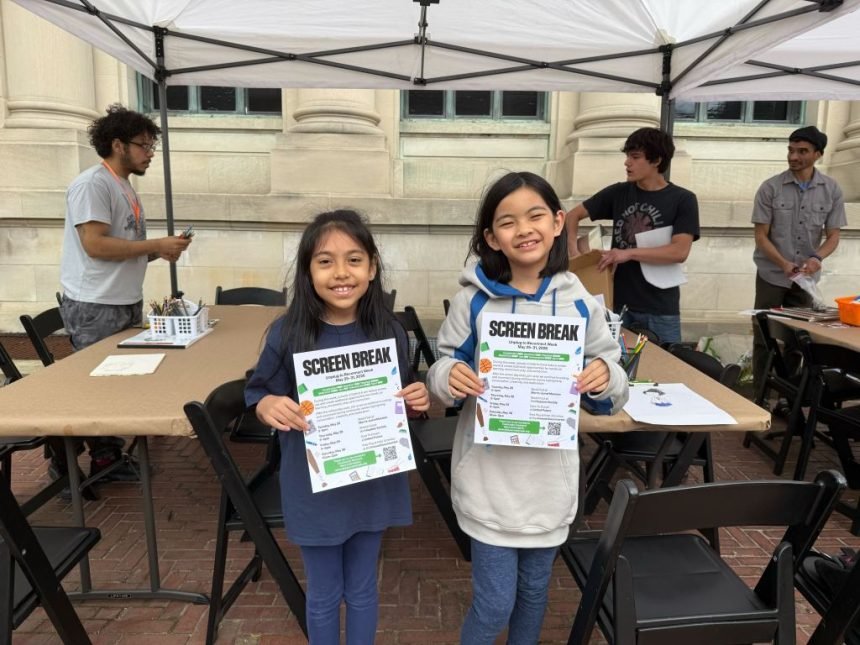
“I think it’s good to not use computers once in a while,” said Elani, a third grader at P.S. 153 Adam Clayton Powell, who attended a sketch class after school on Thursday at The Hispanic Society Museum & Library with her schoolmate Dulce.
Dulce, who’s in the same grade as Elani, agreed. She said she sometimes uses a children’s dictionary to spell words instead of Google when she doesn’t want to use a laptop — or her dad won’t tell her the answer.
“If I watch something for a while, my head starts to get weird. It makes me feel sleepy,” Dulce said. “If the whole world gets consumed with technology, like computers… our brains might become fried.”
“Not like fried chicken,” she quickly clarified.
Cayla Bamberger / New York Daily News
Students attended a sketch class after school on Thursday at The Hispanic Society Museum & Library in Upper Manhattan. (Cayla Bamberger / New York Daily News)
Too much tech?
The screen-free week was the latest example of local parents organizing this school year against the growing role of technology in the public schools. A parent coalition that opposes artificial intelligence, unaffiliated with the Upper Manhattan movement, has protested at City Hall and testified at school boarding meetings for a two-year moratorium.
It also comes toward the end of the first school year of New York’s bell-to-bell cellphone ban, suggesting the concerns about screens in the classroom may go beyond just phones.
The idea for a screen break was first proposed by Olympia Kazi, a parent of two students at P.S./I.S. 187 Hudson Cliffs, who said she’s raising her children to have a “balanced relationship” with screens. She lets the kids, ages 8 and 10, watch television, but almost exclusively on weekends. She’ll make an exception for sick days or school breaks.
But Kazi is increasingly concerned about the rapid growth of screens in education. She said her daughter in third grade has a school-issued Google Chromebook with Gemini AI installed. A teacher told her son in fifth grade that for a drawing assignment, he could use Canva AI, an image generator, instead of relying on his own creativity.
The unease goes beyond AI. Her son also had an assignment to play Prodigy Math, a video game where kids answer adaptive math questions to win battles and complete quests. “I saw what he was doing, and then I realized that he could buy one of the accounts,” Kazi said. “I was like, this is in the public school?”

Cayla Bamberger / New York Daily News
Olympia Kazi, a parent of two students at P.S./I.S. 187 Hudson Cliffs, first proposed the idea for a screen break. (Cayla Bamberger / New York Daily News)
For Kazi, the final straw was a news article in March about today’s children falling behind their parents’ generation. She wrote a letter to her superintendent, Renzo Martinez, and Chancellor Kamar Samuels.
“In the letter, I was saying, here I am today reading yet one more article about this. And you know what? I don’t want to lament. I want to do something about it. Can we do something?” Kazi said Martinez responded within the hour.
Breaking the addiction
The district-wide screen break was scheduled for after computer-based state tests and a short school week, when students already had off for Memorial Day and Eid al-Adha. On school days, some principals reorganized class schedules so that children could have a “double recess,” with more time to get outdoors or play. In older grades, teachers led discussions about technology and its role in students’ lives.
Emily, another P.S. 187 parent who spoke on the condition that her last name be withheld, said all the teachers, according to her children, embraced the screen-free week. Some used a white board, instead of a Smart Board. And her kids in different grades got to spend more time with each other in the school’s garden, a program that she feels is under-utilized.
“They might’ve groaned a little at the beginning of the week,” Emily said of her kids. “Because, of course, screens are very addictive. And they serve a role. But they were so happy when I picked them up.”
In a statement, a rep for the city’s school system said the initiative reflected a “shared commitment to supporting the whole child.”
“We appreciate the collaboration taking place in District 6, where families, educators, and community leaders are working together to thoughtfully explore innovative ways to support student well-being and engagement,” said the spokeswoman, Chyann Tull.
Kazi wants there to be more “screen breaks” in future school years. But she also hopes the week-long experiment can serve as an opportunity to reflect on the surge in children’s screen time during the COVID-19 pandemic when schools pivoted to remote learning, and question if it’s still beneficial.
“This was about a pause for reflection,” Kazi said. “We may be doing things that (are) not useful and also without thinking.”