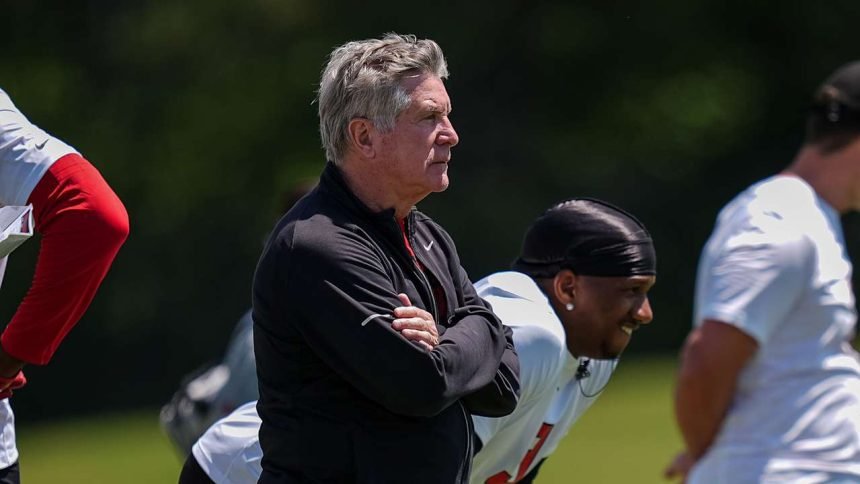
As Callahan seeks to keep the production going, he is still looking for ways to introduce new ideas and techniques to the group. Even the best routines can use a shakeup.
But there is nuance to how Callahan approaches his teaching method. He tailors the approach to the individual player; a conversation with Matthews will look very different than one with rookie Ethan Onianwa.
“I don’t want to confuse the young guys, so I don’t give them too much,” Callahan said. “But I also want to be able to challenge the older vets with some new information, maybe things that they haven’t heard or things that they haven’t done before.”
Callahan speaks a language that cuts through to both a veteran who has seen it all and a rookie learning for the first time: Results. The list of players Callahan has worked with throughout his career is long and distinguished, including a litany of All-Pros like Nick Mangold, Zack Martin and Joel Bitonio.
“The guys will chuckle a lot because he’s always got some type of memory or a throwback with a Hall of Fame player, and it’s like, ‘Yeah, you definitely know what you are talking about,'” Matthews said.
Achieving success with a five-man unit requires more than just one or two Pro Bowlers, however. More than perhaps any other position group in football, the offensive line relies upon having no weak links. Callahan has had a hand in building some of the best offensive lines this century, and he’s done so by developing players to ensure the entire chain is strong.
That is a focus of his as he nears his first training camp in Atlanta. Helping a late-round draft pick or undrafted free agent grow into a starter or quality depth piece can have multiple positive impacts for a club. Not only does it reinforce a competitive culture that rewards improvement, but it also allows money to be spent on other positions.
The Falcons offer a good internal example of successful development. Drew Dalman was a fourth-round pick in the 2021 NFL Draft. After learning as a backup during his rookie season, Dalman entered the starting lineup in 2022 and remained in that role for three seasons. When Dalman left as a free agent in 2025, the Falcons had groomed undrafted center Ryan Neuzil to take over.
Atlanta did not need to use a draft pick to try and find Dalman’s replacement, and it did not have to pay top dollar to keep him in-house or bring in a veteran free agent. Those assets could be used on other positions.
“The value of developing a young offensive lineman that could play for you, I mean, monetarily, it just helps everything,” Callahan said. “Helps the cap, allows you to go get a better player at the skill position. The more we can develop in that area, not expend on a higher pick, that’s what everybody’s shooting for, ideally.”
During the team’s second OTA practice open to the media, another Falcons center earned a growth opportunity. Undrafted free agent James Brockermeyer, who played for Alabama, TCU and Miami in college, ran with the starting offense while Neuzil and other veteran centers were out. He made a good impression on his position coach and Callahan likened him to an air traffic controller who “landed all the planes safely.”
This part of the NFL calendar, during which contact is prohibited, isn’t ideal for offensive line evaluations. Developing good players — and good offensive lines — requires intense competition.
Callahan will get a truer picture of how his group is shaping up when training camp begins in July, and the competition can begin in earnest. That is when he’ll be able to push the veterans and pour into the younger players, strengthening the chain for the season to come.