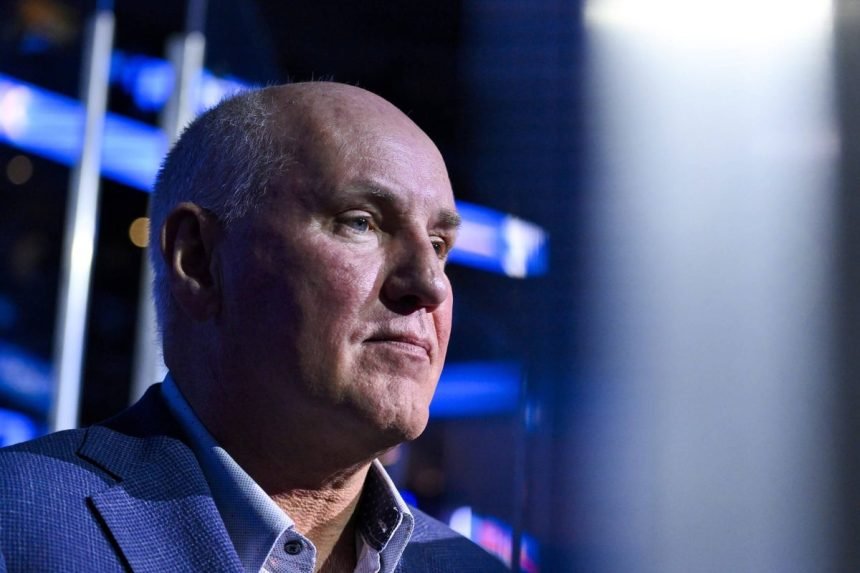
BUFFALO, N.Y. — Doug Armstrong has just two events left on his calendar before his run as the NHL’s longest-tenured general manager will come to an end.
After the NHL Combine in Buffalo this week and the league’s draft June 26-27, Armstrong will give way to Alexander Steen as St. Louis Blues GM on July 1.
While the to-do list is limited, it looms large.
With the Blues having three first-round picks and 12 total in the draft, there’s a lot of prep work for Armstrong and his staff at the combine. And with the possibility of the team trading current key roster players this offseason, it’s a particularly critical period for the franchise.
“It’s a massive month for the Blues,” Armstrong told The Athletic. “The number of picks we have, and it’s a deadline league, and the trade deadline is probably at the draft. We understand the magnitude of this draft.”
Since the end of the Blues’ season in April, fans have been in hurry-up-and-wait mode. The Athletic has made roster projections and even lineup projections for the 2026-27 season. But at this point, even Armstrong and Steen can’t tell you how it’s going to play out.
“You prepare for the opportunities, understanding that there might be none,” Armstrong said.
The Blues have picks Nos. 11, 15 and 29 in the opening round. There’s been great speculation already about what it might take to trade up, perhaps as high as the San Jose Sharks’ pick at No. 2.
Ivar Stenberg, a highly rated winger and the younger brother of the Blues’ Otto Stenberg, could be available there.
Armstrong, who typically has a good pulse of the fans, would like to appease them by uniting the brothers, right?
“Yeah,” he said, laughing. “I think it was George McPhee who said, ‘Once you start thinking like the fans, you become one.’”
Kidding aside, what is the Blues’ interest level in trading up?
Armstrong didn’t downplay the possibility but said, “The only way we can move up is if somebody wants to move back. So you’re at the rhythm of what other teams are trying to accomplish.”
And historically, this far out from the draft, it’s not yet known what the teams holding those picks are trying to accomplish.
“In my experience, this trading up and trading back right now is more media-driven,” Armstrong said. “These things don’t happen until maybe 48 hours before the draft, when all the information is in.
“Now, I’ll say that, and then one of the top two picks will be traded in an hour, but those happen way closer to the draft. So I don’t put a lot of stock into the moving up or moving back until you almost get to draft week.”
This summer, there’s perhaps even more uncertainty, with mock drafts showing a variety of players high on the board.
“If you look at the mocks, you probably have seen seven or eight players going anywhere in the top five,” Armstrong said. “That’s different (than other years).”
So, if the Blues are eyeing a player who’s projected to go in the top five, they may have to wait until draft night before making a move.
Armstrong said the team puts players into blocks and will only trade up if someone in a higher block is still available.
“Let’s say the block is five players and they’re all gone, we’re not moving up to No. 6 no matter who the sixth guy is,” Armstrong said. “Because if we think the block of players between Nos. 6 and 11 are the same, we know we’re going to get one guy in that block.”
It’s also too soon, Armstrong said, to know whether the Blues will be trading one or more of their top players.
The Athletic’s offseason trade board recently included four players from the Blues’ roster: Jordan Kyrou, Jordan Binnington, Robert Thomas and Colton Parayko.
When asked about the current market for them, Armstrong said, “That’s a June 20 question, not a June 1 question. People don’t make decisions this early. Even if I wanted to answer that question, I couldn’t because nobody knows. It’s three (more) weeks before it gets serious.”
But as Armstrong said, the draft could act as a pseudo trade deadline, so it could get serious soon. The picks are potential assets that could be used in a trade before the draft.
For months, Armstrong has indicated that Steen will be making those calls, and he repeated that Tuesday.
“I don’t want to say Alex has the ‘final’ say, because I don’t know if we ever have a final say, but his input on that is greater than mine,” said Armstrong, who will remain as the team’s president of hockey operations. “Any roster decisions of that magnitude, the questions from (other general) managers will run through me, but the answers will run through Alex.”
It’s been well-documented that Kyrou, Thomas and Parayko each possess a full no-trade clause and Binnington has a modified NTC, which drops from a 14-team no-trade list to 10 teams on July 1.
That may remain a challenge, as the Blues witnessed last March when Parayko invoked his NTC to nix a trade to the Buffalo Sabres.
Now that the season is over and players have had time to digest a potential move, not just Parayko, does that mean there’s a greater chance of them waiving their NTCs?
Armstrong doesn’t see it that way.
“Ultimately, you have to make a decision,” he said. “The way that we have operated — right, wrong or indifferent — is once we’re comfortable with the trade, then we go to the player and they make their decision. I’m saying this from management’s perspective, and it’s just my opinion, but I believe that NHL players have a lot more depth than (only being able to make a decision in the offseason).
“I just think when it’s presented, they make the decision. It’s a decision that they either want to exercise the right that they’ve 100-percent negotiated, and we 100-percent respect, or they view it differently.”
So there seems to be a wide range of potential outcomes for the Blues’ offseason: 1) Trade up in the draft or make all three first-round picks; 2) Trade a key roster player or return with the same group; 3) Sign free agents or stay out of that market.
“I can certainly see a path where we pick 11, 15, 29, and we get to July with the same team,” Armstrong said. “Maybe you get to mid-July, where teams missed on free agency and then Alex has to decide what to do on trades, and then he and I will work on that. But Alex and I are planning to be as active as other people around us want to be.”
Whether they’re active in free agency will depend on what they accomplish before July 1.
“It’s a fencepost thing,” Armstrong said. “Once the draft is over, we’re going to know what we did at the draft. If we made all of our picks and have all of our players, free agency becomes a less likely scenario. We run through many different scenarios, but I don’t spend a lot of time in the gray area. When it’s not black and white, we’ll react to it.”
In the meantime, Armstrong and Steen will continue laying the groundwork. The frequency of their conversations is comparable, Armstrong said, to his days alongside coach Ken Hitchcock.
“I talk to Alex a few times a day, and these aren’t just conversations where he’s learning things,” Armstrong said. “It’s me asking what he wants to do. That’s how I view my job now: How can we all serve Alex to make sure he can be the best GM that the Blues can have?”
The events in which Armstrong will be in charge are dwindling.
“I would say since the season ended, I’ve had times of reflection,” he said. “I’m going to miss being a GM, for sure. I love doing this job, but I know it’s the right time for the organization. It’s been an interesting six to eight weeks, but I think those feelings are going to go away now because we’re all just laser-focused on the draft and there’s no time for emotion now. But yeah, I’m interested to see what July 1 looks like.”
As are Blues fans.