Game Creek Video’s Flagship A, B, C, and D unit will wind up its first year on the road at Madison Square Garden
Partying like it’s 1999 is the most apt way to describe the 2026 NBA Finals, which offer the New York Knicks and San Antonio Spurs in a rematch from that long-ago year. For this year’s championship, airing on ABC, ESPN will deploy workflows that weren’t readily available 27 years ago, including a near end-to-end 1080p HDR production plan and a complete ST 2110 signal flow to all participating broadcasters.
“The 2025-26 NBA on ESPN was a season of many changes,” says Eddie Okuno, director, specialist operations, ESPN, noting “the launch of HDR, partnerships with new media rightsholders, and a new cadence of playoff games. Our operations and technical team thrived and excelled through it all, so we’re very proud of everyone doing their part and beyond in making this season so successful.”
Flagship-Supported Finals: GCV Mobile Unit Leads Fleet of Trucks
This year’s NBA Finals will serve as an acknowledgment of one of the workhorses in the broadcast compound: Game Creek Video Flagship. Having debuted during last year’s NBA Playoffs, it was heavily featured during the Indianapolis leg of the 2025 NBA Finals. The truck became the core mobile unit for ESPN’s coverage of Monday Night Football and the NFL Playoffs before heading to Phoenix for the 2026 Women’s Final Four in April. It stopped in Pittsburgh for the 2026 NFL Draft three weeks later and is currently parked at Knicks’ home Madison Square Garden for Games 3, 4, and, if necessary, 6.
“Game Creek Video Flagship and its staff that supports the fleet have been outstanding,” says Okuno. “Flagship was purpose-built with a large IP infrastructure scale but with flexibility to support all the ESPN productions it has touched since launching about a year ago.”
Flagship is one of many Game Creek Video mobile units being deployed for the championship round. In the first-ever broadcast compound with full ST 2110 signal flow for all rightsholders in sync in 1080p HDR, the production teams at MSG and at San Antonio’s Frost Bank Center will have their own dedicated fleets.
In San Antonio for Games 1, 2, and, if necessary, 5 and 7, GCV Varsity A will handle game production and main audio/video control; Varsity B will handle replay and media management, traditional game graphics, and wired-sound editing; Justice the game’s submix, lead production for programming on ESPN Deportes, and ESPN’s alternative broadcasts; and augmented-reality/virtual-reality/mixed-reality graphics; Edit 2 game communications, audio for SportsCenter With Scott Van Pelt, and helping with ESPN Deportes programming; Magic A and B onsite editions of Inside the NBA; and Gotham NBA’s world-feed production.
ESPN’s effort at Frost Bank Center is managed by Remote Operations Producer II Christine Rouskas, Senior Remote Operations Producer Johnathan Williams, Senior Remote Operations Coordinator Luis Manuel Lopez, Remote Operations Specialist Zaac Christopher, and Senior Remote Operations Producer Justin McIntosh.

In New York, GCV Flagship A is responsible for engineering and game audio; Flagship B game production and both traditional and virtual graphics; Flagship C replay and media management, programming on ESPN Deportes, and ESPN’s alternative broadcasts, virtual ad signage, and wired-sound editing; Flagship D game communications and transmission and remote traffic; Bird A/B Inside the NBA and SportsCenter With Scott Van Pelt; and Celtic and B4 NBA’s world-feed production.
ESPN’s effort at Madison Square Garden is managed by Senior Remote Operations Producer Kelley Nagi, Remote Operations Producer II Jason Dorsey, Senior Remote Operations Coordinator Matthew Garrison, Senior Remote Operations Specialist Alan McDonald, and Remote Operations Specialist Tommy Clark. Remote Operations Coordinator I Kimberly Conrad, Recurring Remote Operations Producer II Scott Garifo, and Recurring Remote Operations Producer II Erik Guyton will be stationed in both cities.
Each compound will have its own infrastructure. In San Antonio, the compound — located 1,150 ft. from the venue’s traditional site — is powered by CES 4X 500-kW generators and two 175-kW towable plant generators and has 504 strands of temporary fiber, 10 SMPTE homeruns of 1,150 ft. each, and copper audio backup.

In MSG’s traditional compound, CES 4X 500k-W generators work alongside office workspace relocated to the MSG Theatre and offsite office space in rental locations and hotel meeting rooms. This specific compound will be deconstructed after Game 4; if the series goes to Game 6, all trucks and generators will be reparked on Monday, June 15 at 3 a.m. for the game at 8:30 p.m. on Tuesday, June 16. After that game, that setup also will be torn down to make way for tech installation on Friday, June 19 at 7 a.m. for two days of Goose concerts.
Besides the operations teams, key personnel include, on the crewing side, Supervisor, Crewing, Candice Morales; Crewing Coordinator II Stephanie Cannon; and Crewing Coordinator I Max Morales. In remote traffic, Manager, Remote Traffic Operations, Daryl Timothy; Remote Traffic Operations Coordinator II Christopher Baylis; and Senior Remote Traffic Operations Coordinator Neang Ne. For mobile-unit operations, Senior Remote Mobile Unit Operations Coordinator Vicki DiTolla and Senior Manager, Remote Mobile Unit Operations, Liza Cole.
Tech Toys: Two Debuts in EVS 4K PMX Replay, Fujifilm 4K Lens for 52-Camera Show
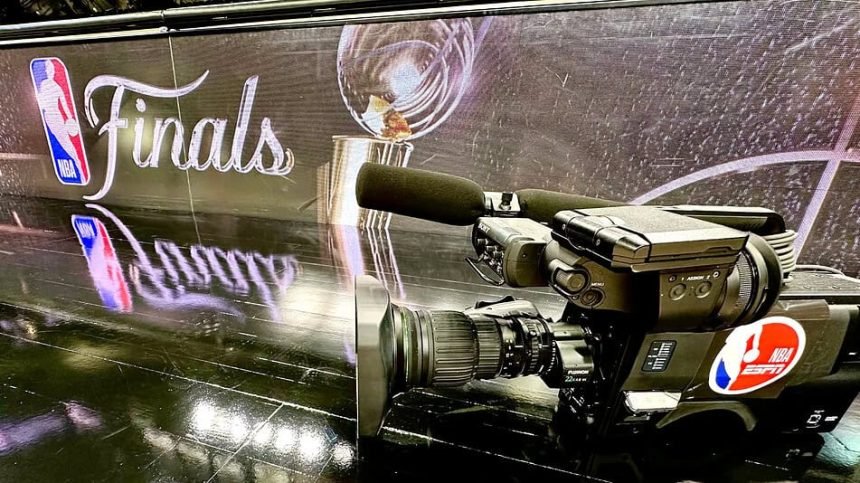
ESPN’s playoffs coverage will culminate in the lifting of the Larry O’Brien Trophy. Resources from previous rounds will be ready to go for the best-of-seven series, and the overall camera count will hover just above 50 with 52 video feeds. Ancillary feeds will be coming from activations like watch parties around the world and military flyovers, but at the crux of ESPN’s camera complement are14 1080p HDR cameras that are high-frame-rate (HFR) and super-slow-motion, four cameras in native 4K at 240-fps HFR capture, a Skycam at 4K HFR, an aerial drone, and a shallow–depth-of-field camera with a Canon EOS C80 cinema camera and a compact full-size sensor chip that offers internal HFR super-slow-motion recording with playback over RF. An addition to the arsenal is the Fujifilm/Fujinon 22×4.8mm 4K lens. For the duration of the series, this piece of hardware will be fixed to a court-level handheld camera to the left of the basket.

A handful of workflows from EVS drive the replay portion of each broadcast. First, the new 4K PMX replay servers — comprising four EVS PAM 4K processing and media management — will have the ability to zoom on all four 4K sources for close-up shots for replay review. EVS XtraMotion will continue to be a mainstay on the production. For the Finals, this includes 120 1080p HDR EVS VIA record and replay channels and being available for all games to four of the package-building machines. Creative Mobile Solutions is assisting as the backbone of media management, HDR-media quality control, and transport to all rightsholders and end users.
On the audio side, the broadcasts will capture the raucous crowds in both cities. This will be done via two Calrec Argo Q consoles, Q5X Axient Digital Player Mic X and coach mics, Shure DCA 901 digital microphone array, Soundfield digital surround mics, Holophone, Neumann digital cardioid condenser mics, and Sennheiser shotgun cardioid condenser mics.
“Our approach to our audio presentation is balanced within the overdriving PA and ambient crowd sound,” says Okuno. “Announcers and reporters are always front and center with specialized effects mics giving our audio mixers the tools they need to create the most immersive audio experience possible.”
Diving Into the Format: An Almost Wholly 1080p HDR Production
Support by the reliable broadcast compounds, ESPN looks to continue down the path of 1080p HDR. Nearly its entire production chain is running in the format: signals from the venue to remote staffers in Bristol, CT; internal signal flow in Bristol; and delivery to ESPN’s streaming platforms and the ESPN App. The sole workflow in 1080p SDR is linear transmission and integration on ABC.
“We will be operating at about 90% onsite production,” adds Okuno. “We are utilizing our new EVS media rooms in Bristol for replay and Libero strategy operators with Libero Producer at home. Full network IP connections from Bristol EVS VIA controllers will use XClient to connect to Game Creek Video Varsity or Flagship EVS VIA servers.”

The push toward elevated HDR workflows has improved graphics output. New York and San Antonio will each receive its own traditional and augmented-reality/virtual-reality graphics kits. They will include seven Viz Gen 5 v5.5 units from NEP Rentals, which have been upgraded to support HDR for the past three months, to support ESPN Creative Services in executing game font, scorebug and AR/VR implementations on Skycam, drone, and the shallow–depth-of-field camera.
Spearheaded by ESPN Supervising Real-Time Graphics Developer Brad Griswold and NEP Group Engineering Manager John DeSilva, the playoffs-long workflow of more than 30 units upgraded the broadcaster’s HDR pipeline to reduce the hardware needed inside the truck and reduce QC checks. Virtual signage and ad insertion will be driven by SMT for production elements like real-time shot-distance markers. This downstream workflow has increased signal stability and reduced latency of real-time programming to a quarter of a second.
Detailed Approach: Highlighting Nuances of the NBA Finals
On any broadcast, there are both technologies that make headlines and smaller workflows that aren’t as flashy but are still as important to the show. On a production as massive as the NBA Finals, smaller details can become magnified when the eyes of the world are watching. ESPN is enhancing the smaller and sometimes overlooked aspects of a show: improving its customary black-and-gold graphics package and showing elements like the singing of the National Anthem and player introductions. Creatively, each game will have a unique show open. Although each open will be different, they will collectively celebrate the achievements of the game’s biggest superstars on the game’s brightest stage.
“Many memorable moments have happened during the NBA Finals,” notes Tim Corrigan, SVP, production, ESPN. “It has been a fun history project that a large group of us have been involved in.”

Along with capturing the pomp and circumstance of the most important series of the NBA season, the regular season has provided a slate of lessons for production. For regular-season games that are split among ESPN and the teams’ respective broadcast outlet, the national network is accustomed to specifying camera positions and ample space for its technologies within the building. As the number of teams remaining in the playoffs began to dwindle, Corrigan and his team visited arenas to sketch out a plan of attack, and, although Madison Square Garden has a more intimate feel than other venues around the league, the building itself will not be a hindrance.
“There’s nothing about Madison Square Garden that will prevent us from doing exactly what we want to do on-air,” he says. “We’ve been thrilled with the energy we’ve felt in games at MSG and the excitement from fans around the city.”

From technical and operations to production and creative, the 2026 NBA Finals — a rematch of two teams that battled at the cusp of the new millennium — is a special project to work on. Having worked numerous championship series, Corrigan speaks for the entire team when he says how lucky he is to be a part of this show.
“This is a highlight for us every year,” he adds. “It’s the kind of thing you dream about working on. It’s an honor and a privilege to take on the responsibility of producing the NBA Finals.”
After tonight’s Game 1, the 2026 NBA Finals on ABC will adhere to the following schedule with every tip-off at 8:30 p.m. ET: Game 2 on Friday, June 5; Game 3 on Monday, June 8; Game 4 on Wednesday, June 10; and, as necessary, Game 5 on Saturday, June 13; Game 6 on Tuesday, June 16; and Game 7 on Friday, June 19.
SVG’s Jason Dachman contributed to this article.