As fans prepare to fill stadiums for the 2026 FIFA World Cup from Los Angeles to Miami, a familiar question remains: Will U.S. soccer finally recognize the Latino players, fans, and cultural traditions that have sustained the sport for generations?
Latin American players and fans have always been essential to soccer’s growth here. They have also always been pushed away by teams and owners who couldn’t quite accept Latinos as Americans. The story of the Los Angeles Aztecs, a 1970s-era franchise, gives insight into a decades-long cultural struggle that still haunts American soccer.
Fútbol first came to the Americas in the 19th century, when British sailors brought the game to Latin American port cities like Buenos Aires. What began as an elite pastime quickly spread into everyday life. Soccer’s simplicity made it easy to play anywhere, allowing working-class and immigrant communities to adapt it and make it their own. By the 20th century, Latin American fútbol became a powerful symbol of identity. Today the game remains an enduring passion. Streets empty during major matches, families gather to watch, and entire nations celebrate or mourn together.
Things are different in the U.S., where European immigrants introduced the sport, forming local clubs tied to ethnic communities that remained largely outside the American sports mainstream. But here, too, fútbol thrived in Latino neighborhoods through informal play, local leagues, and strong ties to home country teams. As Latino populations grew in cities like Los Angeles, Houston, and New York, so did soccer’s popularity. But the sport only began to go mainstream in the U.S. in 1967, with the creation of the North American Soccer League, or NASL, which aimed to build a “major league” version of fútbol defined by growth in teams, visibility, and spectators.
Enter the Los Angeles Aztecs. In 1974, hoping to tap into the Latino market, real estate millionaire and medical doctor Jack Gregory launched the team, intentionally named to invoke Mexico’s pre-Columbian heritage and connect with Southern California’s large Mexican fan base. The team rode the wave of a working NASL strategy all the way to the top.
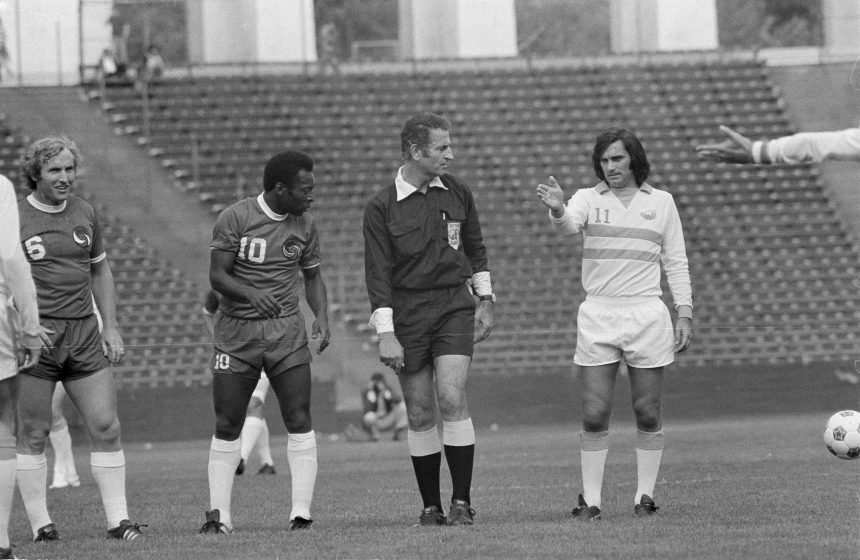
NASL broadcasts on major television networks performed well. Pelé’s debut for the New York Cosmos, in June 1975, drew over 21,000 spectators in person and an estimated 10 million viewers on TV, one of the largest soccer audiences in U.S. history. During the NASL’s so-called “Golden Era,” from roughly 1975 to 1980, league-wide average attendance exceeded 13,000 spectators per match. The league expanded to 24 teams, and it showcased major Latin American and global icons, including Hugo Sánchez, Carlos Alberto, and Teófilo “El Nene” Cubillas. It intensified outreach to Spanish‑speaking fans, a key potential audience, executives believed.
You Might Also Like
The Aztecs assembled what their original coach, Alex Perolli, described as a “polyglot team,” with players from Argentina, Brazil, Trinidad, Uruguay, Mexico, and the U.S.; the team actively recruited Mexican and Mexican American talent, including UCLA star José López, Santa Ana native Sergio Velázquez, and local standout Miguel López. The club’s first match, on Cinco de Mayo at East Los Angeles College Stadium, began with a “Día de los Niños” celebration, with free jerseys distributed to the first 2,000 attendees. Before kickoff, spectators watched performances by Mariachi de Panchito Peña, Ballet Folklórico, and even an acrobatic motorcycle troupe.
Winning the NASL Championship in its inaugural season, defeating the Miami Toros in penalty kicks, the Aztecs seemed poised to succeed. But though East Los Angeles was accessible to Mexican American fans and deeply connected to local soccer culture, average attendance hovered around 5,000 spectators per game—far below the 10,000 owners believed was necessary to break even financially. Team officials began blaming the club’s East Los Angeles location, with one Aztecs executive suggesting that “people were fearful of coming to East Los Angeles.”
Anglo perceptions of East L.A. shaped the franchise’s business decisions even as the club relied heavily on Mexican American supporters. Two Argentine players filed a $1 million lawsuit against Gregory, alleging he reported them to immigration authorities during a contract dispute. Exposing the precarious position of foreign-born players in the NASL, the lawsuit cast a shadow over the Aztecs’ image at a moment when the franchise was already struggling to expand attendance.
After the championship season, businessman John Chaffetz purchased the team and moved the franchise from East Los Angeles to Torrance, a predominantly middle-class white community. New coach Terry Fisher sought to reshape the roster by recruiting more American college players, telling reporters that his players “must speak English so that they could understand his instructions,” and openly criticizing the club’s earlier ethnic marketing approach. “Too much emphasis on the ethnic groups doesn’t mean success in my book,” he told the New York Times. The Aztecs transformed from a predominantly Latin American team—with 15 Latin American players on the 1974 roster—to no Latin American representation on the squad by the 1977 season.
Around the same time, the NASL instituted the so-called “4-American Rule,” requiring U.S.-born players to remain on the field at all times while increasing the quota of “American” players on active rosters. Many saw the move as part of a broader effort to distance professional soccer from its immigrant and ethnic roots. Latino criticism was swift. In a 1978 article in the magazine Nuestro, coach Horacio “Ric” Fonseca, formerly of Los Angeles Mission College, accused the NASL of systematically pushing out Latino athletes. Citing league rosters, Fonseca noted that the league now employed only 15 Latino players (but more than 400 players from England). U.S.-born Latinos, he argued, were viewed as insufficiently “American” as league executives increasingly privileged English fluency and an “English style of play,” coded language for recruiting more Anglo or white players. In one notorious incident, players on the Philadelphia Atoms refused to play alongside Mexican recruits, deriding them as “Mexican scrubs.”
Aztecs attendance languished, down to 6,000 fans per game in 1979. The team soon folded, as did the NASL.
In decades that followed, soccer bounced back. The FIFA World Cup debuted in the States in 1994, and Major League Soccer (MLS) launched in 1996. Latin American players and soccer culture continued to exert strong influence on the game, “driving higher engagement than ever before.” According to Nielsen, as of September 2025 “Hispanics were 39% more likely to be avid MLS fans than the general population.” Stars such as Mexico’s Carlos Vela, Venezuela’s Josef Martínez, and Argentina’s Lionel Messi are major draws for fans. MLS has increasingly institutionalized its connection to Latin American soccer, operating within a larger hemispheric soccer system historically dominated by Latin American leagues.
And yet the 2026 World Cup, set to begin in Mexico City this Thursday, June 11, faces the same old paradox. The 2026 North American bid to host the tournament—shared by the United States, Mexico, and Canada—promoted a message of continental “unity,” but FIFA’s leaders have stoked tensions, sidestepped concerns about ICE raids, and focused instead on corporate and political partnerships. During the 2025 Club World Cup in Miami—a tournament widely viewed as a test run for 2026—federal agents arrived at a kickoff-event boat party and questioned attendees about immigration status. They also maintained a visible presence near stadiums. Immigration officials advised noncitizens to carry proof of legal status at all times.
If the World Cup is to fulfill its promise of unity, it must do more than fill stadiums. It must heed lessons of the past to ensure that Latino communities who built the sport in the U.S. are not made to feel like outsiders in their own game.
José M. Alamillo is professor of Chicana/o Studies at California State University, Channel Islands and author of Deportes: The Making of a Sporting Mexican Diaspora.
José Luis Collazo Jr. is an assistant professor of Sociology at California State University, Channel Islands, who writes frequently on immigration and social inequalities affecting Latin American communities.
Primary editor: Eryn Brown | Secondary editor: Talib Jabbar