Image credit:
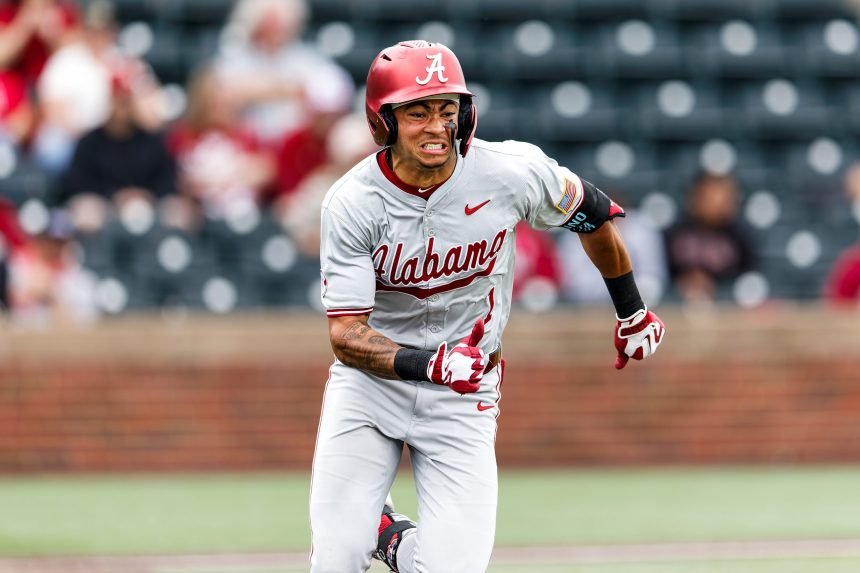
Justin Lebron (Photo by Eddie Kelly)
After a long and winding road to Omaha, the 2026 College World Series field is set. That means college baseball’s brightest stage is about to host some of the best 2026 MLB Draft prospects in the sport.
This year’s College World Series field looks much different than last season’s. None of the eight teams in Omaha reached the College World Series in 2025, and only two of Baseball America’s Top 20 prospects for the 2026 MLB Draft are still playing: Texas outfielder Aiden Robbins (No. 18) and Alabama shortstop Justin Lebron (No. 19).
While it may not be a top-heavy field of 2026 draft prospects, there’s some intrigue hiding under the surface. West Virginia has Baseball America’s No. 1 college prospect in the 2027 class, Gavin Kelly, and three of Baseball America’s five Freshman of the Year finalists—Texas’ Anthony Pack and Sam Cozart, and North Carolina’s Caden Glauber—are also in the field.
These teams are also plenty deep. Georgia, North Carolina and Oklahoma each have seven players who rank among Baseball America’s Top 500 draft prospects, while Ole Miss and Texas trail close behind with six apiece. The Tar Heels, in particular, have a deep group of names who could be called within the first five rounds of the draft, including No. 73 Owen Hull, No. 87 Ryan Lynch, No. 90 Jason DeCaro, No. 91 Jake Schaffner and No. 96 Gavin Gallaher.
Only Troy, the Cinderella of the tournament, enters without a BA 500 prospect, though catcher Jimmy Janicki ranks prominently in the 2027 college list.
Below, you can find scouting reports on the top-ranked prospect for each team in the 2026 College World Series field, as well as a slew of draft rankings exclusively for Baseball America subscribers.
Interested in signing up? You can do so here.
Related Content
Alabama
Justin Lebron, SS
BA 500 Rank: 19
BA 500 Scouting Report: Lebron was an unheralded prospect coming out of Florida, but burst onto the scene with Alabama with strong freshman and sophomore seasons. He’s a career .327/.425/.593 hitter, and in 2025 homered 18 times with 18 doubles and 17 stolen bases, all while making a second straight All-SEC defensive team as the team’s starting shortstop. A 6-foot-2, 180-pound righthanded hitter, Lebron has loud power and speed tools that make him a dynamic player. He feasts on fastballs and can handle velocity, but will need to clean up his contact skills and pitch recognition vs. secondaries. Defensively he’s a no-doubt shortstop and could be a plus defender at the position. He’s got an easy plus arm to go with the athleticism that allows him to make acrobatic, highlight-reel plays.
Related Justin Lebron coverage:
Georgia
BA 500 Rank: 35
BA 500 Scouting Report: Jackson was the primary catcher at Wofford in 2024 as a freshman before transferring to Georgia in 2025, where he was a multi-position slugger who hit 14 home runs albeit with a .218 average. His power has become more impressive in 2026, but he has also slashed his strikeout rate and is hitting for average.
Jackson has shown all-fields power this year, as he’s cleared the batting eye in center field on multiple occasions and is comfortable driving the ball to right field. He matched his 14-homer output from 2025 through just 18 games in 2026. Jackson is more athletic than most catchers. He’s an average runner and an adept basestealer, and he has an average arm. Scouts are less confident in his receiving, as he will clank some balls. He has played in the outfield before, but he’s likely a fringy defender anywhere he will play in pro ball.
Related Daniel Jackson coverage:
North Carolina
Owen Hull, OF
BA 500 Rank: 73
BA 500 Scouting Report: Hull is a physical outfielder with a 6-foot-4, 215-pound frame and an enticing power/speed combination. He spent two years with George Mason, where he hit a combined .351/.462/.537 with 44 steals, then transferred to North Carolina for the 2026 season. Hull’s swing is currently geared more for hard groundball contact but if he’s able to make some adjustments he has the raw power and impact ability to get to more home-run power in games. After playing right field with George Mason, he’s expected to take over center field duties for a Tar Heel program that has recently produced center fielders Kane Kepley and Vance Honeycutt.
From Jacob Rudner’s preseason predictions:
Ole Miss
Cade Townsend, RHP
BA 500 Rank: 29
BA 500 Scouting Report: Townsend was a top-200 prospect out of high school in 2024, but made it to campus at Ole Miss, where he pitched as a starter and reliever in 2025 before sliding into a full-time starter role in 2026. He dominated in his first four outings, before leaving the fifth with some shoulder discomfort, and was one of the most significant up-arrow arms in the country. A 6-foot-1, 185-pound righthander, Townsend attacks hitters with a five-pitch mix. His fastball averages 95-96 mph and has been up to 98. He also mixes a cutter around 90 mph, a slider in the mid 80s with tons of gloveside sweep, a low-80s curveball with 12-to-6 shape and an upper-80s splitter.
Related Cade Townsend coverage:
Oklahoma
Camden Johnson, 3B
BA 500 Rank: 94
BA 500 Scouting Report: Johnson is a speedy infielder who spent two seasons with Wichita State before transferring to Oklahoma for 2026, where his early-season performance catapulted him up draft boards. He’s a 6-foot, 175-pound third baseman and lefthanded hitter who can fly. He’s a bursty, 70-grade runner who gets out of the box quickly and has consistently stolen bases throughout college. Johnson is a lean hitter with a hit-over-power offensive profile. Most of his extra-base hits should come from doubles in the gaps, but he has flashed some pullside power with a metal bat. Johnson has solid body control and actions for third base, but he’s played all over the infield in the past and might have the speed and athleticism to make a strong transition to center field, if necessary.
Texas
Aiden Robbins, OF
BA 500 Rank: 18
BA 500 Scouting Report: Robbins has a tremendous track record of hitting, and in his 2025sophomore season with Seton Hall, his .422 average was good for seventh-best among Division I bats. Overall, he slashed .422/.537/.652 with six home runs, 19 doubles and 20 stolen bases. He then hit over .300 in 26 games with Harwich in the Cape Cod League and transferred to Texas for his 2026 draft season.
Robbins is a 6-foot-2, 190-pound righthanded hitter with a quick bat and solid contact skills. He sticks in the zone nicely and doesn’t expand often, with his loudest contact coming to the pull side—though he doesn’t frequently hit the ball in the air. Robbins is a hit-over-power profile, but his batted-ball data and physical projection do point to more power potential in the tank. Getting the ball up in the air more, especially to the pull side, could lead to more in-game power production. Robbins runs well and is an efficient baserunner who should be able to play all three outfield positions.
Troy
Jimmy Janicki, C/OF
2027 College Rank: 1
Scouting Report: Troy hasn’t had a player drafted in the first two rounds since Michael Felix in 2006, but Janicki could change that in 2027. The 6-foot-4, 225-pound righthanded hitter played third base and hit just two home runs as a freshman, but he began getting to his power with far more frequency in 2026 when he also became the team’s everyday catcher. Janicki has an odd setup with a high handset spaced far from his body, but his exit velocities are among the best in the country and he’s starting to tap into that power far more frequently to the pull side. He’s also got a big arm that could be an asset behind the plate.
West Virginia
Gavin Kelly, C/2B
2027 College Rank: 1
Scouting Report: Kelly flashed impressive hitting traits and defensive versatility as a freshman with West Virginia in 2025, then began tapping into more impact as a sophomore in 2026. A 6-foot, 175-pound righthanded hitter, Kelly has a hitterish look in the box and makes lots of contact with strong swing decisions and very little swing-and-miss in his game. He split his time as a catcher and second baseman in 2026, but also has experience in the outfield.
Related Gavin Kelly coverage: