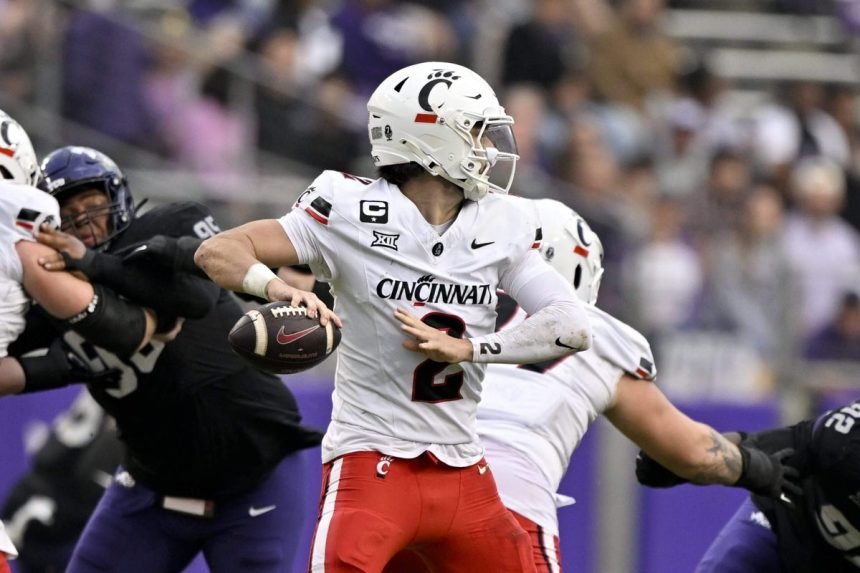
LAS VEGAS — NCAA president Charlie Baker called a judge’s decision to allow Brendan Sorsby to play this season for Texas Tech a “new low,” after the quarterback had previously been ruled permanently ineligible for betting on his own team’s games while at Indiana.
Baker appeared Tuesday at an athletic administrators convention. He met privately with FBS athletic directors before doing a Q&A in a large ballroom, where he was asked about a Texas judge granting Sorsby’s request for a preliminary injunction on Monday. The judge said Sorsby, who committed dozens of violations of NCAA gambling rules during his time at Indiana and Cincinnati, should miss only the first two games of the season while his lawsuit against the NCAA proceeds.
“I spent eight years as governor of Massachusetts, and three years and change in this job. This was pretty much a new low, and I’ll leave it at that,” Baker said. “We’re appealing already, and we’ll pursue every legal avenue that’s available to us. I mean, this is a pretty fundamental issue, and I think the facts can speak for themselves.”
The NCAA has been besieged by legal challenges to its rules over the last few years, many targeting eligibility and transfers.
“The rules on this one (Sorsby case) are pretty clear, and they apply to everybody who plays sports at the amateur and professional level everywhere; but if you think about it, you know three or four of the most challenging issues that Division I faces are all the result of a court case,” Baker said. “And in most cases, it’s one student-athlete, the judge sees that one student-athlete and makes a decision based on that, but the consequences of it ripple all over the place.”
The judge’s ruling keeps the NCAA from taking further action against Sorsby, a prized transfer who was to make up to $5 million this season at Texas Tech. The Big 12 Conference is pondering what it can do to possibly sanction the Red Raiders if they play an ineligible player.
Baker declined to provide any advice for Big 12 commissioner Brett Yormark.
“It is completely up to Brett Yormark to decide what to do with and to his members,” Baker said.
Baker also noted that the Protect College Sports Act, a bipartisan Senate bill that would provide the NCAA and conferences antitrust protections to allow them to enforce rules, would have prevented the Sorsby ruling in Texas.
Baker praised Sens. Ted Cruz, R-Texas, and Maria Cantwell, D-Wash., for their give-and-take on the bill.
“It’s a serious piece of legislation, seeks to solve a bunch of serious problems, and two very serious people from opposite parties are pushing it, and I think that’s a good sign,” Baker said.
The bill is still a work in progress and does not yet have support from the NCAA’s two most powerful conferences, the SEC and Big Ten.
Baker said he hopes the Sorsby situation can help coalesce support for the bill from membership. He said it was a “thunderbolt moment.”
“I mean, so many of the folks that I deal with every day, either through email or text or phone calls, were shocked by this, and I think for a lot of them, it’s going to create a more significant thought process, participation, engagement around where Sen. Cantwell and Sen. Cruz are, and I think that’s probably a good thing,” Baker said.