TIRANA—Since the Trump administration took office in January 2025, observers in the Western Balkans and beyond have wondered whether US policy toward the Southeastern European region would change. For decades under both Democratic and Republican administrations, US strategy centered on support for the region’s eventual European Union and NATO accession, as well as on investments to strengthen democratic governance, energy independence and regional market integration. Though US engagement has decreased since its 1990s peak—as Washington adopted a complementary role to European leadership (except on security and defense)—this strategic anchor remained consistent.
Trump’s second term has upended some of these core principles. There is some policy continuity in the US legislative branch, as codified through a bipartisan Western Balkans Democracy and Prosperity Act, and in the Pentagon, which has not changed US force posture in the region. But the US State Department has taken a different approach in line with broader global shifts. These were clearly articulated in a recent State Department report sent to Congress, which defines the US goal as effectively being “stability … as a means of pursuing economic cooperation.”
As was widely expected, democracy promotion and state-building have been abandoned, as have EU accession and NATO expansion. Operationally, the United States no longer coordinates with Europeans through the QUINT format—the grouping of France, Germany, Italy, the United Kingdom, and the United States. Nor does it intervene actively in managing daily Balkan affairs, moving the United States toward an approach that aims at “empowering local actors to resolve their own challenges.”
This quieter US approach to the region, coupled with the fact that the State Department still has no Senate-confirmed ambassadors there, have created the impression of a lack of clear direction or focus to the region. But many indicators point toward considerable US engagement, albeit through a different strategic frame. The central US focus today seems to be on energy and economic infrastructure projects, and with a broader geographical scope. In the administration’s thinking, the Western Balkans increasingly appears to be absorbed into the broader area of Southern, Central, and Eastern Europe, with which Trump administration energy officials have touted the “opening of a new era of cooperation.”
Russian energy out, American energy in
Under US President Donald Trump, energy dominance has emerged as a strategic doctrine of US foreign and security policy. US efforts to replace Russia as the dominant exporter of natural gas in Europe have seemingly become the main frame through which Washington views its engagement and partnerships in the Balkans as well. The region both needs reliable energy for itself and can serve as an entry/transition point to move US liquefied natural gas (LNG) into Central and Eastern Europe. Reliable energy is also needed to boost US private investments in the region, such as the recently announced multibillion-dollar artificial intelligence data center project in Croatia. The Trump administration has unleashed various financing instruments to advance this goal of reliable energy, including the Export Import Bank and the International Development Finance Corporation, to support energy infrastructure projects from Turkey to Poland and Slovakia.
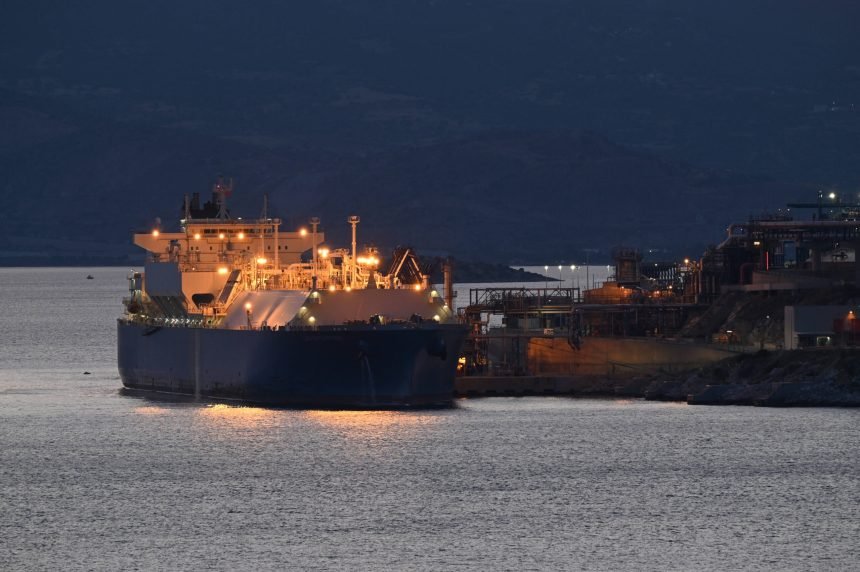
One of the strategic long-term projects in the Balkans is the Vertical Gas Corridor, which aims to turn Greek ports and LNG terminals and the Trans-Balkan Pipeline into a hub for regassifying US LNG and distributing it northward to at least seven countries, hoping to eventually reach Ukraine. Once completed, this corridor would be an alternative to pipelines supplying Russian gas. In recent months, US energy firms ExxonMobil and Chevron also have signed agreements with Greece to explore new natural gas deposits near the Ionian Sea and Crete. In April, Albania, Greece’s northern neighbor, signed a six-billion-dollar, twenty-year framework agreement with US firm Venture Global and Greek company Aktor to import American LNG, initially via Greece, with plans to later turn the southern Albanian port of Vlore into an import hub and to host a new gas-based thermal plant.
Further north, the Croatian LNG terminal at Krk has become another strategic entry point for US LNG into the region. The Trump administration has been working with authorities in Bosnia and Herzegovina (BiH) to develop the Southern Gas Interconnection from Krk into BiH, which would provide the latter with an alternative for its dependence on the Russian gas it receives via Serbia.
Serbia, North Macedonia, and Kosovo are largely expected to be integrated into the US energy corridors. The US State Department report, for example, lists several priority projects, including upgrades to Kosovo’s coal-based plants. Already, Serbia is diversifying its gas supply sources, using an alternative supply route via Greece and Bulgaria. It has also signed an agreement on Strategic Cooperation with the United States, with Washington simultaneously seeking to force Russia’s Gazprom to sell its controlling share in Serbian energy company NIS.
On a collision course with the EU?
The Trump administration clearly views this strategy through the prism of the benefits to the US economy and industry. But it is also as a source of leverage to achieve geopolitical goals, such as securing alignment with US/NATO interests, deterring competitors, and creating incentives for regional cooperation. This approach was on full display this past year in BiH, where there was a seemingly direct tit-for-tat between the United States and Milorad Dodik, the Kremlin proxy and secessionist troublemaker. The US removed sanctions against Dodik at almost exactly the same time as legislative advancements in the Southern Gas Interconnection project in BiH. By moving from Russian gas toward US LNG, the White House apparently presumes that Dodik’s political alignment would also flow along in the same direction.
From a security perspective, a larger US economic presence in the region, and the removal of Russian instruments of coercion, creates a vested interest for Washington to remain engaged in defending the regional order it helped shape. In principle, this is a positive development for regional security, which could weaken the hand of revisionist actors such as Serbian President Aleksandar Vucic in seeking to play geopolitical balancing games between the West and Russia. To this end, it was encouraging that the headline statement from the recent visit to Belgrade by US Ambassador to NATO Matthew Whitaker was to point to the need for Serbia to align its strategic direction with the West—an important point of US policy continuity by the Trump administration.
Yet there is a risk of this strategy colliding with the region’s vitally important EU accession goal. Major investments in gas contradict the EU’s broader green agenda to phase out gas, leaving Western Balkan candidates—which must meet specific criteria and requirements to join the EU—caught in the crossfire of US-EU and intra-EU divisions on the issue. Several EU member states, including Greece and Croatia, are part of US LNG corridors, and they have attempted to push Brussels to soften limitations on gas projects, but it is yet to be determined how successful this will be.
Second, this strategy potentially threatens regional governance, as most investments are structured through opaque government-to-government deals and special legislation granting privileged access to predetermined US companies—as illustrated by EU concerns over BiH’s lex specialis arrangement. Such noncompetitive and nontransparent deals risk incurring unjustifiable financial costs to citizens in the region and benefiting the financial networks of regional strongmen who undermine democracy and the region’s EU path.