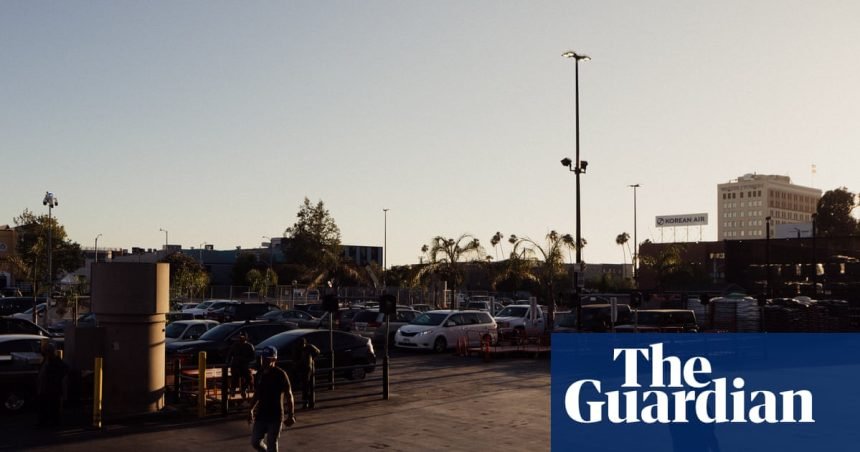
Most people in Brian Gavidia’s life haven’t seemed to notice that a year has passed since armed federal immigration agents descended on their city.
In East Los Angeles, in the neighborhood where he was born and has lived his whole life, the scene this week appeared more or less normal. A family in formalwear settled into the big round table at the torta ahogada restaurant for a post-graduation celebration. The vendors selling fruit or flowers or perfumes were once again lining the streets.
“It makes me happy, to hear music playing, to see that little girl playing,” he said. “But also, it’s not the same.”
His mind still flashes back to the day that agents came to his workplace, pinned him against a gate and refused to accept that he was a US citizen. His skin prickles each time he spots a white van with tinted windows – could it be ICE again?
The raids last summer brought a massive influx of ICE and border patrol agents, as well as an unprecedented incursion of national guard troops, into Los Angeles, which is home to the largest undocumented population of any US city. Angelenos took to the streets in protest. Several immigrants died while being chased down. Lawyers scrambled to locate and help detained people before Immigration and Customs Enforcement swiftly transferred them out of state, or removed them from the country. Mutual aid networks sprang up across the region to help immigrants who were too afraid to leave their homes.
The raids also marked a turning point in the Trump administration’s immigration crusade. The caravans of agents who swept through LA, seizing workers at car washes and garment warehouses and raiding churches eventually moved on to Chicago, Portland, Washington DC and Minneapolis, escalating their tactics at each stop.
One year later, Los Angeles has been left with some scars, some open wounds. Many Angelenos’ lives have been permanently changed.
Lorena – who stayed indoors for weeks as roving patrols made arrests along her street – is back to selling her tamales in Koreatown.
Yurien, who saw her father outside his workplace in LA’s fashion district handcuffed, chained from the waist and ankles and whisked away by agents, is haunted by the image.
Noemi and her husband used to get ready together before she headed to work at LA international airport; now he calls her on the phone at 8am with a morning greeting – from Mexico, where he was deported last June.
Angelenos have adapted, they have adjusted and they have persevered, said Elizabeth Brennan of the Warehouse Workers Resource Center, a local advocacy group: “But if you start to look close, it’s like we have little missing teeth, everywhere.”
Almost exactly a year ago – on 12 June – Gavidia was at work in his car lot when immigration agents rushed in, pinned him against the gate and asked him to name the hospital where he was born. His story became part of a class-action lawsuit challenging ICE’s racial profiling of Angelenos.
After that day, everything in his life turned upside down. Federal agents kept coming back to the neighborhood. Business declined, and it felt unsafe to work. He had to close his used-car refurbishing business and dealership. “For the first time in seven years, I had to look for a job, and work for somebody else,” he said.
He saw neighbors and childhood friends targeted by roving patrols, and he had to tell his nine-year-old daughter – who lives with her mother in Portland – she couldn’t come spend the summer with him, as she usually does. “It was painful,” he said. “But it wasn’t safe for her.”
He started to feel heartened in July after a federal court ordered federal agents to halt their indiscriminate raids and the racial profiling. Then, in September, the supreme court overturned the ruling. “I was devastated,” Gavidia said.
The American Civil Liberties Union, alongside a coalition of immigrant rights groups, are still challenging that result and have submitted an amended legal complaint. Gavidia said he wants to keep sharing his story until the racial profiling stops.
“I feel a responsibility,” he said. “I want us all to feel safe again.”
But it’s hard, he said, not knowing when that will be.
In central LA, a few day laborers were standing outside a Home Depot in MacArthur Park, looking to pick up odd jobs installing siding, or painting or landscaping. Some were chatting about how Donald Trump had just signed a $70bn funding package from immigration enforcement.
Immigration agents had targeted dozens of Home Depots across LA last summer – after Stephen Miller, the architect of the administration’s immigration policies – ordered them to sweep up undocumented workers.
On 6 June last year, masked federal agents came to the MacArthur Park Home Depot in a fleet of white vans, ambushed workers and whisked away nearly two dozen people. In August, despite a federal court order halting indiscriminate raids in the region, border patrol agents came back to the same Home Depot – this time, in a yellow rental truck. The driver told workers he had jobs to offer; then, masked agents jumped out of the back and started making arrests.
“Until the mandate of the president ends, we are going to be in danger,” said Frederico, 62, a laborer and security guard who was at the construction store looking for jobs. “It hasn’t been safe since then, and it’s not safe now.”
Frederico came to the US from Guatemala in 1998 and has been living and working in LA ever since. Fewer and fewer workers have been coming here, he said, and there are fewer jobs: “Businesses have closed, people no longer want to build, they no longer want to spend, to invest.”
A couple of miles away, in the fashion district, a few people peruse rolls of colorful fabrics and browse the racks of ready-to-wear apparel. Here, too, the shadow of the raids lingers.
June used to be a busy season here, said Antonio, 52, who co-owns a fabric shop with his wife, Alma: “Especially in this season, people are everywhere shopping. Graduations, graduations, parties, parties, parties.”
But the neighbourhood, which is home to hundreds of fabric shops, ateliers, tailors and clothing factories run by and employing immigrants, was one of the first to be targeted by agents last year.
In a single swoop on 6 June, agents arrested dozens of workers – many of them from the Indigenous Zapotec community – at Ambiance Apparel, a large manufacturer and retailer in the district. Fourteen members of Citlali Fermin’s family were arrested that day.
In the months afterwards, 11 were released after organizers and family members launched a public campaign called Lucha Zapoteca. “One was deported after he was coerced into signing documents under false pretenses.One decided to exit due to the inhumane conditions in detention Lastly, our last relative decided to exit after six months in detention,” said Fermin, who is also an organizer with Trabajadores Unidos Workers United.
Antonio remembers when that raid happened. He was at his store, finalizing a large order: 20 rolls of fabric, each of which cost $200-$300. That’s when news started to spread that federal agents had arrived.
Antonio’s client called him shortly after to cancel the order. Since then, sales have gone down about 85%, he says: “It’s a drastic change.”
It is not only Los Angeles that has changed since the raids – it’s the whole immigration system, said Melissa Shepard, director of legal services at the legal aid non-profit ImmDef.
Though it is uncommon now to see roving caravans of agents patrolling LA, people are still being detained. Often, this is at immigration check-in appointments. But Shepard and other attorneys and advocates said people are still being arrested in targeted raids, or as bystanders at raids.
She has heard of an Amazon driver detained after making a delivery to a military base. Jorge Nicolás, a senior organizer at a day labor center called Central American Resource Center (Carecen), said he recently witnessed agents chasing a laborer into a Home Depot, and taking him away bloodied and in handcuffs.
“The arrests never really stopped,” Nicolás said.
The number of people in immigration detention in the LA area spiked when the raids began last June. Before the raids, fewer than 1,000 people were detained in ICE’s Los Angeles area of responsibility on any given day; since then, the number has doubled.
At the Adelanto detention center, located in the high desert east of Los Angeles, detainees began a hunger strike in May to protest murky drinking water, moldy food and a lack of medical care. Many of those participating in the strike alleged that they were zip-tied, and threatened with teargas and transfers to other ICE facilities, according to ImmDef. The US Department of Homeland Security (DHS) has denied there is a hunger strike.
“The state of dysfunction of the detention centers is alarming,” said Shepard. “They are being used as a deterrent and also as a punishment for immigrants.” Conditions are so bad, she said, that many detainees feel pressured to accept deportation and give up their immigration cases, just so they can leave the detention system.
For immigrants inside detention, it has also become exponentially more difficult to secure a release through bond.
The minimum bond amount is $1,500, but according to Shepard, judges are increasingly requiring bonds that are 10 times higher – at $15,000 or $20,000. Detainees have to pay the full amount in order to be released.
Jennifer Gutierrez, the executive director of Clergy and Laity United for Economic Justice (Clue), a southern California-based non-profit, said her organization raised and spent at least $1.5m to help 150 immigrants pay their bonds. “We’ve got a long list of applicants who are waiting for their bonds to be paid,” she said. The government holds the bond until after immigration cases are closed. But the court system is severely backlogged; of the 150 bonds the group has paid on behalf of individuals, she added, they’ve only gotten three back so far.
Gutierrez and Shepard were among dozens of activists, attorneys and Angelenos who testified at the People’s Hearing on Immigration Enforcement, a public forum led by Rochelle Garza, chair of the US Commission on Civil Rights.
“What we are seeing is a terrorizing of our communities,” said Garza, who held a similar hearing in Minneapolis in March and another in Chicago in May.
Underlying the conversations that day was a big, open question of how and when Angelenos would receive some reprieve or reparations for what they experienced. Gavidia was one of the people who testified. “I do believe a lot in America,” he said. “We’re not done fighting for our rights.”
Afterwards, he shared some good news: he was getting ready to restart his used car business. “I’m excited. We have to keep building.”