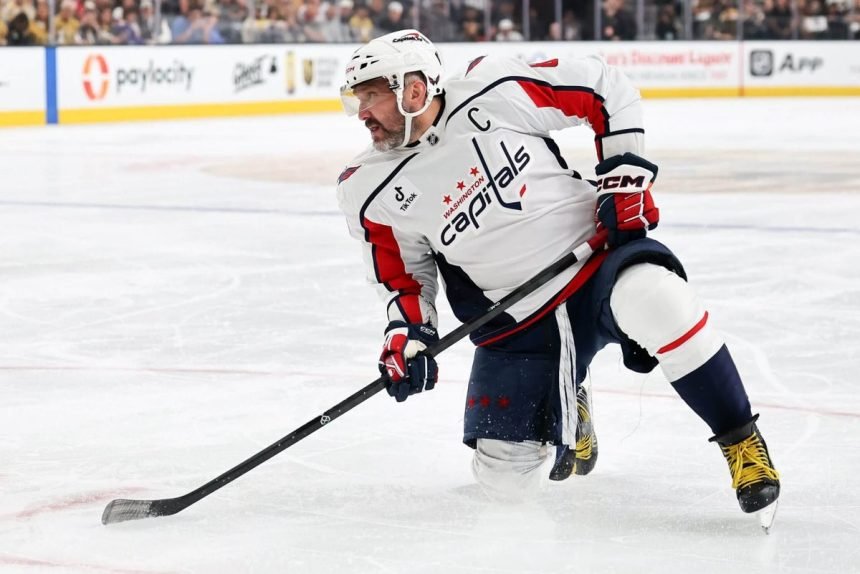
In April, before Alex Ovechkin had decided between retiring from the NHL and returning for a 22nd season with the Washington Capitals, his head coach was prepared for both possibilities.
“Whether he’s back next year, he’ll be welcomed with open arms from my standpoint as the head coach and as our captain,” Spencer Carbery said. “And if this is it, we’ll support him that way, and I’ll celebrate him and give him a big hug and have a cold beer with him.”
Those beers will have to wait. On Thursday, the Capitals announced that Ovechkin, nearly 41 years old and already the NHL’s all-time leading goal scorer, had signed a one-year contract with Washington worth $4.25 million against the salary cap.
“I’m back!” Ovechkin said in a release. “Thank you to everyone for giving me and my family the time to make this decision. I’m healthy. I love playing hockey and competing to win. I’m excited to come back and join my teammates so we can fight for a playoff spot and have a chance to win. See you in September, DC!”
According to the team, the contract has a $1 million base salary plus a $3.25 million signing bonus and another $4.75 million performance bonus if Ovechkin hits the 10-game mark. In other words, if he indeed plays 10 games, Ovechkin will pocket a total of $9 million.
Ovechkin, who in April 2025 broke Wayne Gretzky’s career record for regular-season goals with his 895th, added 32 more last season for the Capitals, but his contract status and age-related decline in other areas of his game turned the prospect of another season in Washington into an open question.
From training camp to the final game of the five-year, $47.5 million contract he signed in 2021, Ovechkin maintained that he’d made no decision on his next chapter, even amid on-ice acknowledgements in Pittsburgh against his long-time foil Sidney Crosby and at Washington’s Capital One Arena in what could’ve been his final home game.
Fans showered Ovechkin with cheers and adulation, despite his refusal to acknowledge the surrounding uncertainty. Further complicating the situation was the fact that the Capitals were still in the hunt for a playoff spot.
“Of course, they love me, but I think they love the (Capitals) boys,” Ovechkin said after the game. “They love how we play, because we play for them. It’s a big moment right now for us. If we lose this game, we’re out (of a playoff spot). And everybody was dialed in and it was a solid game.”
He was speaking with his sons at his side — another signal that the end, potentially, had come.
“I’ll remember this moment,” he said as 8-year-old Sergei and 6-year-old Ilya flanked him. “I’ll remember playoffs. Obviously, it’s a good thing we have lots of video cameras, cell phones. They’re gonna watch it when they’re growing up, and they’re gonna remember it and they’re gonna enjoy it.”
Now, they’ll have a few more moments to enjoy. Ovechkin rejoins a team he once again led in goals despite his advanced age, a reality borne both of his talent and Carbery’s ability to maximize his strengths while minimizing his weaknesses as a skater and 200-foot player. Ovechkin didn’t start a single shift in the defensive zone until the 73rd game of Washington’s season. The Capitals’ power play, with Ovechkin still its centerpiece, was an issue last season as well; it converted on 17.8 percent of its chances, 25th in the league.
“We are excited to have Alex return and continue his illustrious career,” Capitals team owner Ted Leonsis said in a news release. “Ever since we drafted him, there have been two constants: his love for the game and his relentless drive to win.
“I am incredibly proud of everything he has accomplished in a Capitals sweater, and I have no doubt he will continue to add to that legacy next season.”
What Ovi’s return means for the Capitals
For years, the Capitals navigated Ovechkin’s pursuit of the goals record while executing an on-the-fly rebuild around him. No non-playoff team finished with more points last season than Washington’s 95. In 2024-25, the Capitals won the Metropolitan Division and advanced to the second round of the Stanley Cup playoffs.
And now, that on-the-fly rebuild seems have to largely been completed. At the start of this offseason, the Capitals had more than $30 million in projected cap space and plans to target high-end additions to their forward group. Through two trades, they succeeded. The first was for Jordan Kyrou, a dynamic top-six offensive talent who’d scored 31 goals or more in three of his last four seasons with the St. Louis Blues. The second was for former Buffalo Sabres winger Alex Tuch, a well-rounded five-on-five player who, had he reached the open market, almost certainly would’ve been the league’s highest-paid unrestricted free agent.
General manager Chris Patrick’s work continued on July 1, the first day of unrestricted free agency, when he signed quality third-liner Boone Jenner (four years, $5.75 million AAV) and defenseman Vincent Desharnais (four years, $4.2 million AAV), a physical right shot who does solid work in his own end.
Those moves pushed Washington closer to the upper limit than initially expected, but Ovechkin, as a player over the age of 35, was eligible to sign a bonus-laden deal and push his ultimate payout for 2026-27 onto the following season’s books.
The outstanding questions for the Capitals are whether they added enough to push them into a higher class of contender for 2026-27, and exactly how Ovechkin — a speciality player, in a sense — figures into those plans.
Those answers will come in time. On Thursday, their biggest offseason question got its answer.