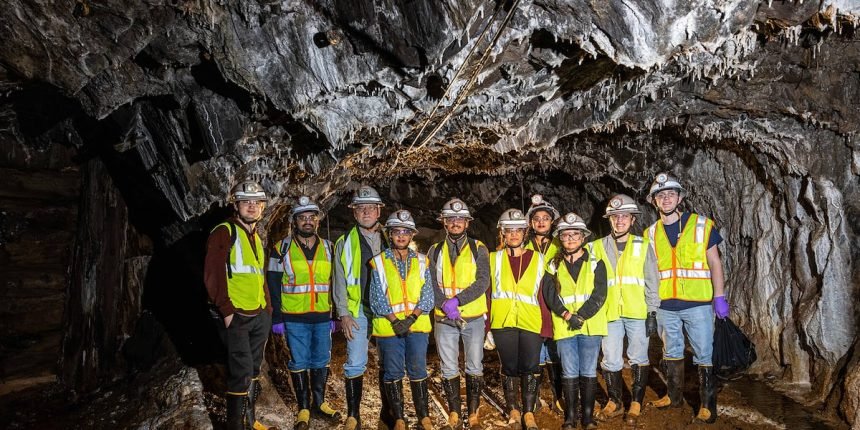
RAPID CITY, S.D. (KOTA) – Researchers at South Dakota Mines say tiny microorganisms found deep beneath the Black Hills could help tackle one of the energy industry’s biggest challenges: capturing carbon emissions more efficiently.
The research, led by assistant professor Tanvi Govil, uses engineered enzymes inspired by microbes discovered at the Sanford Underground Research Facility. Instead of storing carbon dioxide underground, the technology captures it directly from industrial emissions and converts it into minerals that can be used in products like concrete.
“We learned from these organisms and used that knowledge to engineer enzymes that can efficiently remove CO2 directly from industrial emissions,” Govil said.
Researchers say the enzymes dramatically speed up the carbon capture process, reducing reactions that normally take years to just minutes. They also function in the harsh conditions found at power plants and other industrial facilities.
The process also makes use of coal ash, combining it with captured carbon dioxide to create calcium carbonate, a material used to strengthen concrete.
The technology is being commercialized through Carbon EnZero, a startup launched by Govil. The company won first place and $20,000 in this year’s South Dakota Governor’s Giant Vision Business Plan Competition and plans to begin beta testing in 2026.
Rather than building complete carbon capture systems, Carbon EnZero plans to provide its specialized enzymes while partnering with engineering firms to install the technology at industrial sites.
Researchers say the project has already attracted interest from industry partners, including Black Hills Energy, and the next step is developing a mobile pilot system to test the technology at industrial facilities.
See a spelling or grammatical error in our story? Please click here to report it.
Do you have a photo or video of a breaking news story? Send it to us here with a brief description.
Copyright 2026 KOTA. All rights reserved.