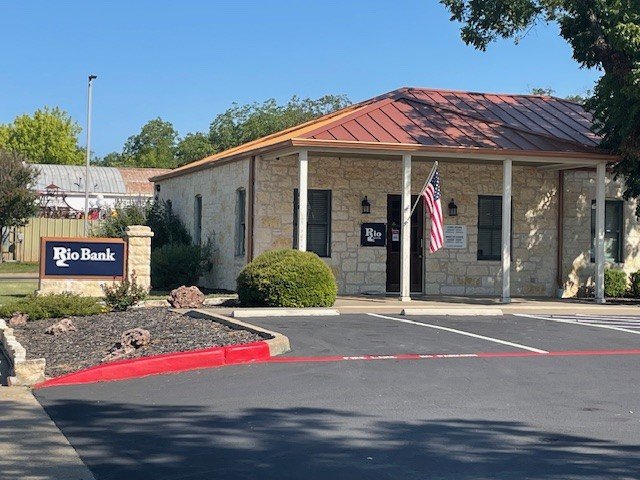
Fredericksburg and Rio Bank are fighting in federal court over the bank operating a branch in the city’s historic district. Shown is the branch at 610 W. Main St.
A federal magistrate judge has recommended allowing Rio Bank to move forward with its claims that the city of Fredericksburg improperly blocked the bank from operating a downtown branch while allowing other banks and chain businesses to remain in the city’s historic district.
The recommendation would allow McAllen-based Rio Bank to begin gathering evidence from the city, including internal records and sworn testimony from officials about how they enforced the historic district ordinance.
U.S. Magistrate Judge Elizabeth “Betsy” Chestney in San Antonio said the bank had alleged enough facts for two of its claims to proceed but recommended dismissing others, including the bank’s argument that federal banking law overrides the city’s ordinance.
Article continues below this ad
U.S. District Judge Fred Biery will review Chestney’s report and recommendation before deciding whether the lawsuit can proceed on those claims.
The dispute centers on Rio Bank’s purchase of a longtime bank building on Fredericksburg’s Main Street. City officials say the bank cannot operate there because a 2008 ordinance generally requires businesses with more than 10 locations to obtain a conditional use permit before opening in the historic shopping district.
City leaders say they adopted the 2008 law to preserve the historic shopping district’s small-town character by limiting chain-style businesses.
Article continues below this ad
Rio Bank argues the city is selectively enforcing the ordinance. It says other banks and nationally recognized businesses continue operating in the district while Fredericksburg is trying to force only Rio Bank to close.
The bank wants a court to rule that its use of the property at 610 W. Main St. is allowed. It also seeks unspecified financial damages.
Rio Bank filed suit July 30, 2025, after the city denied its permit application and ordered the bank to stop operating the branch.
The city responded four days later by filing a lawsuit in Gillespie County District Court, seeking to stop the bank from operating in the historic district. That complaint has been suspended while the federal case proceeds.
Article continues below this ad
In Thursday’s report and recommendation, Chestney concluded Rio Bank had plausibly alleged the city treated it differently from other businesses in the historic district and should be allowed to try to prove those allegations through evidence gathered during discovery.
She also concluded Rio Bank had adequately alleged that the city’s actions deprived it of the economic use of its property, allowing that claim to proceed as well.
The city had argued the lawsuit should be thrown out, saying Rio Bank failed to follow required administrative procedures and that its constitutional claims lacked merit. Chestney rejected those arguments in part but agreed others were sufficient to eliminate several of Rio Bank’s claims.
She did recommend dismissing Rio Bank’s claims that federal banking law prevents the city from enforcing its ordinance against the bank and that the city violated the bank’s rights to free speech and due process.
City attorney William “Mick” McKamie said the city was “pleased with Judge Chestney’s thoughtful report and recommendation” but expects to file objections before Biery decides whether to adopt it.
Article continues below this ad
McKamie said the recommendation would dismiss major portions of Rio Bank’s lawsuit and that the city remains confident the ordinance ultimately will be upheld. He disputed Rio Bank’s claim of selective enforcement, saying the bank was the only standardized business to begin operating after its permit application was denied.
Attorneys for the bank couldn’t be reached for comment.
The bank has about two dozen locations, including in Alamo Heights and Stone Oak. It has about $1.4 billion in assets.