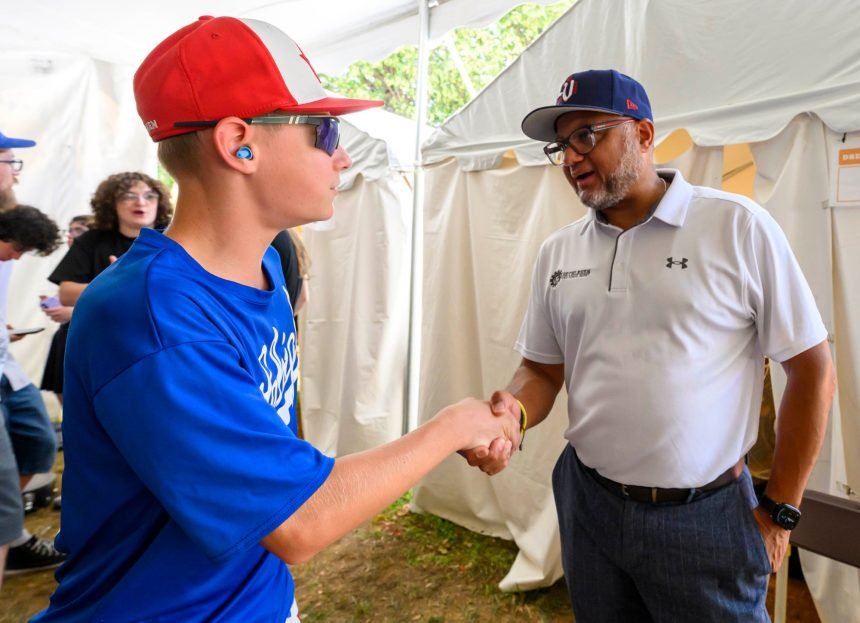
Renato Lajara remembers walking into school with the blood of a murdered friend still on his sneakers. He doesn’t remember any adult in that North Philadelphia building asking if he was OK.
That’s not an experience he wants any student to repeat, Lajara said. So it’s why the creation of “welcoming, safe schools” is one of his top priorities now that he is the superintendent of Bethlehem Area schools.
Lajara’s image of a welcoming teacher is inspired by the second grade educator who fought to have him, 7 years old and recently arrived from the Dominican Republic, moved out of a third grade special education class and into one of Philadelphia’s first English as a Second Language classes.
After growing up in Philadelphia schools, Lajara served as a teacher and administrator in the city, working in both traditional district schools and charter schools. He spent some time as an administrator in the nearby Cheltenham School District and then moved back to Philadelphia to serve as an assistant superintendent, overseeing 8,000 students in 15 North Philadelphia schools.
As Bethlehem Area superintendent, Lajara will oversee more than 12,000 students at 22 schools.
Nearly half of the district’s students are Hispanic, with data presented during budget talks this spring showing that number at 46.4%, and the school board has identified Lajara as the district’s first superintendent from that demographic.
Across the state, Hispanic and Latino leadership is rare in the highest offices of public school districts. Pennsylvania Education Department data from the 2025-26 school year shows only four superintendents in that category across the 485 leaders of public school districts.
It’s both “surreal” and “overwhelming” to be the district’s first Latino superintendent, Lajara said, adding, “I’m grateful.”
“I want them to see themselves in me and see that anything is possible,” Lajara said of students who share his background.
Engaging the community
After years of living and working in Philadelphia and its suburbs, Lajara and his wife moved to South Side Bethlehem in late July. He has two children in college and another who will finish their last two years of high school in their suburban Philadelphia district where the family was living before moving to Bethlehem.
Although Lajara said he knew very little about the Bethlehem area before professional mentors identified its superintendent opening as a potential good fit for his experience, he said driving around south Bethlehem immediately reminded him of the North Philadelphia neighborhoods where he grew up.
“I just fell in love with the place,” Lajara said.
Lajara brings a “fresh perspective,” and it’s been impressive to see how quickly he has immersed himself in the community, Assistant Superintendent Maureen Leeson said in an email.
“In just a short time, he has attended events such as Musikfest, Bernie Fritz Night, local swim meets, and tours of the National Museum of Industrial History, taking every opportunity to meet residents, learn about our community, and experience what makes Bethlehem so special,” Leeson said. “His genuine interest in listening, learning, and building relationships reflects the collaborative leadership that will serve our students, staff, and community well.”
Setting district goals
In a recent interview with The Morning Call, Lajara said he’s in a fact-finding mode as he completes his first 100 days. That has meant one-on-one meetings with district staff, building tours and community events, and he plans to continue those observation sessions once classrooms get back into operation.
“I just want to see our schools in action,” Lajara said.
The new superintendent has “made it a priority to be visible, listen, and learn as much as he can about Bethlehem,” school board President Michael Faccinetto said in an email. “I appreciate that he is using his first 100 days to gather information rather than coming in with all the answers.”
Lajara listed his overall goals as improving attendance; creating welcoming, safe schools; increasing staff and student well-being; and focusing on shared leadership through principal and teacher professional development efforts.
“I am especially encouraged by his focus on shared leadership,” Faccinetto said. “Lasting improvement cannot come from one person or one office. It happens when principals, teachers, staff, families, and students all have a voice in the work.”
The good work being done in Bethlehem Area schools needs a better spotlight, Lajara said, outlining plans to use his personal social media accounts and the district accounts to illustrate how the district is a “hidden gem.”
Such marketing efforts were identified as a need by Bethlehem Area Chief Financial Officer Harry Aristakesian during this spring’s budget discussions, as he highlighted how much increasing enrollment in charter schools has cost the district in tuition payments.
“We need to tell our story as a district,” Lajara said.

Assessing operations
Considering his focus on staff and student well-being, Lajara said he’s encouraged to see the wide range of partnerships the district already holds with regional health networks and nonprofits.
He aims to strengthen those partnerships and to expand the work of the district’s community schools, citing their food pantries as one example of a service that could be broadened.
The district is already well set up with career paths that connect students to local universities and vocational training programs, Lajara said, and he wants to see more data shared with the public regarding metrics such as college acceptance rates, scholarship money granted and passing rates for career tech courses.
Preparing for students for the future, to Lajara, means a focus on the four Es: employment, enrollment (in a two-year or four-year postsecondary institution), enlistment (in the military) or entrepreneurship.
As far as focusing students on their current studies, Lajara said he hasn’t yet had a chance to fully digest how well the district’s cellphone restrictions are operating, but he believes consistency of enforcement is crucial.
As a principal at Kensington High School in North Philadelphia, Lajara banned cellphones from school grounds, in part due to safety concerns, so he is no stranger to efforts to manage students’ technology use.
Regarding artificial intelligence, Lajara said schools are still assessing the ways in which that technology provides both opportunities and challenges.
One thing, he said, is certain: “AI can’t give a kid a hug.”