LAS VEGAS (FOX5) — A popular Las Vegas Valley cottage bakery known for its cinnamon rolls received a “cease and desist” order to halt customer pickups from their doorstep.
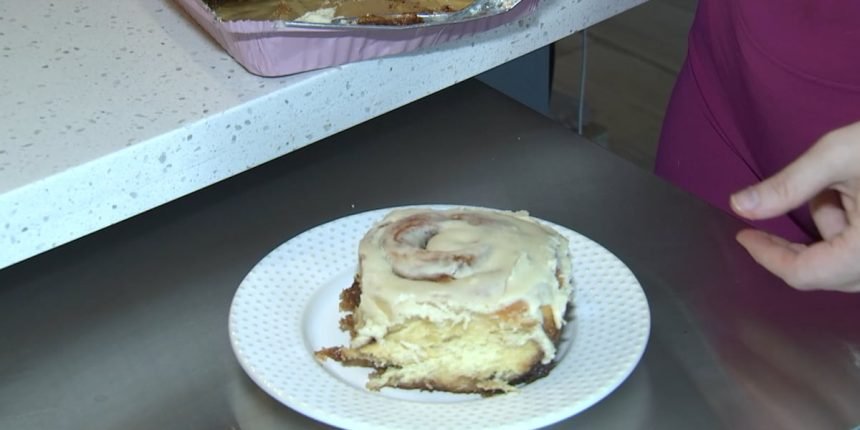
Mama Llama Bakery has more than 132,000 followers on Instagram and 28,000 followers on TikTok. Mom Lindsay Skolnik developed her latest recipe for cinnamon rolls during her second pregnancy, and has efforted sales of baked goods from her home. Customers can pick up their orders from shelves outside her doorstep.
MORE ON FOX5: Las Vegas bakery goes viral for stuffed conchas
Some Las Vegas locals and influencers have argued that her cinnamon rolls may be the best in Las Vegas; Skolnik tells FOX5, she works to space out her customers’ pickup orders to eliminate disruptions, and says her neighbors are supportive of her enterprise; she does not know who could have reported her to Clark County.
Code Enforcement officers came to her door, she tells FOX5.
“They just wanted to know that I wasn’t running an Airbnb or short-term rental. Obviously, I’m not. My nanny actually answered the door and told them that I was a cottage baker. They’re assuming that they knew what cottage bakeries are, and so the next day, I had a warning stamped on my door,” she said.
Her post detailing the Code Enforcement order and letter has thousands of comments and more than 200,000 views.
Skolnik tells FOX5, she previously went to the County and obtained a proper business license. Clark County sent the following statement to FOX5:
This address is in violation of CCC30.03.03(A)(13) Home Occupation, which in part, prohibits on-site clients and customers. Additionally, this business does not have a business license, and one is required to operate a business in Clark County.
Public Safety is a top priority for Clark County. Permit and licensing requirements are in place to help keep all residents safe and healthy. For anyone who is interested in operating a business from a residence or elsewhere, please reach out to the Clark County Department of Comprehensive Planning and the Clark County Business License Department to understand the requirements to be permitted and licensed to operate in unincorporated Clark County.
Skolnik thought she was operating legally.
“You spend $1,000 setting up your business. You get your LLC, which is another $400. And then…You get your business license. You pay for that. They say you’re all good to go… it really doesn’t make sense,” she said.
“When I spoke to the officer, he basically said that my business license says that I can’t do porch pickup. I thought that was the whole point of a cottage bakery business,” she said.
Skolnik has started a petition to call for regulatory changes for cottage bakeries.
“I’ve been very respectful of this policy and to not overstep as a neighbor. I think that’s really important. I really think that cottage bakeries should be allowed to have a porch pickup if it’s structured the way that I’m basically doing it,” she said.
Her post caught the attention of State Sen. Fabian Donate, who advocated for a pathway for street vendors to operate legally. Donate reached out to help Skolnik with her situation.
The State Senator sent FOX5 this statement:
“Current state law allows certain homemade food businesses to operate under Nevada’s cottage food framework, but there are still limitations on what can be sold, how these businesses can operate and the local requirements entrepreneurs may have to navigate. For many small business owners, particularly those starting from their own kitchens or operating on a very small scale, that process can be difficult to understand and navigate.
Cases like Mama Llama highlight an opportunity for all of us, at the state, county and Health District levels, to take a closer look at whether our current regulations are keeping pace with the realities of today’s small entrepreneurs. These are people who are working hard to support their families, invest in their communities and build a business, often with very limited resources.
Our responsibility is to find the right balance: protecting public health and consumers while also creating a clear, reasonable and accessible pathway for entrepreneurs to operate legally. That was the goal behind SB 295. The legislation would have helped streamline parts of the regulatory process and address some of the barriers facing cottage food businesses and other small food entrepreneurs. Unfortunately, the bill was vetoed, but the issues it sought to address remain.
We also have to look at the entire regulatory picture. State law is only one piece of it. Local requirements, permitting processes and even restrictions imposed by HOAs can create additional challenges for someone trying to operate a small business from their home.
I believe there is an opportunity to work collaboratively with Clark County, the Southern Nevada Health District and our small-business community to identify practical solutions. My hope is that we can make progress together before the next legislative session. If additional changes to state law are necessary, I am prepared to continue this work in 2027 so Nevada has a regulatory system that protects the public while also giving small entrepreneurs a fair opportunity to succeed.”
The order gives a deadline of August 20 to comply; Skolnik said customers will have one last chance to pick up their orders before she ceases doorstep pickups. Though she can currently sell her goods at farmer’s markets, Skolnik said doing so is not realistic with very young children at this time.
Copyright 2026 KVVU. All rights reserved.