Boston nonprofit Lawyers for Civil Rights is opening a hub for small business owners from underserved communities in Massachusetts this fall, aiming to provide free legal training, co-working space, and other resources to hundreds of entrepreneurs.
BizGrow Central, which will serve entrepreneurs of color, as well as female, immigrant, and low-income owners, will operate out of a second-floor office space at 141 Tremont St. in downtown Boston, across from Boston Common. It’s the first physical location for BizGrow, a program offered by the civil rights organization that has served thousands of owners over its 25-year history.
The space is meant to make it easier for entrepreneurs to grow their brands and connect with other small businesses, as well as address the equity problems affecting the state’s marginalized entrepreneurs. At the center, BizGrow members will have access to a range of free resources, including time with experienced consultants to help develop their business models, legal assistance with drafting contracts, and modern working space.
It will also fill a space in a neighborhood where the commercial real estate market is still recovering from the pandemic, said Iván Espinoza-Madrigal, the executive director of Lawyers for Civil Rights.
“I want to live in a city where a low-income entrepreneur can dream of opening a shop in Downtown Crossing and can actually fill those vacancies,” said Espinoza-Madrigal.
BizGrow Central is also designed to chip away at larger inequities. A 2025 MassINC Polling Group survey found that 68 percent of Black business owners and 70 percent of Latino business owners said getting capital was a high priority, with MassINC calling it “one of the most pressing challenges facing entrepreneurs of color.”
Entrepreneurs who work out of the new offices will be within walking distance of the city’s Office of Small Business, which offers help with securing licensing and other regulatory hurdles.
About 100 businesses have already applied for BizGrow Central membership ahead of the Oct. 19 ribbon-cutting, according to Espinoza-Madrigal. Lawyers for Civil Rights aims to invest around $1 million into the new location, with plans to serve around 200 small businesses in its first year, Espinoza-Madrigal said.
To open the center, BizGrow is depending on philanthropic support from the Barr Foundation, the Boston Foundation, several banks, and private donors.
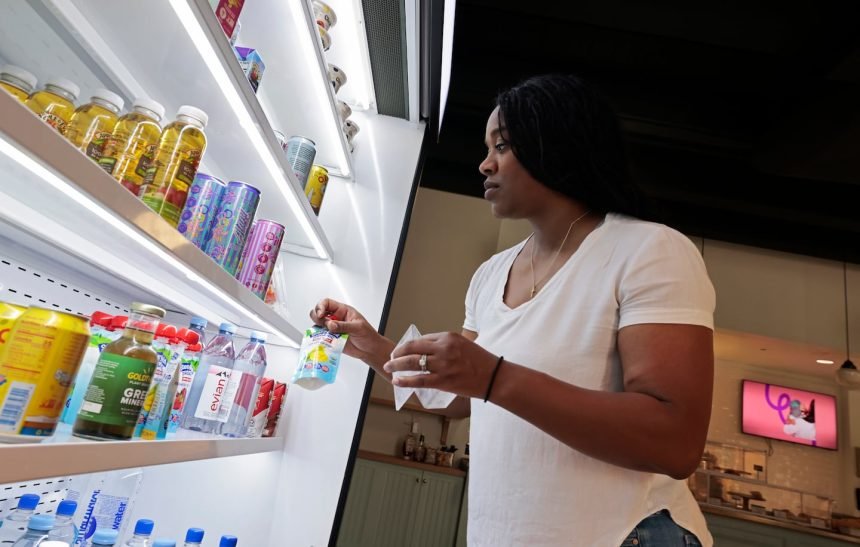
Since its founding in 2001, BizGrow has supported entrepreneurs in industries ranging from tech to food to entertainment. Among those owners is Tracy Skelly, who runs Little Cocoa Bean Co., which has a kid-friendly coffee shop in the Seaport that focuses on healthy food options. She has been working with BizGrow since she opened her business in 2019.
From BizGrow, Skelly has received over $15,000 to launch the brand, legal assistance to review contract agreements, and a tech consultant to help with her sales system.
“The reality is, I needed every dime of that money. I could not start my business without finding outside capital,” she said.
Even with that support, though, Skelly often wonders if she can afford to keep business sustainable.
“If we really poured into [small-business owners], we’d have much more loving neighborhoods,” Skelly said. “We’d have people who could pay their bills, who weren’t moving out of the city and Massachusetts.”
Donald Wright, Boston’s interim chief of economic opportunity and inclusion, hopes BizGrow’s location is a step toward narrowing the state’s racial wealth gap. Among Black and Hispanic/Latino households in Massachusetts with two earners and two children, only about a quarter, on average, had incomes above the middle-class threshold from 2020–2024, according to MassINC Policy Center research. That’s compared to 57 percent of their white counterparts, 65 percent of Asian households, and 33 percent of other non-Hispanic households.
“It is so valuable to equip early entrepreneurs with information and resources to avoid common pitfalls,” Wright said.
Auzzy Byrdsell can be reached at austin.byrdsell@globe.com.