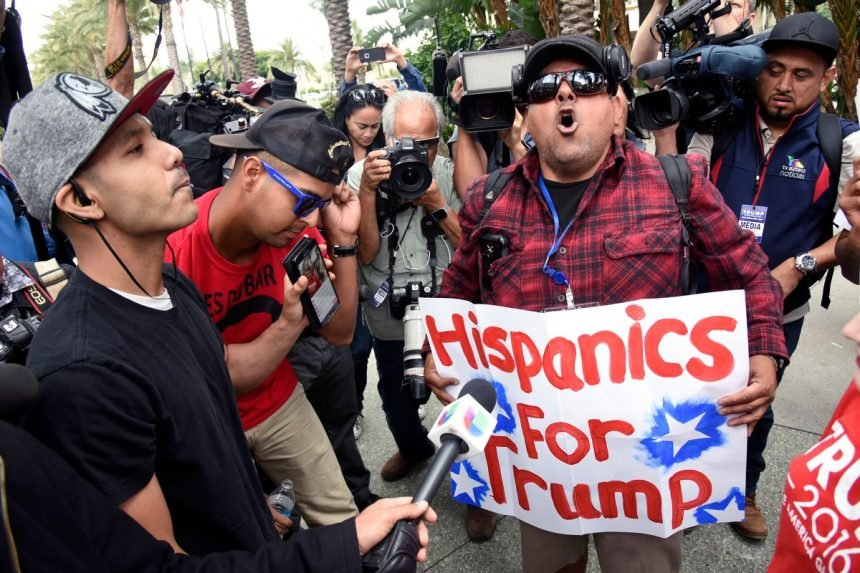
President Donald Trump’s approval rating among Hispanic and Latino men, a critical group he flipped in the 2024 election, has plummeted in recent months as his administration faces growing backlash over the economy.
Hispanic and Latino voters have historically broken for Democrats, but Trump made inroads with these voters in 2024, helping propel his return to the White House in key states, especially in places like Arizona and Nevada. Democrats have worked to win back Hispanic and Latino voters in the midterms, and a key question is whether there will be a reversion back to Democrats or if those GOP gains are permanent.
Winning back Hispanic and Latino men may be critical for Democrats. In 2024, Trump won Latino men by 10 points over former Vice President Kamala Harris, 54 percent to 44 percent, according to CNN exit polling data. In 2020, former President Joe Biden won Latino men by 23 points, 59 percent to 36 percent. In 2016, former Secretary of State Hillary Clinton won Latino men by 31 points, 63 percent to 32 percent.
Democrats winning back those voters could create a political challenge for Trump in the midterms in competitive states with a high Hispanic and Latino population like Texas. The shift in Hispanic and Latino polling numbers comes as Trump continues to lose ground nationwide in his approval rating.
Furthermore, Republicans in states like Florida and Texas redrew their congressional maps to favor their party ahead of the midterms, largely based around the 2024 numbers. A significant reversion among Hispanic and Latino voters could lead to more of those districts becoming competitive.
In a statement to Newsweek on Monday, White House spokesperson Davis Ingle wrote that November 5, 2024 was “the ultimate poll” when “nearly 80 million Americans overwhelmingly elected President Trump to deliver on his popular and commonsense agenda.”
“No other President in history has accomplished more for the American people than President Trump, who is working tirelessly to create jobs, cool inflation, increase housing affordability, and more. The President has already made historic progress not only in America but around the world, and this is just the beginning as his agenda continues taking effect,” he said.
Trump Approval Rating Declines with Hispanic Men
CNN data analyst Harry Enten on Monday highlighted new polling data showing Trump’s approval slipping among Hispanic voters. He pointed to polling data from CNN and SSRS showing that the president’s approval rating among Hispanic men is -41 points despite winning them by 10 points less than two years ago.
“All of that movement that you saw, that historic performance that President Trump had among Hispanic men, adios amigos. Goodbye. See you later,” he said.
He said the shift is largely due to the economy, with data showing his approval on the economy among Hispanic men stood at -49 points, despite being more trusted by 11 points over former Vice President Kamala Harris in the fall of 2024.
He explained that this could have major implications for the midterms, as Hispanic men favor Democrats by 20 points in the midterms.
“What we’re seeing among Hispanic men and their views of President Trump very much diving toward the negative, absolutely look like they’re going to have a massive impact on the midterm elections,” he said.
That data is backed up by some other polls, though many pollsters do not release crosstab data for Hispanic men specifically, as that is often a small subset that may not always be statistically significant.
Civiqs, which has surveyed more than 123,000 Americans since January 2025 on Trump’s approval rating, does provide such information. It found that 59 percent of Hispanic and Latino men disapproved of Trump, while 36 percent approved.
Meanwhile, a UnidosUS poll also found him underwater with Latino men, finding his approval at 34 percent and disapproval at 64 percent. It surveyed 3,000 Latino registered voters from April 27 to May 14, 2026, and had a margin of error overall of ±1.8 percentage points.
What This Means for the Midterm Elections
Republicans losing ground among Hispanic voters could have major implications for the midterms.
In Texas, for instance, Trump’s strong showing with Hispanic voters helped make up for a decade of Democratic gains in the state. It shifted from backing Trump by fewer than 6 points in 2020 to nearly 14 points in 2024, largely due to his support among Hispanic and Latino voters.
Trump won Hispanic and Latino men by 30 points, 65 percent to 35 percent, and Hispanic voters overall by 10 points, 55 percent to 45 percent, in the Lone Star State.
The Texas Senate race between Democratic state Representative James Talarico and Republican Attorney General Ken Paxton is expected to be among the most competitive of the midterms. Building back support among Hispanic and Latino voters is critical to Talarico’s path to victory, and polling suggests he is on track to do so.
A recent Emerson College poll, which found Paxton up one point overall, showed Talarico with support of 55 percent of Hispanic and Latino voters, compared to Paxton’s 36 percent support. It surveyed 1,000 likely voters from August 9 to 10, 2026 and had an overall margin of error of plus or minus ±3 percentage points.
Other competitive states like Arizona and Nevada also have high percentages of Hispanic and Latino voters. Both states have competitive gubernatorial races and shifted significantly toward Trump in 2024.
Arizona backed Trump by about 5.5 points, after backing Biden by less than half a percentage point in 2020. Nevada backed Biden by just over 2 points in 2020 but Trump by about 3 points in 2024. Arizona also has several competitive House races that could come down to Hispanic and Latino voters.
There are also major down-ballot implications due to mid-decade redistricting.
Polls showing poor approval among Hispanic voters may be especially worrying for Trump because new GOP-drawn maps in Florida and Texas were built on the assumption that Hispanic voters would continue trending toward the party as they did in 2024. If their support collapses, those redraws would become less effective—or potentially even backfire on Republicans in the Lone Star State.
Republicans redrew Texas’ congressional map to make several seats in South Texas, a region with a high concentration of Hispanic voters, more conservative. It redrew seats held by Democratic Representatives Henry Cuellar of District 28, Vicente Gonzalez of District 34 and Greg Casar of District 35 to become more friendly to Republicans, but they’re not overwhelmingly conservative.
If GOP support among Hispanic voters collapses, Democrats could hold onto those seats in November. That scenario could also make the more conservative seat held by Representative Monica De La Cruz of District 15 or the open seat in District 23 competitive.
How Hispanic and Latino Voters Have Shifted Over the Years
Overall, Trump came close to winning Latino voters in 2024, according to CNN exit polling. They backed Harris by only a 5-point margin, giving her 51 percent of the vote and Trump 46 percent.
That’s a major shift from 2020 when they gave former President Joe Biden 65 percent of the vote and Trump 32 percent. Even that was a slight rightward shift from 2016, when former Secretary of State Hillary Clinton won 66 percent of Latino voters, and Trump won only 28 percent.
According to exit polling data from The New York Times, former President Barack Obama won Hispanic voters by a 44-point margin in 2012, 71 percent to 27 percent, and a 36-point margin in 2008, 67 percent to 31 percent.
However, they were more evenly divided in 2004, when Democrat John Kerry won them by only 9 points, 53 percent to 44 percent.
Contact Newsweek editors on this story: Jason Lemon and Gray R. Thomas