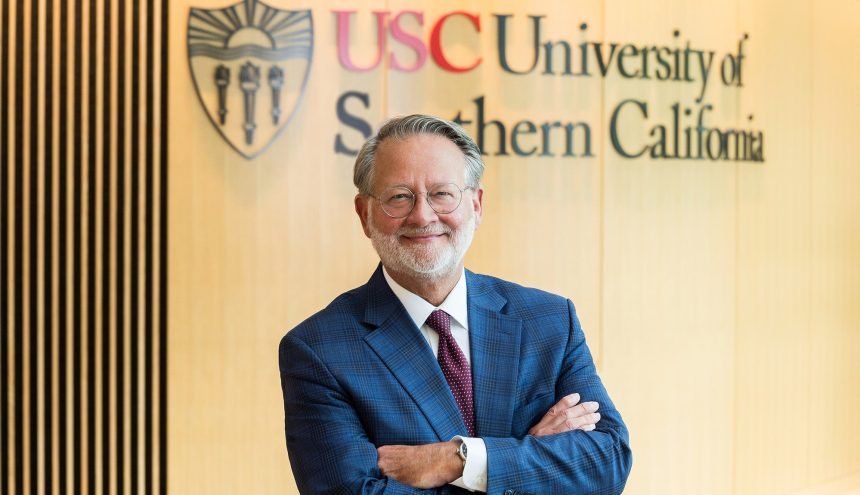
Long before he became Michigan’s senior senator, Gary Peters had begun a career in higher education.
He taught at several Michigan universities and was working toward a doctorate in political philosophy at Michigan State University, intending to become a professor. Instead, politics took him from local and state office to nearly two decades in Congress.
Soon, Peters will return to higher education.
After completing his Senate term in January, he will hold the Carmen H. and Louis Warschaw Endowed Chair in Practical Politics and serve as director of the Center for the Political Future at the USC Dornsife College of Letters, Arts and Sciences. He will serve alongside Republican strategist Mike Murphy, who remains co-director. The center is believed to be the only university political center in the country jointly led by a Democrat and a Republican.
Robert Shrum, CPF’s founding director and current holder of the Warschaw Chair, will retire at the end of 2026. A veteran Democratic strategist, he was honored at galas in Los Angeles and Washington, D.C., earlier this year that recognized his leadership and tremendous contributions to CPF.
Now in his second Senate term after three terms in the House, Peters has been recognized for his legislative effectiveness. The nonpartisan Center for Effective Lawmaking ranked him the most effective U.S. senator in each of the last three Congresses. He first earned the top ranking while his party was in the minority, something no senator had accomplished in more than 50 years.
Inspiring students to be more politically engaged
Peters says what’s drawing him back to higher education is the opportunity to work with young people and encourage them to become more engaged in public life.
“I look at this as a capstone of my years in public service at the local, state and federal level,” Peters said. “It’s never been more important to bring people together, and there’s no better place to start than working with students and getting them engaged in civic activism.”
Peters worries that too many young people see politics as toxic and want little to do with it. He sees CPF’s work preparing students for political life as especially important, whether they eventually run for office, work in government or simply become more active citizens. “It’s critically important that the next generation take the reins and work to find positive solutions to the tough problems we have,” he said.
For Peters, that means reaching students who might never think of themselves as political. He wants to build on CPF’s success by drawing students from across all academic fields at USC into conversations about how politics and public policy affect their professions and their lives.
Since its founding in 2018, CPF has built a range of programs that give students opportunities to learn about politics from the people who shape it. The center has brought political leaders and strategists from across the ideological spectrum to USC as fellows, where they lead small study groups and meet one-on-one with students. Students can also pursue internships, scholarships and professional development through CPF’s Jesse M. Unruh Institute of Politics, while the center’s public events bring together political figures with differing points of view.
CPF’s commitment to civil dialogue was another reason Peters said he was drawn to the center.
“CPF has done a terrific job bringing people with different perspectives together,” he said. “I want to build on Bob Shrum’s accomplishments, and I look forward to working with Mike Murphy to ensure we continue to have a forum where people can discuss tough issues, find common ground and actually accomplish something.”
For Peters, working across political differences isn’t just an aspiration. It has defined his Senate career.
“Gary Peters brings an extraordinary combination of public service, bipartisan leadership and real experience getting things done in Washington,” USC Dornsife Dean James Bullock said. “He has spent his career showing that you can hold strong political convictions and still work productively with people who see the world differently. I’m especially excited about what his leadership will make possible for our students, both in Los Angeles and in Washington.”
Expanding CPF’s reach in D.C.
One of Peters’ biggest ambitions is to expand CPF’s presence in Washington, D.C., with USC’s Capital Campus as a base for courses and programs that bring students closer to the institutions and people shaping national policy.
Los Angeles will remain the center’s home, but Peters will divide his time between L.A. and D.C., teaching courses at both campuses. He wants students in Washington to see policymaking as it happens and interact directly with the people involved in it.
“I’m excited for the opportunity to build out CPF in Washington and to engage students in a meaningful way,” Peters said. He envisions that expansion working in both directions, bringing students closer to policymaking while also bringing USC faculty and their research closer to policymakers.
“I would like to help bridge the gap between academia and practical policymaking in Washington,” he said. “I intend to bring professors doing amazing work in all sorts of fields to D.C., so that they can have a hands-on role in making their ideas become public policy.”
Putting bipartisanship into practice
Peters knows from experience that turning ideas into policy often requires working across party lines.
Republican Sen. Rick Scott of Florida, who worked with Peters on the Senate Homeland Security and Governmental Affairs Committee, described him as “a consistent, bipartisan partner who was always willing to work across the aisle and deliver real results for the American people.”
“I know he will carry that same thoughtful, collaborative spirit with him to USC, and I look forward to seeing what this new partnership produces,” Scott said.
During the 117th Congress, Peters authored 19 bipartisan standalone bills that were signed into law, the most by any senator in a single Congress in more than four decades.
“Gary Peters is that rare thing: a principled politician who also knows how to get things done,” said CPF co-director Murphy. “I very much look forward to working with him as we grow the center’s mission to teach and inspire USC students to embrace the idea that civility and reasoned compromise are far from the enemy of politics; they’re essential to turning political disagreement into practical results.”
A return to higher education
Prior to his election to Congress, Peters worked in the private sector for more than 20 years as both a financial advisor and in a variety of management positions with two major financial services firms. He was an assistant vice president at Merrill Lynch before working at UBS/PaineWebber as a vice president. He also taught strategic management and finance at Oakland University and Wayne State University.
After serving as a Lt. Commander in the U.S. Navy Reserve, a city councilman, and a Michigan state senator, he was appointed as the Robert and Marjorie Griffin Endowed Chair in American Government at Central Michigan University.
This time, he will return to higher education with something he couldn’t have brought to those classrooms: firsthand experience inside Congress and an understanding of how federal political institutions work, why they sometimes don’t, and what it takes to turn ideas into policy.
“I’ve learned a lot over the years about what it takes to get things done at all levels of government, and I look forward to sharing my experience with students,” Peters said. “But I expect to learn from them, too. They’re the ones who are going to take the reins next, and I will do whatever I can to help prepare them for the future.”