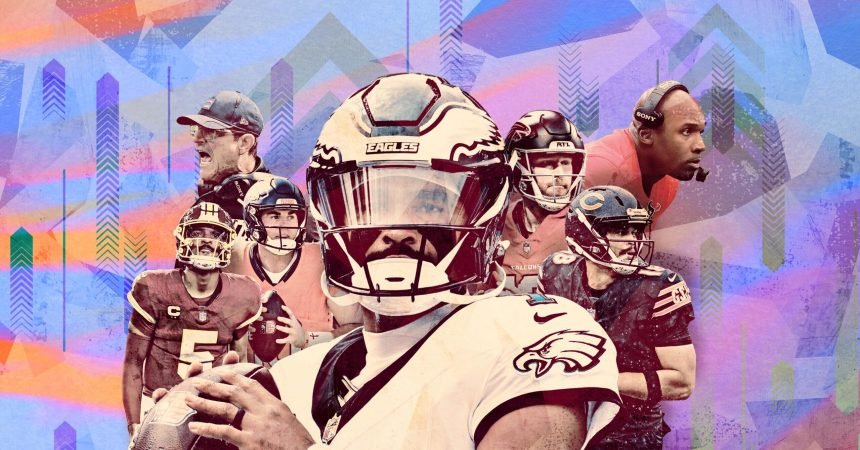

Every week this NFL season, we will break down the highs and lows—and everything in between—from the most recent slate of pro football. This week, two young franchise quarterbacks suffered scary injuries, the Chargers flopped (again!), Jalen Hurts delivered a signature game-winning drive, the Colts blew it against the Chiefs, and more. Welcome to Winners and Losers.
Loser: The Colts’ Overtime Play Calling
Never let a coach tell you that games aren’t won or lost in one moment, one play, or one sequence. Indianapolis lost to Kansas City, 33-30, over the course of exactly 1:45 of game time in the overtime period Sunday night, and head coach Shane Steichen now has to own it.
Trailing 30-27 after Kansas City’s first overtime possession, Colts quarterback Daniel Jones ripped a 48-yard pass to receiver Laquon Treadwell It was a brilliant play call, and an even better throw, and it set the Colts up in the red zone and gave Indianapolis a chance to upset the Chiefs at home. But it would take more aggressive play calling from Steichen to do it—and that’s where he came up short.
Steichen decided to run the ball on first and second down, and those two rushes by Jonathan Taylor went for a combined loss of 3 yards, leaving Jones to try to make magic on third-and-13. Jones, in his second game back after tearing his Achilles tendon last season, kept the ball, scrambled, and was pushed out of bounds well short of the sticks, and Indianapolis—after flirting with the idea of going for it on fourth-and-8 from the 15-yard line—was forced to settle for a game-tying field goal.
You know what happens next when Patrick Mahomes has three minutes on the clock and only needs a field goal to win.
There were a host of questionable coaching decisions in Week 2 (this is what we call a tease for the rest of this piece!) but Steichen’s overtime turtling stands out because it was a choice. A choice to play it safe when aggression had already been rewarded in the same possession. A choice to put Chiefs defensive coordinator Steve Spagnuolo on the ropes, just to allow Spags a chance to recover and get his defense back in an advantageous position. A choice to cede control of the outcome back to one of the greatest late-game quarterbacks in football history.
The loss itself is a gut punch for the Colts, but if you’re an Indianapolis fan, it’s got to feel even worse because it was all so familiar. The Colts lost 23-20 to the Chiefs at Arrowhead Stadium less than a year ago. That time, Steichen misread his offense and what was working, calling for too many passes when the run game was cooking. Sunday night’s game felt like an overcorrection to that loss, and Steichen wasted an opportunity to put Mahomes and the Chiefs away by being too conservative when it counted. Too often, this has been the story of the Steichen era in Indianapolis; a team that’s perpetually close enough to be talked about as one of the AFC’s better teams, but always a tough loss or two away from being a true contender.
In Colts owner Carlie Irsay-Gordon’s first public comments of 2026, she stressed urgency as the clear theme. The team last year traded multiple first-round picks for cornerback Sauce Gardner. Earlier this year, it committed big money to Jones and wide receiver Alec Pierce The Colts can’t afford to wait around and hope for good things to happen in 2026; they need to seize every opportunity to win. That’s especially true for Steichen. There was a chance tonight to avenge last year’s loss to the Chiefs, to bounce back from a blowout loss to Baltimore, to give some signal that the Colts can make their own good fortune. Instead, Steichen decided it’d be better to sit back and watch his opponent do it. —Diante Lee
Losers: Jim Harbaugh and Mike McDaniel
No, these aren’t the same ol’ Chargers. These Chargers might be worse. This is a polished, souped-up team with legendary head coach Jim Harbaugh, super-genius offensive coordinator Mike McDaniel, and a 6-foot-6, 235-pound “football robot” at quarterback—playing in sunny Los Angeles with all the pretty girls. Yet on Sunday, they fell 26-14 to the Raiders, their second straight home loss as touchdown-plus favorites. Harbaugh has literally never started a season 0-2 in more than two decades of coaching in college and the NFL.
The offense is a hot, sticky blend of dysfunctional and clunky. The Bolts were one of the most buzzed-about teams of the preseason because McDaniel was supposed to finally blow the ceiling off a Justin Herbert–led offense using his own brilliance as a run game designer and a running back who looks like a log cabin on wheels (Omarion Hampton).
But through two games, Herbert already looks January-level flustered. It feels like McDaniel and Harbaugh might be stuck competing with or one-upping each other rather than collaborating on a cohesive offense. Harbaugh is full-fat milk and khakis. McDaniel is Cartier. Harbaugh is tough, sound, fundamental football. McDaniel is a lot of flash and candy (wild backfield play fakes and a lot of pre-snap motion).
The bad news is—again, after getting dog-walked by the Cardinals and the Raiders, two teams with dreadful rosters—the Chargers have the hardest schedule in the league by a country mile over the next two months: at Bills, at Seahawks, vs. Broncos, at Chiefs, at Rams, vs. Texans, at Ravens. To call that a gauntlet sells it short. It’s a Thunderdome or a sarlacc pit.
It’s also bad news that the Chargers have the fourth-worst rest edge (–24 days) of any team since 1990. The cherry on top of all that bad news—sorry, there’s no good news—is that the Chargers’ reshuffled interior offensive line is as bad as, if not worse than, last year’s line; their best receiver, Ladd McConkey, is playing with cracked ribs; and their best pass rusher, Khalil Mack, is 35 years old.
The Chargers’ home field felt like a black hole on Sunday, as it has every time the Chargers have hosted the Raiders since Dean Spanos scurried and slimed his way out of San Diego years ago. There was a moment in the broadcast when CBS showed a decked-out Chargers fan amping up the SoFi Stadium crowd with his team staring down a third-and-7 while trailing by three in the fourth quarter.
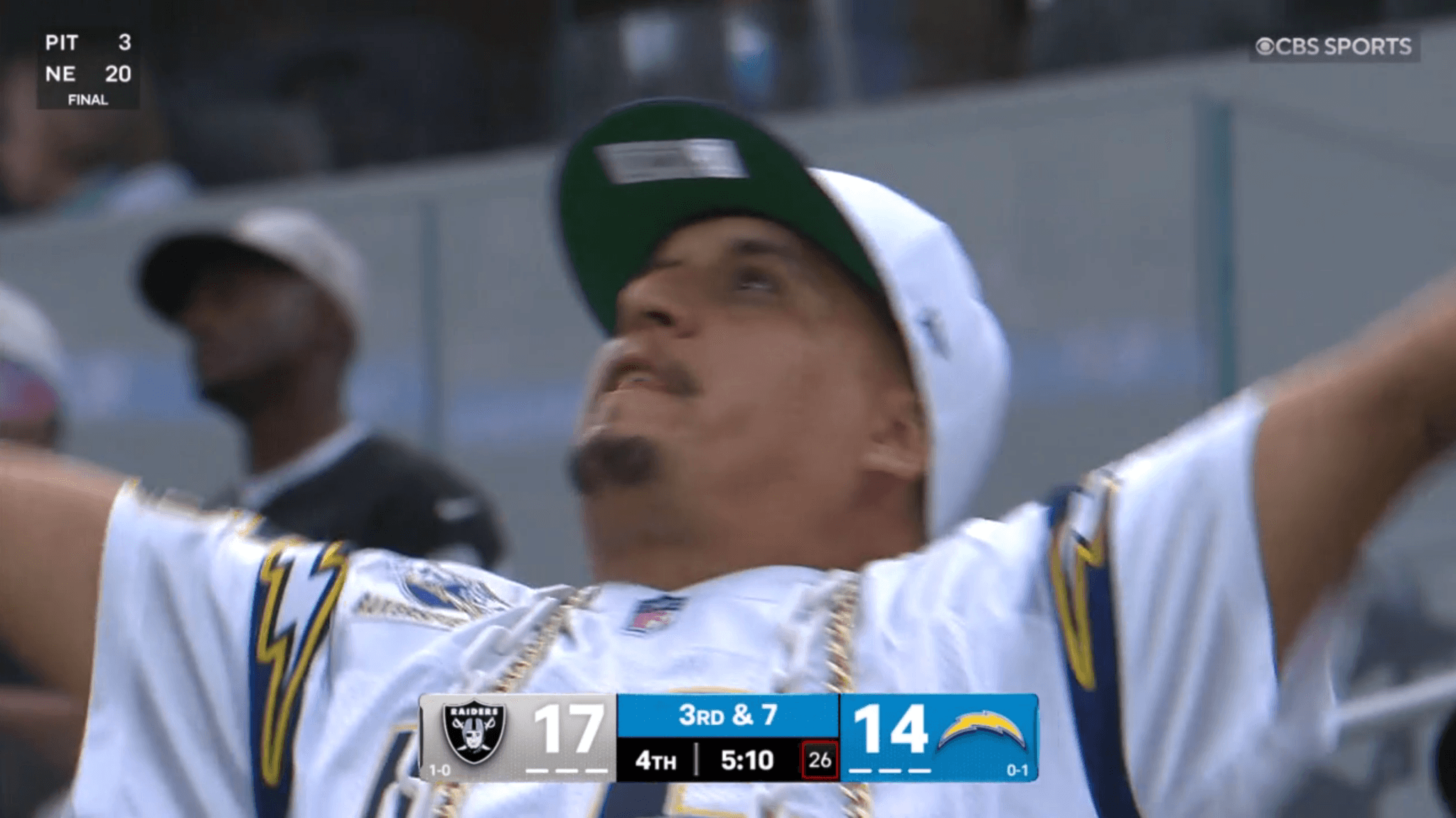
That guy did his job. The stadium full of Raiders fans got loud as hell, and the Raiders got to Herbert for a sack-fumble. Chargers fans don’t exist. The ones that do don’t show up to the games. The ones that show up unknowingly root for the Raiders. Incredible. —Austin Gayle
Loser: Chicago’s Pursuit of the NFL Scoring Record
Bears quarterback Caleb Williams left midway through the fourth quarter of Chicago’s game against Minnesota after suffering a non-contact hamstring injury. Bears head coach Ben Johnson said postgame that the team won’t know the full extent of Williams’s injury until he goes through further testing on Monday, giving Bears fans some hope that maybe Williams didn’t suffer a complete tear. Johnson said Williams was in “good spirits” after the game, and Williams was spotted walking after the game without assistance.
Still, it’s hard to shake the image of Williams writhing on the field after a scramble near the end zone, just when it finally seemed like the Bears offense had come to life, or to watch him get driven to the locker room on a cart without wondering what comes next for the Bears.
After scoring 59 points in its opener against Carolina, Chicago mustered just a field goal in Week 2. If Williams misses several weeks, a Chicago offense that looked unstoppable in Week 1 will have little margin for error. Williams’s scrambles account for more than a quarter of Chicago’s 322 rushing yards through the first two weeks, while nearly a third of his 379 passing yards have come on throws outside of the pocket. The Bears cannot count on that type of production from backup Tyson Bagent. Chicago has been hard to beat since Johnson’s arrival because the combination of Johnson as a schemer and Williams as a playmaker forces defenses to prepare for two separate offenses—Johnson’s on-paper design and what Williams produces with his creativity and dynamism when playing out of structure.
It feels like any pursuit of the all-time scoring record is on hold as long as Williams is sidelined, as the Bears will have to lean heavily on the run game for however long he is out. Chicago’s next game is against the Eagles on Monday Night Football in Week 3, but the slate of opposing defenses after that game isn’t too intimidating, with matches against the Jets, Packers, and Falcons. Chicago may not need the type of explosive offense we saw in Week 1 to win those matchups in Weeks 4-6.
And while Bears fans hold their breath for the results of further testing on Williams’s hamstring, there’s one more way to take a glass-half-full look after a miserable Sunday in Chicago: The Bears don’t have to face a Brian Flores defense again until Week 18. —Lee
Winner: Brian Flores, Scheme Lord
After a 59-point explosion from Chicago’s offense and a second-half master class from Minnesota’s defense last week, I was convinced that we were in for a classic coaching chess match in Week 2 between Bears head coach Ben Johnson and Vikings defensive coordinator Brian Flores.
I imagined a back-and-forth game, going from a perfectly called Flores blitz on one play to a coverage-breaking deep pass dialed up by Johnson on the next. But for most of Sunday’s game, we got neither. Bad weather in Chicago turned this game into a slog. Everything was a struggle. Chicago’s only good plays came when Caleb Williams used his legs; he picked up 27 yards on his three scrambles away from the Vikings’ defensive front. It wasn’t until the fourth quarter that Chicago had a pass of 20 or more yards, and even that came on a 32-yard screen to running back D’Andre Swift that required him to make an unblocked tackler miss. The rest of the game for the Bears was a morass of short gains and incomplete passes while Williams did everything he could to anticipate and evade Flores’s blitzes.
This interception was an example of Williams attempting something that was unnecessarily difficult, the type of decision a quarterback makes when nothing has been open all game.
Flores’s defense wasn’t perfect, but the fact that the Vikings kept the Bears out of the end zone is the week’s biggest win. Chicago had the NFL’s best rushing attack in Week 1 (with 291 rushing yards and six touchdowns), but Minnesota held the Bears to less than 4 yards per carry on Sunday—and that includes Williams’s scrambles. And in the first three quarters of the game (before Williams left with a hamstring injury), Williams’s passer rating was just 46.5.
Flores was the best coach on the field in this game, and this is consistently true whenever the Vikings play. His defensive scheme constantly puts offenses in no-win situations, manufacturing unblocked pressure at the line of scrimmage while somehow keeping receivers from being wide open downfield. The Vikings have a patchwork defensive front with several young and unheralded defensive linemen, yet they totally controlled this game between the tackles. Flores is a Bill Belichick disciple, but he doesn’t just take away the things his opponents do best like his mentor did. His blitzes and disguises are so extreme that he makes opposing offenses, even those as explosive as Chicago’s, completely unrecognizable.
Flores has started off this year with two excellent game plans, and he’ll be hard to overlook as a head coaching candidate next year if he keeps shutting down offenses like he did on Sunday. —Lee
Winner: Jalen Hurts’s Ability to “Finish That Shit”
Jalen Hurts and the Eagles don’t usually care much for style points. Throughout most of the Nick Sirianni era, they have mastered the art of winning ugly. They’ve become the kings of doing just enough to survive while giving their rabid fan base ammunition to criticize them all week long. But on the road Sunday against a Titans team that was hapless in Week 1, the Eagles squandered their chance to salt away an ugly win. They fell behind by three points with less than two minutes remaining, so Hurts needed to engineer something spectacular in order to avoid an embarrassing loss.
It was eerily similar to the last time Hurts faced a Robert Saleh defense. In the Eagles’ playoff loss to the 49ers (with Saleh as their DC) in January, the Eagles had the ball late, down by five, with a chance to save their season. That drive ended with a fourth-down stop. Saleh has had a pretty consistent game plan when he’s faced Hurts over the years. His defenses bring four pass rushers, use those rushers to keep Hurts from scrambling, and play zone on the back end. It tends to work. Hurts threw three interceptions in one of the worst games of his career against Saleh’s Jets in 2023, and a shorthanded Niners defense held the Eagles to 19 points last postseason.
So even after a pretty poor performance against the Jets in Week 1, the Titans defense was confident. All-Pro defensive tackle Jeffery Simmons was very blunt about Tennessee’s defensive game plan earlier in the week. “Make Jalen Hurts be a QB,” Simmons said. “Stop his runs, make sure Hurts doesn’t get out of the pocket and make plays.”
Tennessee got almost exactly the type of game it wanted. The defense intercepted Hurts twice, and kept Philadelphia from being able to run the ball with any consistency. Hurts rarely escaped the pocket to scramble effectively. Philadelphia’s complete ineptitude on early downs for much of the game repeatedly left Hurts trying to rescue possessions on third-and-long.
But with the game on the line, Hurts played QB. He went 6-for-8 for 61 passing yards and a touchdown on the Eagles’ final drive. Once you add in his 4-yard scramble, the Eagles quarterback accounted for all 65 yards in the final 1:56.
First, Hurts found Dontayvion Wicks for a 20-yard gain down the right sideline on third-and-6. When the same down-and-distance arrived again later in the drive, Hurts threw a corner route to DeVonta Smith up the left sideline to put the Eagles inside the 5-yard line with 14 seconds left. And in style, Hurts flipped the ball to a wide-open Darius Cooper in the back of the end zone to win the game. It was the Eagles’ first fourth-quarter game-winning touchdown drive since Week 3’s comeback win against the Rams last year.
Every Eagles game becomes a national referendum on how much credit belongs to Hurts and how much belongs to everything surrounding him. But right now, there are real problems for Philadelphia to solve. The offensive line hasn’t played well in the first two weeks. The early-down offense has created far too many difficult third-down situations. Vic Fangio’s defense has struggled throughout both second halves and allowed Cam Ward to play one of the best games of his career on Sunday.
But after an offseason spent discussing how much talent the Eagles have assembled around their quarterback, they are 2-0 because of him. He was the one who finished that shit, and he got to tell that to Simmons’s face. —Anthony Dabbundo
Winner: Davis Webb’s Job Security
No new play caller entered Week 2 under more pressure than Denver’s Davis Webb. It’s not that the Broncos offense was exponentially worse than the rest of the league in Week 1—though it wasn’t good in a blowout loss to the Chiefs. It’s that no other offensive coordinator has Sean Payton breathing down his neck.
For the first 30 minutes of Sunday’s game against the Jaguars, it felt like Payton might stomp down the sideline and rip the play sheet out of Webb’s hands at any moment. Denver’s offense was sluggish and sloppy, particularly in the red zone. In two early trips deep into Jacksonville territory, the Broncos came away with just three points, thanks to an ugly goal-line sequence of run plays that went backward and a Bo Nix interception.
Can’t fault Webb here. This is just an incredible effort from Jourdan Lewis to outjump Courtland Sutton.
By the fourth quarter, though, Webb and Nix found a rhythm, and they did it by funneling downfield targets to receiver Jaylen Waddle and distributing underneath passes to tight ends and running backs. Waddle, who had just one catch for 2 yards in his Broncos debut, went off for 138 yards on eight catches on Sunday, giving Denver the explosive receiving option the offense was missing last year. Nix averaged 9.3 yards per attempt against Jacksonville, the second-highest mark of his career (behind a Week 18 game against the Chiefs backups in the 2024 season).
Denver knows its winning formula: keep Nix clean (he wasn’t sacked), lean on the defense (Denver flustered Trevor Lawrence, holding him to just 189 passing yards, with two sacks, no touchdowns, and an interception), and keep the game close enough for Nix to make some magic in the fourth quarter. When that plan doesn’t work, like against Kansas City, the Broncos fail spectacularly. But when Webb and Nix are in sync, the Broncos can be dangerous—and Payton can maybe back off a bit. —Lindsay Jones
Loser: Aaron Glenn, Game Manager
When a team makes controversial game management decisions in the fourth quarter or overtime, it usually sets off a cascade of debate among the Analytics Guys vs. True Football Guys. These two factions almost never agree—so you know a head coach really screwed up when they reach a consensus. Enter Aaron Glenn. We can all agree that the Jets head coach blew it in crunch time of a 20-17 overtime loss to the Packers.
Things started going sideways for Glenn’s Jets late in the fourth quarter with the game tied at 17. The Jets called back-to-back runs on third and fourth down, and both runs got stuffed, giving the ball back to the Packers. Before those failed rush attempts, the Jets’ seven rushes in the fourth quarter gained just 12 yards, while quarterback Geno Smith had completed 71 percent of his passes in the final frame. I tend to believe that any team that can’t move the sticks on the ground doesn’t deserve to win, but in this case, taking the ball out of Smith’s hands and giving it to running back Braelon Allen was a mistake.
By some miracle, the football gods didn’t punish Glenn for his conservatism right away. In fact, the Jets defense actually got a stop on the ensuing possession, as Jordan Love threw two incompletions and a pass well short of the sticks on third down. Glenn should have taken a timeout there, stopping the clock before the Packers’ punt with just under a minute to play. Instead, Glenn made the inexplicable decision to allow Green Bay to run down the play clock until it expired and for some reason accepted the Packers’ delay of game penalty and the 10-second runoff that came with it. Instead of getting his team the ball back with enough time to conceivably get into field goal range, Glenn essentially waved a white flag on regulation and headed to overtime.
There’s no game theory or advanced analytics needed; there’s only one correct decision Glenn could have made here. Even if the Packers had downed a punt inside the 5-yard line, at least Glenn would have exhausted every opportunity to win in regulation. When he was asked about his decision postgame, Glenn said he never even considered calling a timeout because he was worried that a punt would have pinned his offense against its own goal line. Huh?? That’s asinine and defeatist, reflective of the kind of losing Jets culture Glenn has been trying to break.
If only that were Glenn’s last bad decision. New York won the overtime coin toss and chose to take possession first. Glenn thought this would give him control of the clock—but that is a fundamentally improper way to approach the NFL’s modern overtime rules. Because both teams are guaranteed a possession as long as time is on the clock, the second team to possess the ball will almost always have more control. The only way the team that gets the ball first can totally dictate the outcome is by going on such a long, slow drive that it takes the entire 10 minutes to score a touchdown. That’s a near-impossible needle to thread.
This overtime decision finally incurred the wrath of the football gods, because when the Jets offense did get the ball, it was a total mess. Smith took two sacks, and the offense committed a false start. The Packers got the ball back needing just a chip-shot field goal to win.
This was a game New York never should have lost. It had a 10-point lead at home in the fourth quarter and had the Packers on the ropes. A 2-0 start was right there. It will be hard for Glenn to come back from this. He was already coaching for his job this season, and for about 59 minutes, the Jets were the better team. But when it mattered most, he wasn’t the better coach. —Lee
Loser: The Bucs … to the Browns and Mother Nature
Losing at home to Deshaun Watson and the Browns feels like a new low point for the Todd Bowles era in Tampa. Maybe it’s because the Bucs are now 0-2. Or because the Bucs are 2-9 in their past 11 games under Bowles. Or because Baker Mayfield, their newly minted $165 million quarterback, has already thrown an interception and lost three fumbles this season. Or maybe it’s because on Sunday the Buccaneers sat through a two-hour lightning delay, which should have been plenty of time to prepare for a potential game-winning drive—and still couldn’t produce one competent play when they needed it most.
Tampa Bay trailed the Browns 23-19 and had driven all the way to the Browns’ 28-yard line when severe weather hit and the teams were sent to the locker room. But when they finally returned to the soggy field, the offense was a mess. A Tristan Wirfs holding penalty put the Buccaneers behind the chains. Mayfield barely escaped a sack on 3rd-and-14, and then he misfired a throw to Emeka Egbuka in the end zone.
It would have been one thing if the Bucs had lost because Watson suddenly resembled a competent NFL quarterback. That isn’t what happened. Tampa Bay’s sloppiness on defense repeatedly allowed Cleveland’s offense to keep drives alive, and eventually the Browns were able to steal the game. Consider: The Browns ran for 44 total yards and won an NFL game on the road.
The Buccaneers aren’t buried in the division race. Nobody is ever buried this early in the middling NFC South. The mediocrity of their rivals will provide more chances for the Bucs to recover than they deserve, but Bowles may not have the same leeway after Sunday’s debacle. —Dabbundo
Winner: New Orleans—Built Shough Tough™
Tyler Shough is like one of those boxers who doesn’t activate until he gets socked in the mouth. The Saints’ second-year quarterback has been punched in the face in each of the first two games against the Lions and Ravens, and yet somehow, Shough has been there at the end. In Week 2, Shough willed the Saints to one of the biggest upsets of the season, rallying from a 17-9 deficit to beat the Ravens in Baltimore. Shough played like a completely different quarterback in the fourth quarter of both games. Shough’s dropback efficiency (as measured by EPA) has jumped from 25th in the first three quarters to fourth in the fourth quarter (and overtime) through the first two weeks of the season. The Saints offense overall also ranks fourth in drive efficiency in the fourth and OT, versus 29th over the first 45 minutes of games, when the Saints have overly relied on an ineffective running game. New $52 million back Travis Etienne Jr. has been merely fine in his first two games for the Saints, while 31-year-old veteran Alvin Kamara looks washed, dried, and folded. New Orleans is one of four teams without a 10-plus-yard run in the first three quarters of Weeks 1 and 2.
Then, for the second straight week, Shough got going right as the going got tough. He completed 6-of-6 passes for 50 yards and a touchdown to Chris , who now has 18 catches for 268 yards and a TD in two games, to help tie the game at 17. Then, Shough led the Saints on a 16-play, 68-yard drive in which New Orleans running backs combined for just 1 yard on four carries. Shough punched in a quarterback sneak on fourth-and-goal to give the Saints their first lead at 24-17 with less than 90 seconds left.
And this week, Shough made his fourth-quarter magic against a good defense, not a bottom-of-the-barrel unit like what he saw in Detroit last week. The Ravens defense is loaded with talent like Kyle Hamilton, Marlon Humphrey, Roquan Smith, Travis Jones, and Nate Wiggins, who are all above-average starters. Shough stared down a team with Lamar Jackson on the other sideline and didn’t blink, and that unwavering confidence might make the Saints the favorite in the NFC South. With the Falcons bottoming and the Bucs swirling down the toilet Bowl(es), the Built Shough Tough™ Saints feel live. It’s clear the Saints have something in Shough. Even if that something is just unbridled fight to the end, that’s special. —Gayle
Loser: Jayden Daniels’s Luck
The Jayden Daniels Experience in the NFL has become equal parts awe and dread. Few quarterbacks make football seem more effortless when they’re playing well, and that’s what Daniels was doing through the first six quarters of this season. And few quarterbacks make you hold your breath at every step or burst into the open field with fearful anticipation that any big hit or open-field stumble could lead to a season- or career-altering injury.
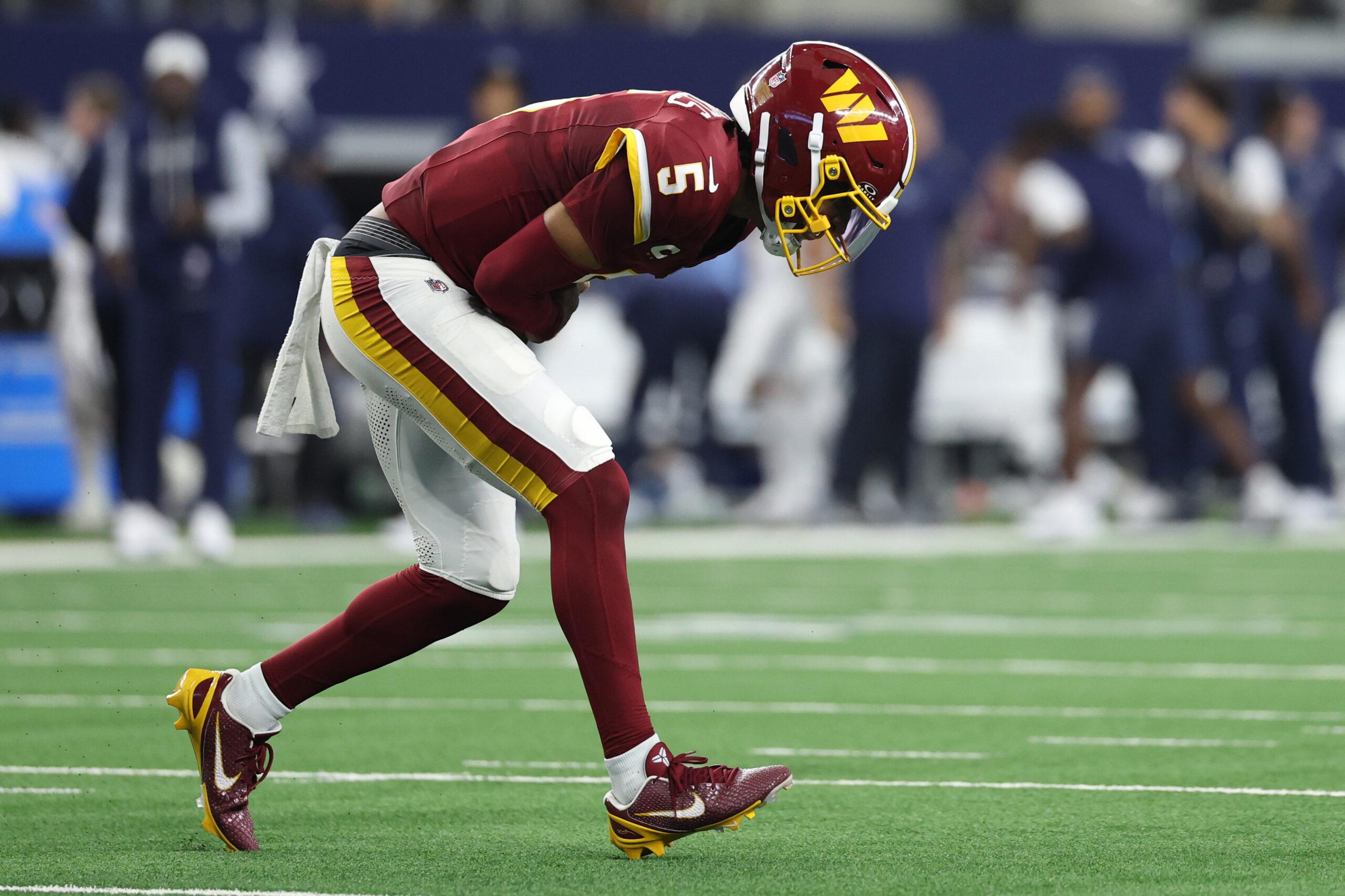
Daniels had diced up a strong Philly defense in the second half of the Commanders’ Week 1 loss. And he was on his way to putting up 17 first-half points in Week 2 against Dallas, going 11-for-17 for 96 passing yards, along with seven runs for 69 yards. The Commanders had one final play before halftime to try to score from the 1-yard line and go into the half tied.
One misstep changed everything. Commanders pulling left guard Chris Paul stepped on Daniels’s foot. Daniels tripped and, as he tried to brace his fall, he dislocated his left elbow, a nearly identical injury to the one that ended his 2025 season. Tom Brady spoke for everyone with a horrified “Oh, shit” on the Fox broadcast.
Daniels was carted to the locker room, and X-rays were negative, but the expectation is Daniels will miss time.
His dazzling rookie season feels further and further in the rearview, and Daniels’s durability questions don’t become any less consequential just because they’re the result of bad luck. Daniels will eventually have to face another round of questions about whether his body will ever allow his talent to fully flourish—even though it’s yet again a freak elbow injury that has sidelined him. Daniels had already missed games due to rib, knee, elbow, and hamstring injuries in his first two full seasons, and now the elbow issue appears to be a recurring one. —Dabbundo
Winner: The Falcons’ March for Arch
Arch Madness has a clear front-runner.
The Falcons had one of the league’s worst quarterback situations heading into this season, and that was before they were forced to start QB3 Cooper Rush in Weeks 1 and 2. No team should reasonably expect to be competitive with their third-stringer, and yet, Rush’s performance has been even worse than anyone could have imagined. He lost a fumble on his first play of the game Sunday against the Panthers, and followed that up with an interception on the Falcons’ second possession. At one point in the first half, he had a —2.20 EPA/dropback. (For context here, remember the Nathan Peterman Game? When the Bills QB threw five interceptions in one half? He was only at —1.41 EPA/DB that day.) Rush was eventually benched during the blowout loss for Jack Strand, an undrafted rookie from Minnesota State-Moorehead. Strand promptly threw a pick-six.
The good news, we suppose, is that the Falcons shouldn’t have to be relying on their QB3 and QB4 for much longer. Michael Penix Jr. has been cleared to return after missing most of training camp while recovering from ACL surgery. He practiced last week but wasn’t quite ready for game action; that should change Thursday night when Atlanta plays Green Bay in Week 3. (QB2 Tua Tagovailoa remains sidelined with an oblique injury that popped up in practice before Week 1.)
But the Falcons look like a team with much deeper issues than the quarterback situation, especially with a defense that put up little fight on Sunday against Bryce Young, who led the Panthers offense on five scoring drives (three touchdowns, two field goals). We should not assume that the Falcons offense will just suddenly become competent when Penix is under center instead of Rush or Strand. Penix was a mediocre quarterback last season before he was injured—ranking 25th by EPA/dropback and 30th out of 33 qualified passers by completion percentage—and missed nearly all of the offseason and preseason, time in which head coach Kevin Stefanski installed a new offense.
There are a handful of teams that figure to be in the market for a new quarterback next season—like the Browns, Cardinals, and Steelers, each of whom are 1-1. So for as painful as Sunday likely was for the Falcons and their fans, falling to 0-2 puts Atlanta in the driver’s seat for the no. 1 pick in next year’s draft. —Jones
Loser: DeMeco Ryans
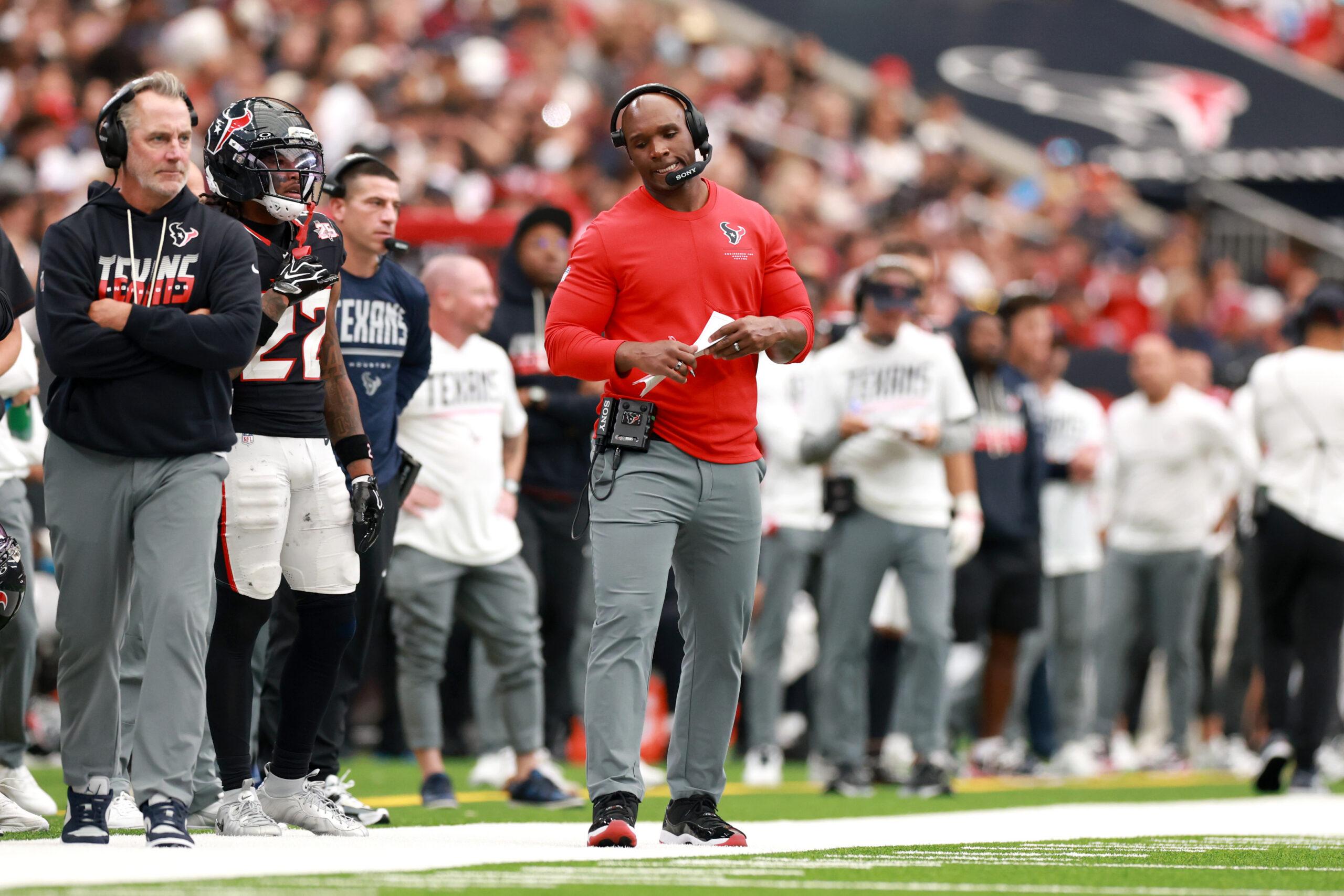
DeMeco Ryans’s team has big problems. The offense stinks—again. The offensive line is bad—still. The run game is non-existent, and quarterback C.J. Stroud is collapsing in big moments—does this sound familiar? But blaming OC Nick Caley, Stroud, and the offensive line is tired. (I’m also unwilling to cede the Nico Collins injury excuse; every team in the NFL is navigating injuries every week.) Ryans, the beautiful, bald franchise legend and defensive genius, just keeps settling for the same ugly offense over and over again.
Caley is uncreative as a play caller and Stroud is panicky in high-leverage situations. That’s a dangerous combination, and now we’ve seen them together for 21 games (including playoffs). Stroud clearly doesn’t trust his offensive line, and Caley has not built any easy buttons into this offense, especially when Collins is out. Houston ranks 28th(!) in second-half EPA per play and 32nd in full-game red zone touchdown percentage since Week 1 last year, and the run game ranks bottom-four in success rate and 10-plus-yards run percentage.
Ryans stuck with former OC Bobby Slowik a year too long, and now it looks like he’s going to go a year too long with Caley, barring a midseason change. That’s on top of Ryans making his own game management mistakes. His biggest mistake in Sunday’s 20-6 loss to the Bengals was when he opted for a 58-yard Ka’imi Fairbairn field goal attempt on fourth-and-1 on the Bengals’ 40-yard line while trailing 10-3 in the third quarter. Fairbairn didn’t even have enough leg for the , which means Ryans trusted his weak-legged kicker over trusting Caley and Stroud to pick up 1 yard. Later, Ryans had an opportunity to go for it again on fourth-and-1 trailing 20-6 with 3:21 left in the fourth quarter, but the game was already out of hand. This time, Ryans went for it—but Caley called a five-man protection out of shotgun. Stroud had no one open and forced a bad pass that was nearly intercepted as the pocket collapsed.
It’s sad to see Ryans like this. He’s pacing for 0-for-2 on OC hires and is now 0-2 to start the season, with a road trip to Indianapolis and then a home game against the Cowboys up next. We can’t consider Houston a true contender until Ryans finds someone he can trust to run even a league-average offense. —Gayle