
NFL Week 3 best bets: Bengals, Seahawks and Lions worth backing
Adam Kaufman breaks down his best bets for NFL Week 3, highlighting favorable spots for the Bengals, Seahawks and Lions.
Sports Seriously
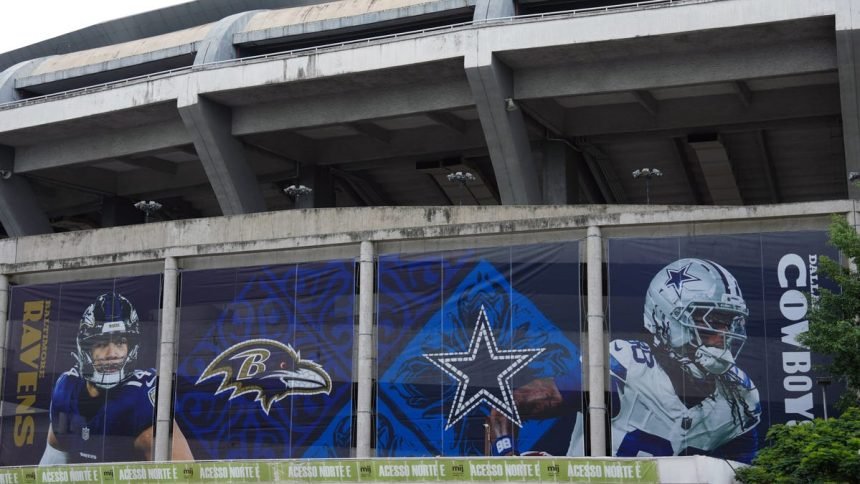
The NFL is preparing to play its first game in Rio de Janeiro on Sunday, when the Dallas Cowboys and Baltimore Ravens will meet in the season’s second international game as the league’s expansion into foreign markets moves into overdrive.
However, week-long speculation has percolated regarding the quality of the field conditions at Maracanã Stadium. The region has been subject to record rainfall, the most Rio has had since it began tracking it in 1997.
While addressing internal and public concerns that Sunday’s playing surface may not be up to NFL standards, NFLPA executive director JC Tretter, who was a starting center for most of his eight seasons as a player with the Green Bay Packers and Cleveland Browns, has put a spotlight on some of those worries with a lengthy statement posted to social media on Friday, Sept. 25.
It’s safe to say the union would like to see the league tap the brakes on its overseas ambitions until field conditions at home and abroad can be more uniformly elevated to a standard the players are comfortable with − and that may materialize as a key issue whenever the NFL and NFLPA negotiate their next collective bargaining agreement, though the current CBA is schedule to run through the 2030 season.
Tretter wrote on X:
“There have been a lot of questions about the field surface in Brazil, and I wanted to provide the NFLPA’s perspective.
“Our number one priority is the health and safety of our players. The concern heading into this week was that the field would be loose, patchy, and lead to excessive slipping. Those conditions are generally more of a playability and performance issue than a significant injury concern.
“But safety isn’t the only standard. Players should be able to perform at the level they expect of themselves and that fans expect from them. A thin, slick field may not present the same risks as a surface with too much traction, but it still affects performance and the quality of the game.
“We’ve been in regular communication with the league about the field. Both the NFLPA’s and the league’s field experts have been on the ground in Brazil for days, monitoring conditions and working to make the surface as safe and playable as possible for Sunday.
“Based on our experts’ assessment, the field needed better traction and stability. They recommended reinforced stitching to help the surface hold together and brought in equipment to reinforce as much of the field as possible before the game. Our experts will remain engaged and continue evaluating conditions through kickoff.
“The work happening this week also highlights two larger issues.
“First, we need field standards that account for both safety and performance. The NFL, NFLPA, and our field and engineering experts spend a lot of time working on these issues, and we’ve made progress. But we’re not where we need to be yet. We can’t have surfaces that melt players’ cleats, like we saw in Nashville last week. We can’t have frozen fields that create unnecessary risks. The best athletes in the world should be playing on surfaces that meet the same standard of excellence we expect from them every week.
“Second, this reinforces one of our concerns about international expansion. Two of the three games played in Brazil have had field-related issues. That’s not a coincidence. This time of year makes it extremely challenging to maintain the kind of grass surface we expect at the NFL level.
“Our guys are exceptional at what they do, and I’m confident they’ll put on a terrific game in Rio this week. They always do. But we owe it to them to provide the best possible opportunity to succeed. Players can overcome a lot. But they shouldn’t have to overcome the field.
“The NFL has been clear they want to continue to grow the game internationally. However, growth alone cannot be the goal. The goal has to be growing the game while maintaining the standards our players deserve. If we can’t do both, then we need to make different decisions.”
The NFL made its entry into the Brazilian market with a game in São Paulo in both the 2024 and ’25 seasons. Both games were staged at Corinthians Arena, where the Philadelphia Eagles and Green Bay Packers expressed concerns about a slick, overly soft surface two years ago. Those issues were largely redressed ahead of last year’s matchup between the Kansas City Chiefs and Los Angeles Chargers, including the field stitching − which creates a hybrid of natural and synthetic elements − the league is now implementing in Rio, where a massive tarp will also be used in a bid to keep the surface from getting saturated anew before kickoff.
The NFL is playing a record nine games abroad this season, including its first forays into Australia, Rio and Paris.
NFL response to NFLPA concern
In a statement to USA TODAY Sports in response to Tretter’s post on X, NFL chief spokesman Brian McCarthy wrote: “The health and safety of NFL players is a shared priority, and the NFL works collaboratively year-round with the union to ensure high-quality fields, including for international games. NFL and union experts have worked hand-in-hand in Rio and are confident the field will be ready for play and in compliance.”
What did Jerry Jones say about Rio field conditions?
Well before Tretter’s missive, Cowboys owner Jerry Jones was asked about the field Tuesday on a regularly scheduled Dallas radio appearance.
“I’m comfortable that the field will be ready for us,” Jones said. “It’s realistic that we can have a good game on the field.”
And while Jones admitted he’d rather be playing in front of the Cowboys‘ extensive fan base in Mexico, he also noted playing in subpar conditions has long been a component of American football.
“I had always thought that football was subject to the elements,” Jones said. “That still doesn’t diminish the need to, in advance, feel good about the field and feel that it’s a safe place to play. There may be some slipping, I played a lot of games in the rain and in the mud.
“That’s part of our game.”
NFL playing surface debate
The lack of consistency with NFL fields has become one of the leading wedge issues between the league and union in recent years.
David White, the NFLPA’s interim executive director before Tretter was elected to the post in March, said during the run-up to Super Bowl 60 earlier this year in San Francisco that 90% of the players want to play on natural grass surfaces, saying it’s “common sense” that those fields are more forgiving to the body despite studies that might indicate there’s no appreciable difference between artificial turf and grass.
“The players want a grass surface,” said Jalen Reeves-Maybin, the NFLPA’s president, back in February, adding that also means high-quality fields − a not-so-veiled shot at issues that regularly occur with the natural surfaces in places like Pittsburgh and Chicago.
“Don’t just give us any grass surface now.”
Players piped up anew over the summer as pristine grass fields were rolled into NFL stadiums for the 2026 World Cup … and removed once the tournament ended. Owners and field experts have noted that soccer pitches and NFL fields are subject to much different forces and strains based on the fundamental differences in the sports. Grass fields are also much more difficult to maintain at northern latitudes in the winter months, though Buffalo’s new Highmark Stadium does have a grass surface − much to the delight of Bills players.
All the NFL news on and off the field. Sign up for USA TODAY’s 4th and Monday newsletter.