Updated September 27, 2026 at 12:05 PM CDT
VERACRUZ, Mexico — The historic city of Veracruz, facing the Gulf of Mexico, is so proud of its musical heritage that every hour on the hour, the bells in the clock tower in the central plaza play “La Bamba.” It’s not Ritchie Valens’ rock ‘n’ roll hit from 1958. The original “La Bamba” has been played in this sultry, moldering port city for centuries.
“It’s our hymn,” said one longtime musician.
“La Bamba” is the most famous song of a regional genre called son jarocho, which means the music of Veracruz. It is played at joyous community fiestas called fandangos that have nothing to do with the online movie-streaming service. The fandango emerged from the multiethnic population that evolved along the Gulf Coast after conquistador Hernán Cortés dropped anchor and established Veracruz as Mexico’s first port in the early 1500s.
This syncopated, jubilant folk music is a melange of European, Caribbean and Indigenous influences. While fandangos — where folks gather to play their instruments, sing and dance — are more than 300 years old, their popularity is now spreading around the world.
But if you want to experience the real thing, go to Veracruz.
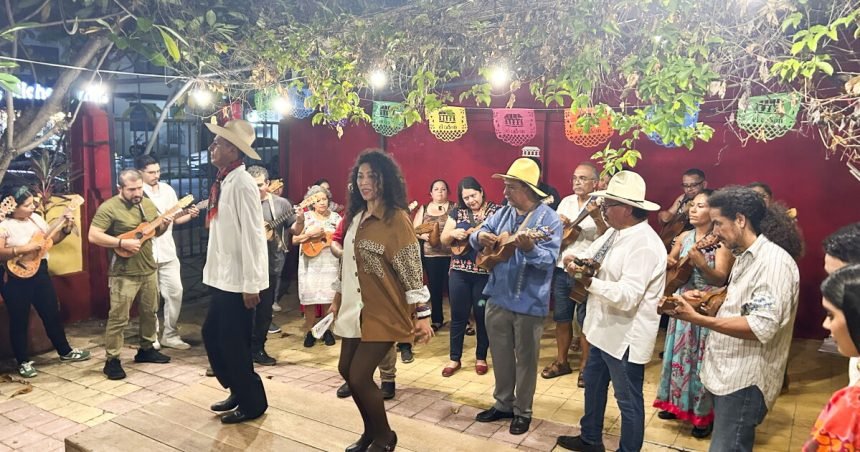
It’s Saturday night in mid-August. The villainous coastal heat of the day has yet to subside. A couple dances on a wooden platform, the woman in a floral dress that fans out when she pounds her heels, the man in a traditional jarocho straw hat and a tropical shirt that’s drenched with sweat. Off to the side, a guy in a black T-shirt and shades is playing a quijada, the jawbone of a donkey, by scraping the teeth and slapping the mandible to make them rattle.
People are swilling ice-cold Mexican beer and eating tamales wrapped in banana leaves. As the night wears on audience members join the trio of musicians so that it becomes a giant jam session. They are playing a diminutive, eight-string guitar native to the region called a jarana.
Pretty soon, La Bamba has two dozen jaraneros up there strumming, and the three-chord song goes on—trance-like—for 15 minutes.
“Para bailar La Bamba, Para bailar La Bamba se necesita una poca de gracia, Un poca de gracia y otra cosita y arriba y arriba…”
“Fifteen minutes is nothing,” said Tacho Utrera, a Grammy-winning jarocho musician and renowned instrument maker. “En Tlacotalpan, where they have the biggest fandangos I’ve ever seen, you can have 80 musicians. La Bamba and the dancing can go on for an hour. You play and play and the dancers keep changing and changing, and it’s interminable!”
Time was in the 60s and 70s, fandangos and son jarocho had fallen out favor. It was considered low-brow music—think of the roots of the delta blues in Mississippi juke joints.
“There were still fandangos but they were very small family affairs,” said Gilberto Gutierrez, one of the giants of son jarocho and a founding member of the seminal band, Mono Blanco. “When they spoke of son jarocho they said it was the music of drunken people… We hung up our instruments or left for Mexico City to look for gigs.”

Today, as Mexico and cities around the world reach for authenticity, originality and soul, son jarocho is thriving. Every weekend in Veracruz, there are fandangos for baptisms, birthdays, wakes, saints’ days and just the joy of existence.
The Saturday night fandango is put on monthly in the old city of Veracruz by the caSon Cultural Center, which celebrates its 25th anniversary this year. Gilberto Gutierrez was the Center’s founder.
“Fandangos happen because there’s a community around the musicians, dancers, singers, and the cooks who bring the food,” Gutierrez said. “Humanity needs this coming together. We all need to belong to something. And I believe that’s why fandangos have spread far and wide.”
Today, you can hear son jarocho in Mexico City, Argentina, Spain, Finland, Germany, Switzerland, Denmark, France, Tokyo, Canada, and in US cities with big Latino populations like Los Angeles and New York.
An essential element of this music is el zapateo, the tap dancing. It is performance and also percussion, to keep the string players in rhythm. The wooden platform is called a taríma.
“To step onto a taríma is an act of respect and skill — that you know how to dance,” said Ada Veronica, a high school teacher from Puebla who’s been dancing for 20 years. “You shouldn’t get up there if you don’t know what you’re doing.”
The classes in jarocho music and dance offered at El caSon fill up quickly. While young Mexicans embrace genre-bending music like reggaeton and corridos tumbados, they’re also flocking to fandangos.

“You simply feel it, you live it,” said Paloma Rizo, a 28-year-old teacher, who took up the jarana earlier this year. She was at the fandango playing her heart out.
“Even if people don’t know what a fandango is,” she continued, “they want to be part of it. You watch the dancing and the playing and it calls you, it invites you.”
The word several Veracruzanos used to describe the vibe of a fandango is convivencia. The literal translation is “coexist,” but in the context of a fandango, a more apt meaning is “alive together.”
Copyright 2026 NPR