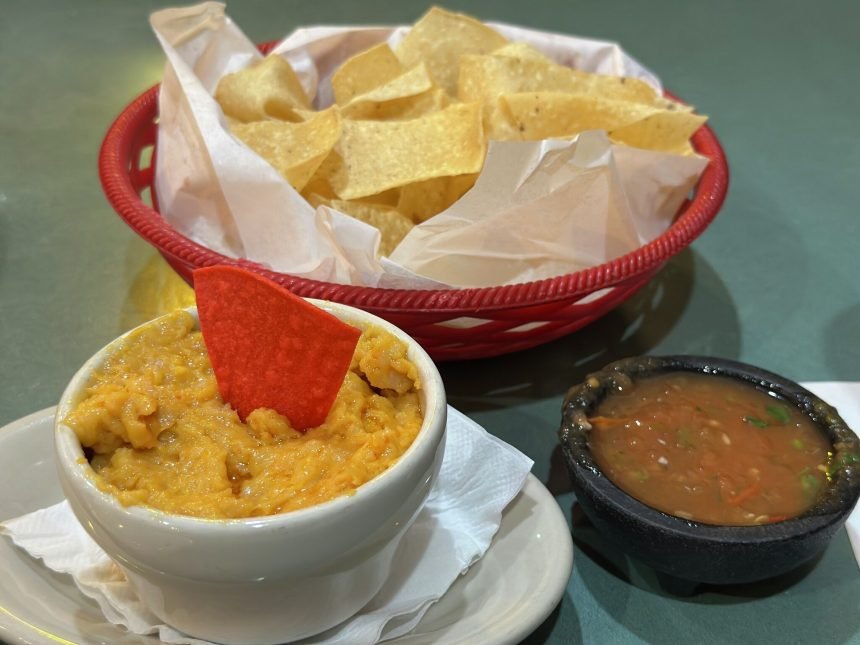
Some Houstonians may only know of one kind of queso. That’s the viscous, yellow cheese liquid that clings to whatever it touches— tortilla chips, plates, wooden tables or an unsteady hand.
But decades ago, local restaurateur and community activist Felix Tijerina introduced at his Felix Mexican Restaurant a sort of proto-queso that has simultaneously befuddled and polarized anyone who’s dipped into it. His method has largely been lost to the passage of time and Velveeta, save for El Patio, which carries on its original recipe: a glob of puttylike cheese amid a red-hued oil.
Why did Tijerina make his queso this way?
Article continues below this ad
Tijerina belongs on the Mount Rushmore of Tex-Mex. He was born in 1905 in Nuevo León, Mexico, though he told everybody he was from Sugar Land. That little distinction was key to understanding Tijerina, according to former Houston Press food critic and Rice University lecturer Katharine Shilcutt.
“From the very beginning, he was presenting himself as American, not Mexican, even though he was Mexican American,” Shilcutt said.
History of Felix Mexican Restaurant
Around 1918, Tijerina became a busboy at George Caldwell’s Original Mexican Restaurant in Downtown Houston. Caldwell mentored Tijerina and helped him to open his own restaurant (with the help of his wife’s successful bet during a horse race).
Article continues below this ad
Around the time Tijerina opened his restaurant, there were roughly 15,000-19,000 Mexicans living in Houston (the total population of Houston that time was 292,352, according to the U.S. Census). Shilcutt said because of the small Mexican population, and the fact that white diners typically had more disposable income, Tijerina’s restaurant naturally targeted a very white audience.
“He knew what anglos were looking for in their Mexican food,” Shilcutt said. “The first most popular food dishes were tamales and chili con carne and, weirdly, spaghetti and enchiladas.”

Felix Mexican Restaurant’s sign is still in the patio area of Uchi Restaurant, even though not a drop of its legendary queso can be found. You can get it now at El Patio.
Mayra Beltran/Houston Chronicle
The concept of the queso Tijerina developed likely originated from the queso fundido that was prevalent in the northern regions of Mexico, specifically in Nuevo León. Shilcutt said it was likely that he knew cheese dip was popular, like Arkansas cheese dip, and sought to make something that was similar.
Article continues below this ad
Tijerina came up with something similar to a French mornaise sauce, made with oil, flour, onions and spices. Tex-Mex enthusiast Jay Francis has his own theory about how the Felix Restaurant proprietor came up with this early progenitor queso.
“Well I have a theory, never proven: When he was getting started, he crossed paths with a French chef who taught him how to make a classic French cheese sauce because the Felix queso, besides the melty American cheese, had flour as a primary ingredient, just like a French cheese sauce,” Francis said.
According to El Patio chef Roberto, who previously worked at the Felix restaurant, Tijerina’s wife, Janine, was a frequent traveler.
“She would look at what was out there and what was being presented,” Roberto said. “In her travels, she probably learned some French cooking.”
Article continues below this ad

Felix queso with its reddish, oily base.
Felix queso recipe
The recipe is as follows:
- 1/2 cup vegetable oil
- 1 onion, chopped
- Salt and ground black pepper to taste
- 1/2 cup canned tomatoes
- 1/4 teaspoon cayenne pepper
- 1 1/2 teaspoons granulated sugar
- 2 tablespoons paprika
- Garlic powder to taste
- 1/4 cup flour
- 1/4 cup water
- 1/2 pound American cheese, grated (2 cups)
Article continues below this ad
“The two spices are cayenne and paprika. Cayenne is such a North American/Louisiana pepper and it has a very different flavor than ancho chile or chile used in Mexico. And Paprika is goulash s–t,” Shilcutt said. “It doesn’t taste Mexican. It tastes like Houston in the 1930s doing what it could and what it had.”
The Felix queso is a very divisive dish—and for good reason. The oil separates from the glob of American cheese and takes on a reddish hue from the spices. When trying El Patio’s version of it, Chron food reporter Chyna Blackmon couldn’t adequately discern its flavor.
What’s sort of mystifying is that Tijerina’s approach to queso is unique. While American or “government” cheese was commonly used in his dish, not many cookbooks or recipes called for flour or paprika. When Francis was younger, he recalled the Mexican restaurants off Telephone Road were using the Velveeta or a quick-melt variety of cheese in their queso at that point.

Best bites, new spots and the restaurant news people actually use.
By signing up, you agree to our Terms Of Use and acknowledge that your information will be used as described in our Privacy Policy.
Yet for some reason Tijerina continued serving his particular dip. El Patio general manager Zaira Ramirez said the queso has attracted a fierce following.
Article continues below this ad
“People that come here, they’re coming for Felix,” Ramirez said. “They’re also taking Felix queso to go. It’s the only item here in 20 years of El Patio that I’ve shipped outside of Houston for more than the queso is worth because it brings people so many memories.”
“Even his salsa picante was different from everyone else’s,” Francis said. “Some things he did that no one else did. But they were kind of cool.”