



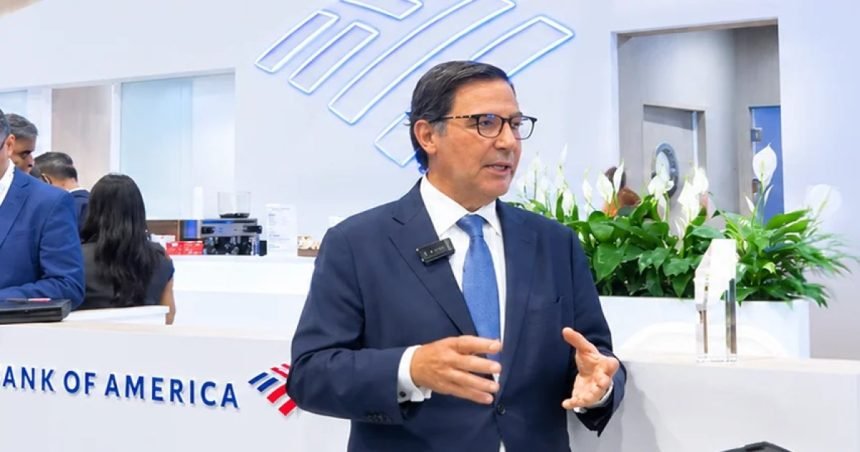
Bank of America sees the convergence of AI, distributed ledgers and tokenisation as a major new technology cycle in payments. Mark Monaco says the opportunity is to turn these technologies into faster, more efficient and safer outcomes for clients, while introducing AI progressively and responsibly.
Transaction banking has absorbed successive waves of technology, from the rise of e-commerce to mobile banking and real-time payments. The current cycle is bringing several technologies together at once, as artificial intelligence (AI), distributed-ledger technology and tokenisation begin to influence how banks process information, move money and design products.
For Bank of America, the question is how to turn that convergence into better client outcomes without weakening the reliability expected of transaction banking. The bank is continuing to invest in its CashPro treasury platform and real-time payment infrastructure, while its approach to AI remains deliberately progressive.
Mark Monaco, Head of Global Payments Solutions at Bank of America, sees the current period as comparable with the mid-2000s, when e-commerce and the broad adoption of broadband and mobile technology helped trigger the digital transformation of payments. What distinguishes the current cycle, he said, is the confluence and speed of change across AI, distributed ledgers and tokenisation.
A new technology cycle is taking shape
A new technology cycle is taking shape
Monaco sees the convergence of AI, distributed ledger technology and tokenisation as one of the most significant and rapid periods of change in transaction banking. The question for banks, he said, is how to adapt by integrating those technologies in a safe and secure manner into products that create better outcomes for clients.
He compared the moment with the period from about 2005 to 2010, when e-commerce and the broad adoption of broadband and mobile technology set off a wave of payments innovation. Monaco sees a similar inflection point now, with AI already being used to make processes faster, more efficient and, importantly, safer.
The comparison shifts the focus from individual technologies to how banks incorporate them into products. For Monaco, the significance of the current cycle will depend on what the technologies enable clients to do, not simply on the pace at which banks adopt them.
CashPro shows where AI is beginning to produce client value
CashPro shows where AI is beginning to produce client value
Monaco sees CashPro, Bank of America’s operating platform for corporate treasurers, as one of the clearest examples of technology investment translating into client value. The platform connects clients to transactions, information and data, and the bank continues to introduce new features and functionality on a regular and accelerating basis.
At Sibos, he cited Payments Insights as an example. Bank of America launched the capability on 28 September 2026 within its AI-powered CashPro Data Intelligence suite. It uses payments data, peer benchmarking and visualisation to help treasury teams identify opportunities around payment efficiency, cross-border flows and working capital performance. CashPro facilitated 213 million payments in the first half of 2026, 10% more than in the same period a year earlier.
Monaco said investments such as these are helping clients operate more efficiently and save money while also contributing to growth in Bank of America’s business. For him, that is evidence that the technology investment is producing tangible results for both clients and the bank.
Real-time payments are moving from infrastructure to broader use
Real-time payments are moving from infrastructure to broader use
Monaco also sees tangible results from Bank of America’s investment in faster and real-time payments. Real-time systems have proliferated over the past 15 to 20 years, he said, but adoption is now accelerating.
Developments around Sibos support that assessment. Bank of America reported on 29 September that corporate transaction volume on The Clearing House’s real-time payments (RTP) network increased 48% in the first half of 2026 from the same period a year earlier, with liquidity management, intercompany transfers and other time sensitive business payments driving broader use. Transactions above $1 million increased 351% over the same period.
The bank also announced that Bradesco had completed the first pilot transaction using Bank of America’s cross-border real-time payments solution – an example of its client-centric approach to innovation. The payment was initiated through Bradesco’s existing Swift connectivity and directly delivered in Hong Kong dollars through Hong Kong’s Faster Payment System with positive confirmation and full transparency. The solution, announced in June 2026, is designed to connect existing client channels with domestic real-time networks.
Together, these developments reinforce Monaco’s point that real-time payments are moving beyond infrastructure build-out towards wider adoption and more varied treasury use cases.
AI adoption depends on confidence
AI adoption depends on confidence
The expansion of AI raises a different question: how much work should a bank delegate to technology? Monaco sees substantial opportunity in AI, but says Bank of America believes it needs to be used responsibly, with a human in the loop.
The bank’s approach is to expand AI progressively, beginning with limited and proprietary data sets that it can observe and monitor. Monaco said use can broaden once the bank has a sufficiently high level of confidence that an application is both safe and efficient.
“We have to be right 100% of the time,” Monaco said of transaction banking products. That standard explains why the bank is not treating technical capability alone as sufficient reason to deploy AI more widely. In transaction banking, faster adoption still has to be reconciled with confidence that the product will work safely and reliably.
Asia remains a priority for investment
Asia remains a priority for investment
Monaco also placed the technology shift within Bank of America’s continuing commitment to Asia. He said the region is critically important to global economic growth and to the bank’s clients, and that Bank of America will continue to invest there. For Monaco, that growth also creates an impetus to continue innovating and investing in transaction banking.
For Monaco, the next technology cycle therefore brings new capabilities to a familiar transaction banking discipline. AI, distributed ledgers and tokenisation can change how products work, while real-time rails can change when money moves. But the test remains whether those technologies produce better outcomes for clients without compromising the reliability on which the business depends.