


COLUMBUS, Ohio — The share of Latinos in the United States who speak Spanish at home has declined over the past two decades, reflecting a broader shift in language use as younger generations grow up in English-speaking environments.
For one central Ohio family, that change has made preserving Spanish a priority, with parents incorporating the language into everyday activities to help their children maintain connections to their Mexican heritage.
According to the Pew Research Center, 68% of Latinos spoke Spanish at home in 2024, down from 78% in 2000. Spanish remains the most widely spoken language in the country after English.
Cecilia Vasquez and Gabriel Davila are raising their children to speak both languages. But with much of their children’s time spent speaking English at school and with friends, the parents have made a deliberate effort to create opportunities to use Spanish at home.
“60% of the day is going to be English, 40% is going to be Spanish. We need to give the 40% the most value we can, like whatever we do is going to be in Spanish,” Davila said.
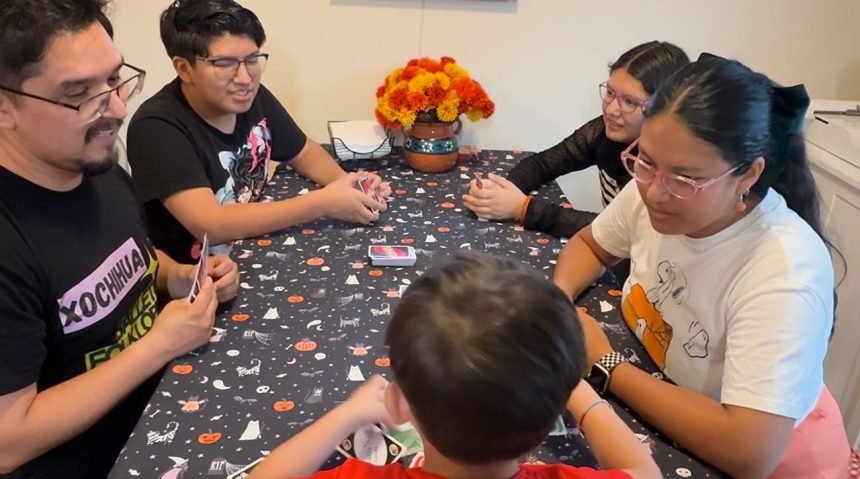
The family incorporates Spanish into activities such as reading books, watching movies and playing games together.
Javier Jasso, an assistant professor in the Department of Spanish and Portuguese at Ohio State University who studies bilingual language development, said the family’s experience reflects patterns researchers have documented among immigrant families.
Children growing up in the United States often develop strong English skills through school and social interactions, while maintaining Spanish can become more difficult without continued opportunities to use it.
“Families that have come in speaking only Spanish, you know, second generation, they are bilingual. By the third generation they have almost completely shifted to English proficiency,” Jasso said.
Jasso’s research has also examined the influence of relatives on bilingual development, including how children use different languages with different members of their families.
Jasso said grandparents can play an important role in helping children acquire and maintain Spanish, particularly when the language allows them to communicate with relatives who primarily speak Spanish. Those connections can remain important even when family members live in different countries.
But parents and grandparents are not the only influences.
“Siblings, for example, can also be instrumental in shaping whether younger children are going to be responding in English or continuing to use and build on their Spanish,” Jasso said.
Davila said losing the language could also make it harder to pass along knowledge and personal experiences tied to their roots.
“You cannot pass down all your stories which come with knowledge, with wisdom, and with the way we live in Mexico, the way we struggle, the way we want to strive for something better that gets lost,” Davila said.
Researchers are also examining whether speaking multiple languages has benefits beyond communication. Findings presented at a neuroscience conference in 2026 suggested that people who spoke two languages had brain-activity patterns associated with brains approximately six years younger than those of people who spoke one language. Among people who spoke four languages, the difference was approximately 13 years.
Researchers said those preliminary findings do not establish that multilingualism causes slower brain aging, and further research is needed to understand the relationship.