



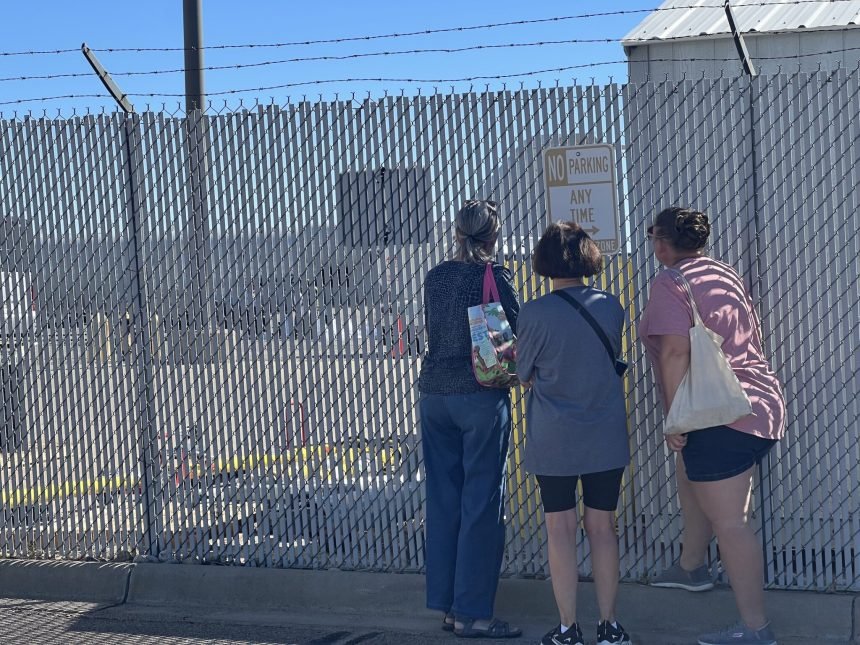
On a Sunday morning in September, three Colorado women met at the cell phone lot near Denver International Airport and waited for a flight from Texas to arrive.
They watched a flight tracker as the plane flew closer to Denver, and prepared to meet it as it landed. But they did not go to the typical arrivals terminal, and they were not awaiting visiting family and friends. This was a plane scheduled to pick up people detained in Colorado by U.S Immigration and Customs Enforcement and transport them to Mesa, Arizona.
Dana Miller, Kristen Aldretti and Amy Farrar drove to the Signature Aviation terminal immediately southeast of the main airport and waited behind a fence near the perimeter of the runway. An Air Wisconsin plane pulled into view, and the typical choreography of an ICE flight began: An unmarked bus pulled up, people began loading white bags of personal belongings onto the airplane and officers laid out silver shackles on the tarmac.
Typically, the women would watch people exit the bus, get shackled and then directed onto the airplane. They carried a handheld tally counter to track the number of detainees, and planned to count the pairs of feet they could see under the bus, since it blocked their line of sight to the plane stairs that day.
But then a security guard pulled up and asked the trio to leave, and they left the terminal, which is private property, without protest. It wasn’t the first time they were kicked out during their dozen or so outings to the airport. Once they got back into their car and pulled out onto the road, a private security vehicle trailed them for about a mile and then turned around.
“Regardless, we learned things,” Aldretti said, categorizing the outing as a success even though they did not witness people getting on the flight. “We learned that they are still parking the buses in front so we can’t see (the stairs). We learned that sometimes the pilots come out. Those are all things that need to be documented, and it goes into our learning for next time.”
Two days later, they were back, and saw 32 people led onto an ICE flight. On Sept. 29, it was 33.
“The general public, at this point, has a common view of what happens when people get picked up from ICE,” Miller said. But there’s still a gap in understanding what happens between someone’s initial detainment and their release or eventual deportation, she said.
“We want people to see what it really looks like,” she said of ICE flights. “It’s when the shackles are all laid out on the pavement, and the sun is shining on them, and then you see them getting put on people, and then people struggling to walk. People should know.”
Calls for cameras
Domestic ICE flights happen on a semi-regular basis out of the Denver airport. There were 118 flights between January and August this year, according to research from Human Rights First. They are part of the Trump administration’s program of mass deportations. Aldretti and Miller began heading to the airport to observe the flights in mid-July, and Aldretti posts about them on a dedicated Instagram account that has grown to almost 1,000 followers. Farrar joined more recently and lives the closest to the airport among the three.
“We have privilege, and if we’re not going to be the ones doing this important work and standing up for others who are vulnerable, who will be?” Aldretti said.
Their goal is to physically witness and count the people being boarded onto these flights and feed it into a national network of volunteer ICE flight observers called Habeas Flight Watch. That website hosts a live dashboard of confirmed ICE flights and volunteers rely on it to track when a flight lands in their city. Other “birders” in the network are able to take clear photos of passengers in an effort to connect people with lawyers and family. The setup at Signature Aviation, with a nearly opaque fence and no clear sight line to the plane, makes that hard.
“If we could even get pictures of these passengers to share with their family members, to share with their lawyers … to make sure that their family knows where the hell they are (would be ideal),” Farrar said.
The group, as well as other immigrant advocacy organizations, have called on city and airport leadership to increase transparency and local surveillance around ICE flights. They see an example in King County, Washington, near Seattle, where county officials in 2023 ordered the airport to log every flight and maintain a livestream to show ICE flight operations. The county recently hired a flight monitoring and outreach coordinator to count passengers and flag safety violations. Activists pressured county officials for years over the issue.
“I hope (we get) the live camera feed, where the public and folks who are monitoring this from a legal perspective can identify (people) and just document this,” Denver City Council member Stacie Gilmore told Colorado Newsline. She said she has heard commitments from airport leadership that they are working on evaluating the feasibility of such a measure.
Signature Aviation did not reply to a request for comment.
The transparency concerns in Denver came to a head recently as council members debated whether to approve a lease for regional passenger service through a subsidiary of Key Lime Air at the airport. Key Lime Air is a Colorado-based company that has operated hundreds of ICE flights since last year, when Colorado Newsline first reported that it was flying for the agency.
An airport spokesperson wrote in an email that leadership has been in discussion with a “number of stakeholder groups to hear their concerns and ideas” over the issue.
“Obviously, it’s not nearly enough, but I think monitoring of these flights is a good first step to actually be able to see what’s happening, and bring a wider lens to the broader public,” said Brandon Gehrke Quintanilla, an organizer with Aurora Unidos CSO who met with airport leadership. He said the Key Lime lease coming before City Council was enough leverage to put pressure on the airport and city leaders about the ICE flights.
City Council delayed the lease approval vote, but then passed it 11-1 on Oct. 13 under the promise from airport officials to continue conversations about transparency measures with advocates like Miller. Gilmore was the lone “no” vote. No council member directly mentioned cameras or livestreams.
“The things I expect moving forward is that the collaboration continues with the community organizations — collaboration and partnership, not lip service,” council member Serena Gonzales-Gutierrez said during that meeting. “I also would like that we implement and maintain transparency measures, such as tracking ICE activity. I know other airports have done this. I want us to be creative and think about how we are doing this.”