


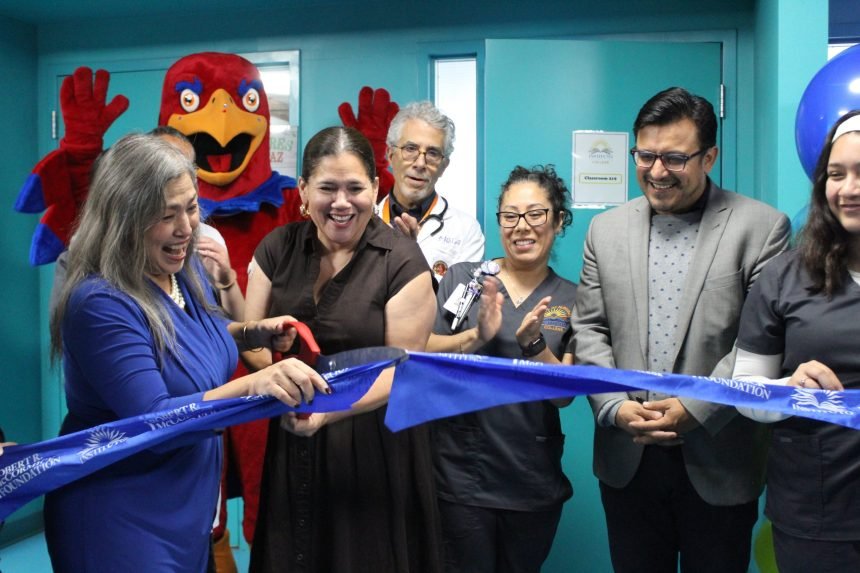
PILSEN – A longstanding Pilsen educational institute inaugurated new state-of-the-art nursing training facilities that will serve students in the process of obtaining nursing degrees.
Instituto del Progreso Latino opened new training facilities within Instituto College, the organization’s nursing program.
Students will now have access to a high-fidelity simulation lab, hands-on practice stations, furniture and electronic health record systems similar to those used in hospitals.
The facilities were built with the support of a more than $3 million donation by the McCormick Foundation. Within the simulation lab, students will be able to prepare for the best- and worst-case scenarios when attending to strokes, childbirth, postpartum care and other medical conditions by using high-technology mannequins that recreate the clinical symptoms.
Flor Mejia, a student of the college’s associate degree in nursing and mother of four kids, is looking forward to her classes in the simulation lab. Mejia enrolled in the program earlier this year after 10 years working as a medical assistant for a healthcare provider on the city’s West Side, she said.
But her interest in healthcare started when she experienced gaps in service during her first pregnancy 28 years ago, she said. At the time, she did not know what to expect during doctor’s visits and there were no bilingual staff to help with translation.
The facilities will also serve as a pathway for nurses to enter fields like maternal and newborn care, said Theodora Banks, associate dean of nursing at Instituto College.
Opened in 2016, the college’s program aims to increase representation of Latinos in the healthcare industry to improve healthcare services for Latinos in the Southwest Side and throughout the city. Latinos make up a third of the city’s population and are the fastest-growing group in the city, according to a recent report by the University of Illinois Chicago Greater Cities Institute. Only 6 percent of healthcare professionals in Illinois are Latino.
Bicultural and bilingual nurses can help patients overcome cultural and language barriers, increase trust and lead to better treatment and health outcomes, said Karina Ayala-Bermejo, president & CEO of Instituto Del Progreso Latino.
“When individuals speak your language, understand your culture, the community and our challenges, whether economic or environmental, you connect on a deeper level,” she said.
Beyond providing important pathways to careers in the healthcare sector, the college’s programs aim to close gaps in healthcare services and to reduce the healthcare workforce shortage, school officials said. At the same time, nursing students find stable career paths that offer economic mobility for them and their families, officials said.

Venesia Romero, a registered nurse and nursing tutor at the college, entered the program when searching for better career opportunities for her and her daughter, she said.
A first-generation Dominican American, Romero enrolled in the nursing program at the end of 2019. As the pandemic hit, the single mother struggled to meet the high demands of the program, work from home and support her family. That is when Instituto del Progreso Latino also offered organized food drives, connected her to rental assistance programs and provided in-kind support that allowed her to finish her studies in 2022. She then was hired in Mt. Sinai’s intensive care unit, she said.
“These resources made the difference between continuing my education or having to walk away,” she said.
Romero is one of hundreds of students who have completed nursing programs that prepare students to become state-certified nursing assistants and registered nurses. Since its opening, more than 600 students have graduated from its basic nursing assistant and associate degree in nursing programs.
Many of its students are single mothers and first-generation college students from underrepresented immigrant communities who can qualify for full or partial tuition scholarships.
Ald. Byron Sigcho-Lopez (25th) said the college’s programs offer educational and career pathways to non-traditional students who can then serve underrepresented communities, increasing health outcomes.
______________________________________________________________________
Support Local News!
Subscribe to Block Club Chicago, an independent, 501(c)(3), journalist-run newsroom. Every dime we make funds reporting from Chicago’s neighborhoods. Already subscribe? Click here to gift a subscription, or you can support Block Club with a tax-deductible donation.
Listen to the Block Club Chicago podcast: